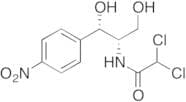
![Acetamide,2,2-dichloro-N-[(1R,2R)-2-hydroxy-1-(hydroxymethyl)-2-(4-nitrophenyl)ethyl]-,rel-](/_next/image/?url=https%3A%2Fstatic.cymitquimica.com%2Fcas-image%2Fthumb-webp%2F465143-acetamide-22-dichloro-n-1r-2r-2-hydroxy-1-hydroxymethyl-2-4-nitrophenyl-ethyl-rel.webp&w=3840&q=75)
CAS 2787-09-9
:Acétamide,2,2-dichloro-N-[(1R,2R)-2-hydroxy-1-(hydroxyméthyl)-2-(4-nitrophényl)éthyl]-,rel-
Description :
L'acétamide, 2,2-dichloro-N-[(1R,2R)-2-hydroxy-1-(hydroxyméthyl)-2-(4-nitrophényl)éthyl]-, rel- est un composé chimique caractérisé par sa structure complexe, qui comprend un groupe fonctionnel acétamide et plusieurs substituants qui contribuent à ses propriétés uniques. La présence de groupes dichlorés indique qu'il a deux atomes de chlore attachés à la chaîne carbonée, ce qui peut influencer sa réactivité et sa solubilité. Le composé présente également un groupe hydroxyle et un moiety nitrophényle, qui peuvent améliorer son activité biologique et ses applications potentielles dans les produits pharmaceutiques ou les agrochimiques. Sa stéréochimie, indiquée par la configuration (1R,2R), suggère des arrangements spatiaux spécifiques qui peuvent affecter ses interactions avec des cibles biologiques. Le numéro CAS 2787-09-9 permet une identification précise et la récupération d'informations concernant ce composé dans les bases de données chimiques. Dans l'ensemble, cette substance peut présenter un comportement chimique intéressant et une utilité potentielle dans divers domaines, y compris la chimie médicinale et la science des matériaux.
Formule :C11H12Cl2N2O5
Synonymes :- Acetamide,2,2-dichloro-N-[2-hydroxy-1-(hydroxymethyl)-2-(4-nitrophenyl)ethyl]-, (R*,R*)-(?à)-
- Acetamide, 2,2-dichloro-N-[b-hydroxy-a-(hydroxymethyl)-p-nitrophenethyl]-,DL-threo- (8CI)
- (?à)-Chloramphenicol
- Acetamide,2,2-dichloro-N-[2-hydroxy-1-(hydroxymethyl)-2-(4-nitrophenyl)ethyl]-, (R*,R*)-
- DL-Chloramphenicol
- DL-trans-1-p-Nitrophenyl-2-dichloroacetylamino-1,3-propanediol
- Synthomycin
- Syntomycin
Trier par
Degré de pureté (%)
0
100
|
0
|
50
|
90
|
95
|
100
2 produits concernés.
DL-Chloramphenicol
CAS :Produit contrôléFormule :C11H12Cl2N2O5Couleur et forme :NeatMasse moléculaire :323.129DL-chloramphenicol
CAS :DL-chloramphenicol is a broad-spectrum antibiotic, which is a synthetic compound derived from natural chloramphenicol originally isolated from the bacterium Streptomyces venezuelae. This compound exerts its effects by inhibiting bacterial protein synthesis. It binds to the 50S subunit of the bacterial ribosome, preventing peptide bond formation and consequently halting the growth of susceptible bacteria. The optical isomer, DL-chloramphenicol, contains equal parts of both D- and L- isomers, with the L-form being responsible for its antibiotic activity.
Formule :C11H12Cl2N2O5Degré de pureté :Min. 95%Masse moléculaire :323.13 g/mol