CAS 28116-23-6
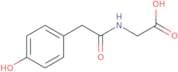
:p-Hydroxyphénylacétylglycine
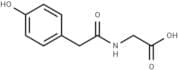
- 2-[2-(4-Hydroxyphenyl)acetamido]acetic acid
- 2-[[2-(4-Hydroxyphenyl)acetyl]amino]acetic acid
- Glycine, N-[(4-hydroxyphenyl)acetyl]-
- Glycine, N-[(p-hydroxyphenyl)acetyl]-
- Glycine, N-[(p-hydroxyphenyl)acetyl]-(7CI,8CI)
- Glycine,N-[(4-hydroxyphenyl)acetyl]- (9CI)
- Hydroxyphenylacetylglycine
- N-[2-(4-Hydroxyphenyl)acetyl]glycine
- [[(4-Hydroxyphenyl)acetyl]amino]acetic acid
- p-Hydroxyphenylacetylglycine
- Glycine, N-[2-(4-hydroxyphenyl)acetyl]-
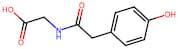
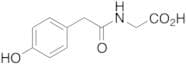
2-[[2-(4-hydroxyphenyl)acetyl]amino]acetic acid
CAS :Formule :C10H11NO4Degré de pureté :97%Couleur et forme :SolidMasse moléculaire :209.1986Hydroxyphenylacetylglycine
CAS :HydroxyphenylacetylglycineDegré de pureté :≥98%Masse moléculaire :209.2g/molp-Hydroxyphenylacetylglycine
CAS :Produit contrôléStability Hygroscopic
Applications p-Hydroxyphenylacetylglycine is derived from the metabolism of L-DOPA (D533751), a dopamine precursor that induces dyskinesia in Parkinson’s disease patients. p-Hydroxyphenylacetylglycine is also used as a reagent to synthesize novel piperazine salts that have antimicrobial activity against Escherichia coli and Bacillus subtilis.
References Abha, B., et al.: Pharma Chemica, 2, 446 (2010); Picconi, B., et al.: Nat. Neurosci., 6, 501 (2003)Formule :C10H11NO4Couleur et forme :NeatMasse moléculaire :209.2Hydroxyphenylacetylglycine
CAS :Hydroxyphenylacetylglycine (p-Hydroxyphenylacetylglycine) is an endogenous human metabolite.
Formule :C10H11NO4Degré de pureté :98.73%Couleur et forme :SolidMasse moléculaire :209.22-[[2-(4-hydroxyphenyl)acetyl]amino]acetic acid
CAS :Degré de pureté :98%Masse moléculaire :209.201004p-Hydroxyphenylacetylglycine-13C2,15N
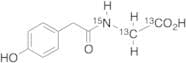
CAS :Produit contrôléApplications p-Hydroxyphenylacetylglycine-13C2,15N is the labelled analogue of p-Hydroxyphenylacetylglycine (H950980).
Formule :C2C8H1115NO4Couleur et forme :NeatMasse moléculaire :212.177p-Hydroxyphenylacetylglycine
CAS :p-Hydroxyphenylacetylglycine (PHPAG) is a metabolite of creatine, which is found in urine samples. It can be detected through chemical analysis of tissue and food composition. The detection sensitivity is determined by the type of sample and the analytical method used. PHPAG has been shown to have diagnostic value for the diagnosis of certain diseases, such as liver cirrhosis, kidney disease, and fatty acid metabolism disorders. PHPAG has also been shown to be an indicator for intracellular levels of fatty acids and polyunsaturated fatty acids (PUFA).
Formule :C10H11NO4Degré de pureté :Min. 95%Masse moléculaire :209.2 g/molRef: 3D-DBA11623
Produit arrêté
![2-[[2-(4-hydroxyphenyl)acetyl]amino]acetic acid](/_next/image/?url=https%3A%2Fstatic.cymitquimica.com%2Fproducts%2FIN%2Fthumb%2FDA00C2RR.jpg&w=3840&q=75)




![2-[[2-(4-hydroxyphenyl)acetyl]amino]acetic acid](/_next/image/?url=https%3A%2Fstatic.cymitquimica.com%2Fproducts%2F10%2Fthumb%2FF863465.jpg&w=3840&q=75)