CAS 28343-61-5
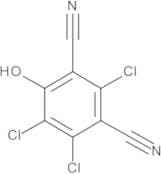
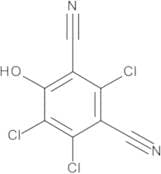
:4-Hydroxy-2,5,6-trichloroisophtalonitrile
Description :
4-Hydroxy-2,5,6-trichloroisophtalonitrile, avec le numéro CAS 28343-61-5, est un composé chimique caractérisé par sa structure, qui comprend un groupe hydroxyle et plusieurs substituants chlorés sur un cadre d'isoftalonitrile. Ce composé apparaît généralement sous forme solide et est connu pour sa stabilité dans diverses conditions. Il présente des propriétés telles qu'une haute stabilité thermique et une résistance à la dégradation, ce qui le rend adapté aux applications en science des matériaux, en particulier dans le développement d'ignifugeants et de polymères. La présence d'atomes de chlore contribue à sa réactivité et à son utilisation potentielle en synthèse, tandis que le groupe hydroxyle peut participer à des liaisons hydrogène, influençant sa solubilité et son interaction avec d'autres substances. De plus, en raison de ses groupes nitrile, il peut présenter certaines propriétés toxicologiques, nécessitant une manipulation et une évaluation prudentes dans les applications industrielles. Dans l'ensemble, 4-Hydroxy-2,5,6-trichloroisophtalonitrile est un composé d'intérêt tant pour la recherche que pour les applications pratiques, en particulier dans les domaines de la chimie et de l'ingénierie des matériaux.
Formule :C8HCl3N2O
InChI :InChI=1/C8HCl3N2O/c9-5-3(1-12)6(10)7(11)8(14)4(5)2-13/h14H
Code InChI :InChIKey=MDQKYGOECVSPIW-UHFFFAOYSA-N
SMILES :C(#N)C1=C(Cl)C(C#N)=C(O)C(Cl)=C1Cl
Synonymes :- 1,3-Benzenedicarbonitrile, 2,4,5-Trichloro-6-Hydroxy-
- 1,3-Dicyano-4-Hydroxy-2,5,6-Trichlorobenzene
- 2,4,5-Trichloro-6-hydroxy-1,3-benzenedicarbonitrile
- 2,4,5-Trichloro-6-hydroxyisophthalonitrile
- 2,5,6-Trichloro-4-hydroxy-1,3-benzenedicarbonitrile
- 28343-61-5
- 4-Hydroxy-2,5,6-trichloroisophthalonitrile
- 4-Hydroxychlorothalonil
- Hydroxychlorothalonil
- Isophthalonitrile, 2,4,5-trichloro-6-hydroxy-
- Sds 3701
- 2,5,6-Trichloro-4-
- Hydroxy Chlorothalonil Q: What is the storage condition of
- Hydroxy Chlorothalonil Q: What is the CAS Number of
- 2,4,5-Trichloro-6-hydroxy-
- Hydroxy Chlorothalonil
- Tribenoside Impurity 6
- Chlorothalonil Metabolite R182281
- hydroxy-1,3-benzenedicarbonitrile
- 4-hydroxy-2,5,6-trichloro-1,3-benzenedicarbonitrile
- Hydroxy ChlorothalonilQ: What is
- 4-hydroxy-2,5,6-trichloro-3-benzenedicarbonitrile
- Hydroxy Chlorothalonil Q: What are the applications of
- TPN-OH
- DRE-C11510400 Chlorothalonil-4-hydroxy
- isophthalonitrile
- Chlorothalonil-4-hydroxy 10.0 μg/ml Acetonitrile
- Voir plus de synonymes
Trier par
Degré de pureté (%)
0
100
|
0
|
50
|
90
|
95
|
100
5 produits concernés.
Chlorothalonil-4-hydroxy 10 µg/mL in Acetonitrile
CAS :Formule :C8HCl3N2OCouleur et forme :Single SolutionMasse moléculaire :247.47Chlorothalonil-4-hydroxy
CAS :Produit contrôléFormule :C8HCl3N2OCouleur et forme :NeatMasse moléculaire :247.47Hydroxy Chlorothalonil
CAS :Produit contrôléApplications Hydroxychlorothalonil is a metabolite of Chlorothalonil (C411250).
Not a dangerous good if item is equal to or less than 1g/ml and there is less than 100g/ml in the package
References Katayama, A., et al.: J. Pest Sci., 22, 12 (1997), Godard, T., et al.: Mutat. Res., 444, 103 (1999), Zeng, L., et al.: Appl. Microbiol. Biotechnol., 79, 881 (2008), Wang, G., et al.: J. Bacteriol., 192, 2737 (2010),Formule :C8HCl3N2OCouleur et forme :Off-WhiteMasse moléculaire :247.472,4,5-Trichloro-6-hydroxyisophthalonitrile
CAS :2,4,5-Trichloro-6-hydroxyisophthalonitrile is a fungicide. It is used in the control of plant diseases such as powdery mildew, rust and blight. 2,4,5-Trichloro-6-hydroxyisophthalonitrile can be applied to plants through foliar spray or root drenching. It acts by inhibiting the enzyme activities of fungi that are responsible for cell growth. This compound has been shown to have genotoxic activity in vivo and in vitro models and may be carcinogenic to humans. The mechanism of action of 2,4,5-trichloro-6-hydroxyisophthalonitrile remains unclear due to its high resistance to degradation in vivo. 2,4,5-Trichloro-6-hydroxyisophthalonitrile has also shown synergistic effects when combined with zirconium oxide and matrixFormule :C8HCl3N2ODegré de pureté :Min. 95%Masse moléculaire :247.47 g/mol