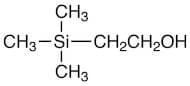
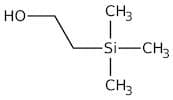
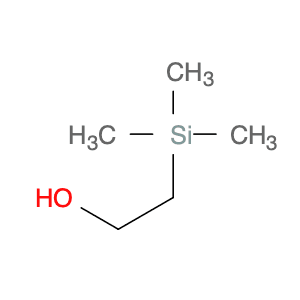
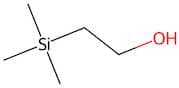
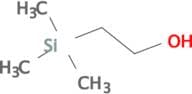
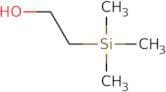
CAS 2916-68-9
:2-(Triméthylsilyl)éthanol
- (2-Hydroxyethyl)trimethylsilane
- 2-(Trimethylsilanyl)ethanol
- 2-(Trimethylsilyl)ethan-1-ol
- 2-(Trimethylsilyl)ethyl alcohol
- Ethanol, 2-(trimethylsilyl)-
- NSC 96784
- O-(2-Mesitylenesulfonyl)acethydroxaMic acid ethyl ester
- β-(Trimethylsilyl)ethanol
- 2-(Trimethylsilyl)ethanol
- 2-(Trimethylsilyl) ethanol
- 2-(TRIMETHYLSILYL)ETHANAL
- Silane, (2-hydroxyethyl)trimethyl-
- 2-HYDROXYETHYLTRIMETHYLSILANE
- 2-(TRIMETHYLSILYL)ETHANOL, 98+%
- (2-hydroxyethyl)trimethyl-silan
- TIMTEC-BB SBB009030
- trimethylsilylethanol
- Voir plus de synonymes
2-(Trimethylsilyl)ethanol
CAS :Formule :C5H14OSiDegré de pureté :>96.0%(GC)Couleur et forme :Colorless to Almost colorless clear liquidMasse moléculaire :118.252-(Trimethylsilyl)ethanol, 98+%
CAS :2-(Trimethylsilyl)ethanol is used as a protecting reagent for carboxyl, phosphoryl, hydroxyl and amino group in organic synthesis. It is used as a precursor to prepare trimethyl(2-phenoxyethyl)silanes by reacting with aromatic fluoride. It is also used in the synthesis of teoc-protected amines by uFormule :C5H14OSiDegré de pureté :98+%Couleur et forme :Clear colorless, LiquidMasse moléculaire :118.25Ethanol, 2-(trimethylsilyl)-
CAS :Formule :C5H14OSiDegré de pureté :97%Couleur et forme :LiquidMasse moléculaire :118.24962-(Trimethylsilyl)ethan-1-ol
CAS :2-(Trimethylsilyl)ethan-1-olFormule :C5H14OSiDegré de pureté :99%Couleur et forme : clear. colourless liquidMasse moléculaire :118.25g/mol2-(Trimethylsilyl)ethanol
CAS :Produit contrôléFormule :C5H14OSiCouleur et forme :NeatMasse moléculaire :118.252-Trimethylsilylethanol
CAS :S19375 - 2-Trimethylsilylethanol
Formule :C5H14OSiDegré de pureté :95%Couleur et forme :ClearMasse moléculaire :118.2512-(Trimethylsily)ethanol
CAS :2- (Trimethylsily)ethanol is a hdac inhibitor that is used in the synthesis of other chemical substances. It inhibits HDAC activity by binding to the hydroxyl group on the histone and prevents acetylation of lysine residues, preventing gene transcription. 2-(Trimethylsily)ethanol has been shown to inhibit oxidation reactions in biological systems, such as those caused by trifluoroacetic acid or trichloroacetic acid. In addition, this reagent can be used to prepare functional groups through a synthetic method with an activation energy of 15 kcal/mol and a reaction rate constant of 0.04 M-1 s-1. 2-(Trimethylsily)ethanol has also been used for preparative methods with cleavage products including sulfamoyl chloride.
Formule :C5H14OSiDegré de pureté :95%NmrCouleur et forme :PowderMasse moléculaire :118.25 g/mol