CAS 29554-26-5
:Caféoylputrescine
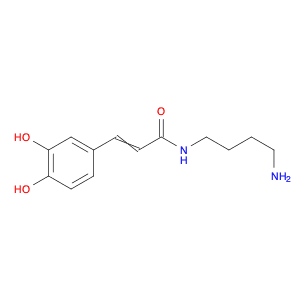
- N-(4-Aminobutyl)-3-(3,4-dihydroxyphenyl)-2-propenamide
- Cinnamamide, N-(4-aminobutyl)-3,4-dihydroxy-
- Caffeoylputrescine
- 2-Propenamide, N-(4-aminobutyl)-3-(3,4-dihydroxyphenyl)-
- N-Caffeoylputrescine, (E)-
- N-Caffeoylputrescine
- N-(4-Aminobutyl)-3-(3,4-dihydroxyphenyl)propenamide USP/EP/BP
- N-(4-Aminobutyl)-3-(3,4-dihydroxyphenyl)propenamide
- (E)-N-Caffeoylputrescine
- Voir plus de synonymes
2-Propenamide, N-(4-aminobutyl)-3-(3,4-dihydroxyphenyl)-
CAS :Formule :C13H18N2O3Degré de pureté :98%Couleur et forme :SolidMasse moléculaire :250.2936N-caffeoylputrescine, (E)-
CAS :N-caffeoylputrescine, (E)-Degré de pureté :99%Masse moléculaire :250.3g/molN-Caffeoylputrescine,(E)-
CAS :N-Caffeoylputrescine has antioxidant activity.Formule :C13H18N2O3Degré de pureté :98%Couleur et forme :SolidMasse moléculaire :250.29Caffeoylputrescine
CAS :Caffeoylputrescine is a naturally occurring phenolic compound found in plants. It has been shown to regulate transcription, which is the process of converting DNA sequences into RNA. Caffeoylputrescine has been investigated as a potential cancer therapy and has shown to be effective against tumour cells in cell culture and tissue culture. Caffeoylputrescine was able to induce a molecular response by binding to the response element-binding protein, which controls the transcription of genes that are involved in cellular responses to external stimuli such as environmental stressors or infection. This compound also regulates enzyme activities and fatty acid synthesis. The formation rate of caffeoylputrescine varies depending on the plant species; for example, it is highest in Solanum tuberosum (potato).
Formule :C13H18N2O3Degré de pureté :Min. 95%Masse moléculaire :250.3 g/mol