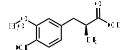
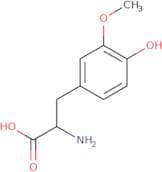
CAS 300-48-1
:3-Méthoxy-L-tyrosine
Description :
3-Méthoxy-L-tyrosine, également connu sous le nom d'acide homovanillique, est un dérivé d'acide aminé caractérisé par la présence d'un groupe méthoxy attaché à l'anneau aromatique de la structure de la tyrosine. C'est un acide aminé non protéinogène, ce qui signifie qu'il n'est pas incorporé dans les protéines lors de la traduction. Ce composé est remarquable pour son rôle dans le métabolisme des catécholamines et est souvent étudié dans le contexte de la recherche neurologique, en particulier en ce qui concerne ses implications potentielles dans le métabolisme de la dopamine. 3-Méthoxy-L-tyrosine présente des propriétés telles que la solubilité dans l'eau et les solvants organiques, qui peuvent varier en fonction du pH et de la concentration. Sa structure moléculaire comprend un groupe hydroxyle phénolique, contribuant à sa réactivité et à ses potentielles propriétés antioxydantes. De plus, il peut servir de biomarqueur dans certaines conditions médicales, en particulier dans l'évaluation des tumeurs neuroendocrines. Dans l'ensemble, 3-Méthoxy-L-tyrosine est un composé significatif tant dans la recherche biochimique que dans les études cliniques, soulignant sa pertinence dans la compréhension de divers processus physiologiques.
Formule :C10H13NO4
InChI :InChI=1S/C10H13NO4/c1-15-9-5-6(2-3-8(9)12)4-7(11)10(13)14/h2-3,5,7,12H,4,11H2,1H3,(H,13,14)/t7-/m0/s1
Code InChI :InChIKey=PFDUUKDQEHURQC-ZETCQYMHSA-N
SMILES :C([C@@H](C(O)=O)N)C1=CC(OC)=C(O)C=C1
Synonymes :- (2S)-2-Amino-3-(4-hydroxy-3-methoxyphenyl)propanoic acid
- (S)-2-Amino-3-(4-hydroxy-3-methoxyphenyl)propanoic acid
- 2-Amino-3-(4-hydroxy-3-(methoxyl)phenyl)propanoic acid
- 3-(4-hydroxy-3-methoxyphenyl)-L-alanine
- 3-Methoxy-4-hydroxyphenylalanine
- 3-Methoxy-<span class="text-smallcaps">L</span>-tyrosine
- 3-Methoxy-DOPA
- 3-Methoxytyrosine
- 3-O-Methyl-<span class="text-smallcaps">L</span>-DOPA
- 3-O-methyldopa
- 3-methoxy-L-tyrosine
- <span class="text-smallcaps">L</span>-3-Methoxy-4-hydroxyphenylalanine
- <span class="text-smallcaps">L</span>-3-O-Methyl-DOPA
- <span class="text-smallcaps">L</span>-4-Hydroxy-3-methoxyphenylalanine
- <span class="text-smallcaps">L</span>-Tyrosine, 3-methoxy-
- Tyrosine, 3-methoxy-, <span class="text-smallcaps">L</span>-
- 3-O-Methyl-L-DOPA
- L-Tyrosine, 3-methoxy-
- Voir plus de synonymes
Trier par
Degré de pureté (%)
0
100
|
0
|
50
|
90
|
95
|
100
4 produits concernés.
L-Tyrosine, 3-methoxy-
CAS :Formule :C10H13NO4Degré de pureté :96%Couleur et forme :SolidMasse moléculaire :211.2145Levodopa EP Impurity C (S-Isomer) (L-3-O-Methyldopa)
CAS :Formule :C10H13NO4Couleur et forme :White To Off-White SolidMasse moléculaire :211.22(2S)-2-Amino-3-(4-hydroxy-3-methoxyphenyl)propanoic acid
CAS :Produit contrôléL-DOPA is a natural amino acid and intermediate in the biosynthesis of dopamine. It is also a precursor for the synthesis of norepinephrine from dopamine. L-DOPA is synthesized from the amino acid tyrosine by the enzyme tyrosine hydroxylase. It can be used as a drug to treat Parkinson's disease and other disorders that affect motor function, such as Huntington's disease and Tourette syndrome. L-DOPA is converted to dopamine by the enzyme dopa decarboxylase, which converts it to dopamine in a two-step process. The conversion of L-DOPA to dopamine can be monitored using electrochemical detection or fluorescence spectroscopy.Formule :C10H13NO4Degré de pureté :Min. 95%Masse moléculaire :211.21 g/mol