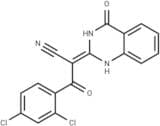
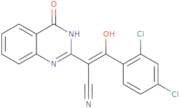
CAS 302803-72-1
:Trier par
Degré de pureté (%)
0
100
|
0
|
50
|
90
|
95
|
100
6 produits concernés.
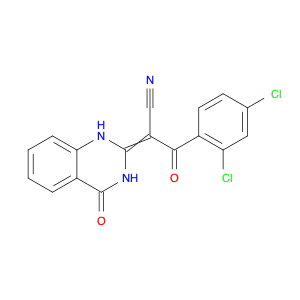
Benzenepropanenitrile, 2,4-dichloro-α-(3,4-dihydro-4-oxo-2(1H)-quinazolinylidene)-β-oxo-
CAS :Formule :C17H9Cl2N3O2Degré de pureté :98%Couleur et forme :SolidMasse moléculaire :358.17833-(2,4-Dichlorophenyl)-3-Oxo-2-(4-Oxo-3,4-Dihydroquinazolin-2(1H)-Ylidene)Propanenitrile
CAS :3-(2,4-Dichlorophenyl)-3-Oxo-2-(4-Oxo-3,4-Dihydroquinazolin-2(1H)-Ylidene)PropanenitrileDegré de pureté :≥98%Masse moléculaire :358.18g/molHPI-4
CAS :Formule :C17H9Cl2N3O2Degré de pureté :≥ 98.0%Couleur et forme :Yellow solidMasse moléculaire :358.18Ciliobrevin A
CAS :Ciliobrevin A (HPI-4) is an inhibitor of hedgehog signaling pathway with an IC50 <10 μM.Formule :C17H9Cl2N3O2Degré de pureté :98.54% - 99.57%Couleur et forme :SolidMasse moléculaire :358.18Ref: TM-T3156
2mg39,00€5mg56,00€10mg80,00€25mg165,00€50mg224,00€100mg314,00€200mg467,00€1mL*10mM (DMSO)65,00€Ciliobrevin A
CAS :Ciliobrevin A is a protein that has been found in the human body and is involved in the formation of cilia. Ciliobrevin A is also known as ciliary rootlet-associated protein (CRAP). Ciliobrevin A interacts with molecules of leishmania, which are parasites that can cause severe infection in humans. This protein is a member of the signal pathway in neurons and may be involved in cancer development. Ciliobrevin A has been shown to regulate cancer cell growth by interacting with the rapamycin complex. It also regulates fetal bovine lung cells, specifically by affecting the function of chemical inhibitors and chemical biology.Formule :C17H9Cl2N3O2Degré de pureté :Min. 95%Masse moléculaire :358.18 g/mol