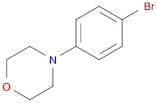
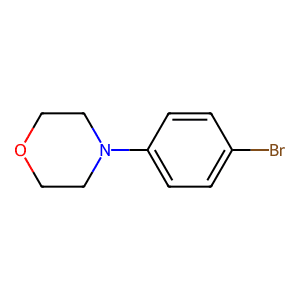
CAS 30483-75-1
:4-(4-Bromophényl)morpholine
- Morpholine, 4-(4-bromophenyl)-
- N-(4-Bromophenyl)morpholine
- 4-(4'-BROMOPHENYL)MORPHOLINE
- 1-Bromo-4-morpholinobenzene
- 4-(4-Bromophenyl)morpholine 97%
Morpholine, 4-(4-bromophenyl)-
CAS :Formule :C10H12BrNODegré de pureté :95%Couleur et forme :SolidMasse moléculaire :242.11244-(4-Bromophenyl)morpholine
CAS :4-(4-Bromophenyl)morpholineDegré de pureté :98%Couleur et forme :Beige SolidMasse moléculaire :242.11238g/mol4-(4-Bromophenyl)morpholine
CAS :4-(4-Bromophenyl)morpholine is a microbicide that can be used as a conditioning agent. It has been shown to have microbicidal properties and is active against bacteria, fungi, and amoeba. 4-(4-Bromophenyl)morpholine has been shown to inhibit the growth of Gram-positive bacteria such as Staphylococcus aureus and Clostridium perfringens. The mechanism of action for this compound is nucleophilic attack by the bromine atom on the chloride ion to form a chlorobenzene intermediate. This intermediate reacts with an amine group in the bacterial cell wall, leading to cell death by cross-coupling with DNA or protein synthesis inhibition. 4-(4-Bromophenyl)morpholine also has fungicidal activity against Candida albicans yeast cells, but does not show activity against human cells.
Formule :C10H12BrNODegré de pureté :Min. 95%Masse moléculaire :242.11 g/mol4-(4-Bromophenyl)morpholine
CAS :Formule :C10H12BrNODegré de pureté :>98.0%(GC)(T)Couleur et forme :White to Light yellow to Light orange powder to crystalMasse moléculaire :242.124-(4-Bromophenyl)morpholine
CAS :Formule :C10H12BrNODegré de pureté :95%Couleur et forme :SolidMasse moléculaire :242.116