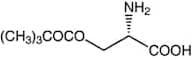
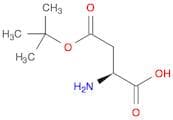
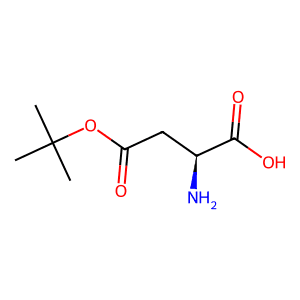
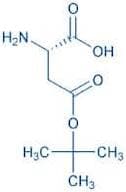
CAS 3057-74-7
:4-(1,1-Diméthyléthyl) hydrogène L-aspartate
Description :
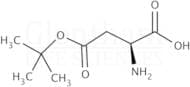
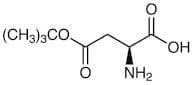
4-(1,1-Diméthyléthyl) hydrogène L-aspartate, également connu sous son numéro CAS 3057-74-7, est un dérivé d'acide aminé qui présente un groupe tert-butyle attaché au carbone alpha de L-aspartate. Ce composé se caractérise par sa complexité structurelle, qui comprend à la fois un groupe amino et un groupe carboxylique, typique des acides aminés. La présence du volumineux groupe tert-butyle influence ses propriétés stériques et peut affecter sa solubilité et sa réactivité. En général, les dérivés d'acides aminés comme celui-ci suscitent un intérêt dans la recherche biochimique et les applications pharmaceutiques en raison de leurs rôles potentiels dans la synthèse des protéines et les voies métaboliques. Le composé peut présenter des activités biologiques spécifiques, bien que des études détaillées soient nécessaires pour élucider ses fonctions et interactions exactes dans les systèmes biologiques. De plus, sa stabilité et son comportement dans divers solvants peuvent être influencés par la présence du groupe tert-butyle, ce qui en fait un sujet d'intérêt tant en synthèse organique qu'en chimie médicinale.
Formule :C8H15NO4
InChI :InChI=1S/C8H15NO4/c1-8(2,3)13-6(10)4-5(9)7(11)12/h5H,4,9H2,1-3H3,(H,11,12)/t5-/m0/s1
Code InChI :InChIKey=MXWMFBYWXMXRPD-YFKPBYRVSA-N
SMILES :C(C(OC(C)(C)C)=O)[C@@H](C(O)=O)N
Synonymes :- (2R)-2-ammonio-4-tert-butoxy-4-oxobutanoate
- (2S)-2-Amino-4-(tert-butoxy)-4-oxobutanoic acid
- (2S)-2-Amino-4-[(2-methylpropan-2-yl)oxy]-4-oxobutanoic acid
- (2S)-2-ammonio-4-tert-butoxy-4-oxobutanoate
- (S)-2-Amino-4-tert-butoxy-4-oxobutanoic acid
- 2-Amino-4-Tert-Butoxy-4-Oxobutanoic Acid (Non-Preferred Name)
- 4-(1,1-Dimethylethyl) hydrogen <span class="text-smallcaps">L</span>-aspartate
- <span class="text-smallcaps">L</span>-Aspartic acid 4-tert-butyl ester
- <span class="text-smallcaps">L</span>-Aspartic acid β-tert-butyl ester
- <span class="text-smallcaps">L</span>-Aspartic acid, 4-(1,1-dimethylethyl) ester
- Aspartic acid β-tert-butyl ester
- Aspartic acid, 4-tert-butyl ester
- L-Aspartic acid-4-tert-butyl ester
- β-tert-Butyl <span class="text-smallcaps">L</span>-aspartate
- β-tert-Butyl aspartate
- 4-(1,1-Dimethylethyl) hydrogen L-aspartate
- L-Aspartic acid, 4-(1,1-dimethylethyl) ester
- Voir plus de synonymes
Trier par
Degré de pureté (%)
0
100
|
0
|
50
|
90
|
95
|
100
10 produits concernés.
L-Aspartic acid 4-tert-butyl ester, 98%
CAS :This Thermo Scientific Chemicals brand product was originally part of the Alfa Aesar product portfolio. Some documentation and label information may refer to the legacy brand. The original Alfa Aesar product / item code or SKU reference has not changed as a part of the brand transition to Thermo SciFormule :C8H15NO4Degré de pureté :98%Masse moléculaire :189.21L-Aspartic acid 4-tert-butyl ester
CAS :Formule :C8H15NO4Degré de pureté :98%Couleur et forme :SolidMasse moléculaire :189.2090(2S)-2-Amino-4-tert-butoxy-4-oxo-butanoic acid
CAS :(2S)-2-Amino-4-tert-butoxy-4-oxo-butanoic acidDegré de pureté :98%Masse moléculaire :189.21g/mol4-tert-Butyl L-Aspartate
CAS :Formule :C8H15NO4Degré de pureté :>98.0%(T)Couleur et forme :White to Almost white powder to crystalMasse moléculaire :189.21L-Aspartic acid 4-tert-butyl ester
CAS :H-Asp(OtBu)-OH (L-Aspartic acid 4-tert-butyl ester) is an aspartic acid derivative that can be used for the synthesis of short peptides.Formule :C8H15NO4Degré de pureté :99.77% - 99.87%Couleur et forme :SolidMasse moléculaire :189.21H-Asp(OtBu)-OH
CAS :M03010 - H-Asp(OtBu)-OH
Formule :C8H15NO4Degré de pureté :98%Couleur et forme :Solid, White powderMasse moléculaire :189.211L-Aspartic Acid 4-tert-Butyl Ester
CAS :Produit contrôléStability Hygroscopic
Applications L-Aspartic acid 4-tert-butyl ester is a protected form of L-Aspartic acid (A790024). L-Aspartic acid is a nonessential amino acid that is used to biosynthesize other amino acids within the human body. L-Aspartic acid also increases membrane conductance of mammalian neurons by voltage-dependent means, causing depolarization and nerve impulses that travel to key areas of the central nervous system.
References Anderson, H., et al.: J. Nutr., 99, 82 (1969); Honey, C., et al.: Neurosci. Lett., 61, 135 (1985); MacDonald, J., et al.: Brain Res., 237, 248 (1982)Formule :C8H15NO4Couleur et forme :NeatMasse moléculaire :189.21H-Asp(OtBu)-OH
CAS :Bachem ID: 4002930.
Formule :C8H15NO4Degré de pureté :> 99%Couleur et forme :White PowderMasse moléculaire :189.21