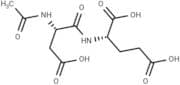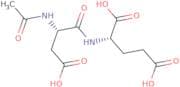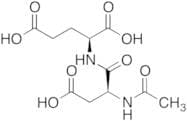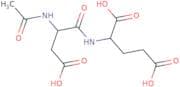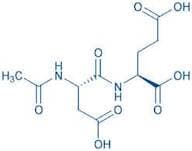
CAS 3106-85-2
:Acide N-acétylaspartylglutamique
Description :
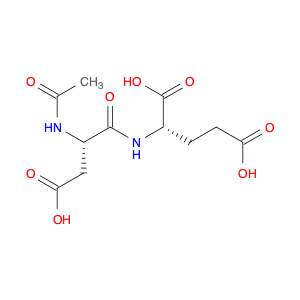
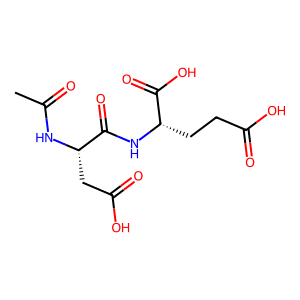
Acide N-acétylaspartylglutamique, communément appelé NAAG, est un dipeptide naturellement présent composé des acides aminés N-acétylaspartate et glutamate. Il est classé comme un neurotransmetteur et joue un rôle significatif dans le système nerveux central, en particulier dans la modulation de la transmission synaptique et la neuroprotection. On sait que le NAAG agit sur les récepteurs métabotropiques du glutamate, influençant divers processus physiologiques, y compris la perception de la douleur et la neuroplasticité. La substance est soluble dans l'eau et présente une stabilité dans des conditions physiologiques, ce qui la rend pertinente pour la recherche en neurobiologie et les applications thérapeutiques potentielles. Son numéro CAS, 3106-85-2, est utilisé pour l'identification dans les bases de données chimiques. L'implication du NAAG dans les maladies neurodégénératives et son potentiel en tant que biomarqueur pour certaines conditions neurologiques sont des domaines de recherche en cours, soulignant son importance dans les sciences fondamentales et appliquées.
Formule :C11H16N2O8
InChI :InChI=1S/C11H16N2O8/c1-5(14)12-7(4-9(17)18)10(19)13-6(11(20)21)2-3-8(15)16/h6-7H,2-4H2,1H3,(H,12,14)(H,13,19)(H,15,16)(H,17,18)(H,20,21)/t6-,7-/m0/s1
Code InChI :InChIKey=OPVPGKGADVGKTG-BQBZGAKWSA-N
SMILES :[C@@H](C(N[C@@H](CCC(O)=O)C(O)=O)=O)(CC(O)=O)NC(C)=O
Synonymes :- <span class="text-smallcaps">L</smallcap>-Glutamic acid, N-(N-acetyl-<smallcap>L</span>-α-aspartyl)-
- <span class="text-smallcaps">L</smallcap>-Glutamic acid, N-acetyl-<smallcap>L</span>-α-aspartyl-
- Ac-Asp-Glu-OH
- Acetyl-α-<span class="text-smallcaps">L</span>-aspartylglutamic acid
- Glutamic acid, N-(N-acetyl-<span class="text-smallcaps">L</smallcap>-aspartyl)-, <smallcap>L</span>-
- Isospaglumic Acid
- N-(N-Acetylaspartyl)glutamic acid
- N-Acetyl-<span class="text-smallcaps">L</smallcap>-aspartyl-<smallcap>L</span>-glutamic acid
- N-Acetyl-<span class="text-smallcaps">L</smallcap>-α-aspartyl-<smallcap>L</span>-glutamic acid
- N-Acetyl-α-<span class="text-smallcaps">L</smallcap>-aspartyl-<smallcap>L</span>-glutamic acid
- N-Acetyl-α-aspartylglutamic acid
- N-Acetylaspartylglutamic acid
- N-acetyl-D-alpha-aspartyl-L-glutamic acid
- N-acetyl-L-alpha-aspartyl-L-glutamic acid
- N-acetyl-alpha-aspartylglutamic acid
- α-Spaglumic acid
- L-Glutamic acid, N-acetyl-L-α-aspartyl-
- Glutamic acid, N-(N-acetyl-L-aspartyl)-, L-
- N-Acetyl-L-α-aspartyl-L-glutamic acid
- Voir plus de synonymes
Trier par
Degré de pureté (%)
0
100
|
0
|
50
|
90
|
95
|
100
10 produits concernés.
L-Glutamic acid, N-acetyl-L-α-aspartyl-
CAS :Formule :C11H16N2O8Degré de pureté :95%Couleur et forme :SolidMasse moléculaire :304.2533(S)-2-((S)-2-Acetamido-3-Carboxypropanamido)Pentanedioic Acid
CAS :(S)-2-((S)-2-Acetamido-3-Carboxypropanamido)Pentanedioic AcidDegré de pureté :95%Masse moléculaire :304.25g/molN-Acetyl-Asp-Glu
CAS :Formule :C11H16N2O8Degré de pureté :≥ 95.0%Couleur et forme :White to off-white powderMasse moléculaire :304.25Spaglumic acid
CAS :Spaglumic acid (N-Acetylaspartylglutamic acid) is a neuropeptide found in millimolar concentrations in the brain.Formule :C11H16N2O8Degré de pureté :99.92%Couleur et forme :White PowderMasse moléculaire :304.25Spaglumic Acid-d3
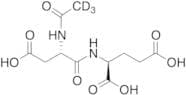
CAS :Produit contrôléStability Hygroscopic
Applications Spaglumic Acid-d3 is the isotope labelled analogue of Spaglumic Acid, a marker of neuronal integrity and was used in the detection of therapeutic values of antidrepressant treatments.
References Taylor, M.J., et al.: Int. J. Neuropharmacol., 15, 1541 (2012); Shi, D.X., et al.: J. Neurochem., 123, 971 (2012); Sun,W., et al.: Science., 339, 197 (2013);Formule :C11H13D3N2O8Couleur et forme :NeatMasse moléculaire :307.27N-Acetyl-L-aspartyl-L-glutamic acid
CAS :N-Acetyl-L-aspartyl-L-glutamic acid is an amino acid that is used as a substrate in the biochemical assay for glutamate. It is also used to measure brain functions. NAAG is a low potency agonist of the NMDA receptor, which may contribute to neuronal death. NAAG is used as a model system to study bowel disease and eosinophil cationic protein. It has been shown to be effective in vitro against cancer cells and fungi. The structural analysis of NAAG has revealed that it contains an acidic group on its side chain, which can be detected with a pH indicator such as phenol red or bromocresol purple.Formule :C11H16N2O8Degré de pureté :Min. 95 Area-%Couleur et forme :White Off-White PowderMasse moléculaire :304.25 g/molSpaglumic Acid
CAS :Produit contrôléApplications Spaglumic Acid is a marker of neuronal integrity and was used in the detection of therapeutic values of antidrepressant treatments.
References Taylor, M.J., et al.: Int. J. Neuropharmacol., 15, 1541 (2012); Shi, D.X., et al.: J. Neurochem., 123, 971 (2012); Sun,W., et al.: Science., 339, 197 (2013);Formule :C11H16N2O8Couleur et forme :NeatMasse moléculaire :304.25Ac-Asp-Glu • H2O
CAS :Ac-Asp-Glu • H2O is a water soluble molecule that belongs to the class of inhibitors. It has been shown to inhibit the polymerase chain reaction and is used as an analytical method for detecting DNA sequences. Ac-Asp-Glu • H2O induces neuronal death in the caudate putamen, thereby causing bowel disease, by inhibiting energy metabolism. This compound also inhibits the synthesis of proteins in the hippocampus, which leads to reduced locomotor activity and eosinophil cationic protein production. Ac-Asp-Glu • H2O is acidic and its concentration–time curve shows a bell shape. The half life of this compound is six hours.Formule :C11H16N2O8•H2ODegré de pureté :Min. 95%Masse moléculaire :322.28 g/molAc-Asp-Glu-OH
CAS :An endogenous dipeptide with high affinity for a brain glutamate receptor. NAAG is the most abundant peptide neurotransmitter in the mammalian central nervous system.Formule :C11H16N2O8Degré de pureté :> 99%Couleur et forme :White PowderMasse moléculaire :304.26