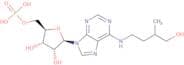
CAS 31284-94-3
:Acide 5'-adénylique, N-(4-hydroxy-3-méthylbutyl)-
Description :
Acide 5'-adénylique, N-(4-hydroxy-3-méthylbutyl)-, également connu comme un dérivé de l'adénosine monophosphate (AMP), est un nucléotide qui joue un rôle crucial dans le métabolisme cellulaire et la signalisation. Ce composé présente un squelette d'adénosine, qui consiste en une base d'adénine liée à un sucre ribose, avec un groupe phosphate attaché à la position 5'. Le substituant N-(4-hydroxy-3-méthylbutyle) indique la présence d'une chaîne alkyle ramifiée qui peut influencer la solubilité, la stabilité et l'activité biologique du composé. En général, de telles modifications peuvent améliorer l'interaction du composé avec des enzymes ou des récepteurs, affectant potentiellement son rôle dans les voies biochimiques. La présence du groupe hydroxyle suggère qu'il pourrait participer à des liaisons hydrogène, ce qui peut encore influencer sa réactivité et ses interactions dans les systèmes biologiques. Dans l'ensemble, ce composé suscite un intérêt dans la recherche biochimique, en particulier dans les études liées au métabolisme des nucléotides et aux voies de signalisation.
Formule :C15H24N5O8P
Synonymes :- DIHYDROZEATIN RIBOSIDE-5'-MONOPHOSPHATE SODIUM SALT (DHZMP)
- Dihydrozeatin riboside-5'-monophosphate sodium salt
- Dihydrozeatin ribotide
- Dihydrozeatin 9-riboside 5'-phosphate
- N-(4-Hydroxy-3-methylbutyl)-5'-adenylic acid
Trier par
Degré de pureté (%)
0
100
|
0
|
50
|
90
|
95
|
100
1 produits concernés.
Dihydrozeatin riboside-5'-monophosphate sodium salt
CAS :Dihydrozeatin riboside-5'-monophosphate sodium salt is a cytokinin that belongs to the group of indole compounds. It has been shown to inhibit the biosynthesis of ethylene, which prevents fruit from ripening. Dihydrozeatin riboside-5'-monophosphate sodium salt is also able to inhibit the synthesis of adenosine, another plant hormone that inhibits growth and promotes dormancy in plants. The bioassay for this product has been done with amanita muscaria, an edible mushroom found in North America and Europe. This mushroom contains dihydrozeatin as well as other related compounds such as zeatin, which can be converted into dihydrozeatin by enzymes present in the intestines. The symptoms of poisoning by this mushroom include vomiting and diarrhea, owing to its effects on intestinal motility.Formule :C15H22N5Na2O8P·H2ODegré de pureté :Min. 95%Couleur et forme :White To Off-White SolidMasse moléculaire :495.33 g/mol