CAS 31302-52-0
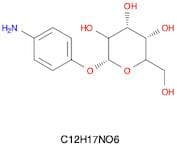
:4-aminophényl-alpha-D-glucopyranoside
Description :
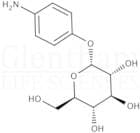
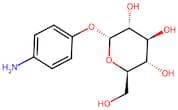
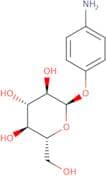
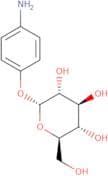
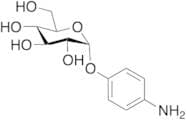
4-aminophényl-alpha-D-glucopyranoside est un composé chimique caractérisé par la présence d'un groupe amino et d'une partie glucopyranoside. Il présente un cycle phénylique substitué par un groupe amino en position para, ce qui contribue à son activité biologique potentielle. La partie glucopyranoside indique qu'il s'agit d'un glycoside, spécifiquement un alpha-D-glucopyranoside, ce qui signifie que l'unité de glucose est sous sa forme pyranose et est liée au groupe phénylique par une liaison glycosidique. Ce composé est souvent étudié pour ses applications en biochimie et en chimie médicinale, en particulier dans le contexte de la conception et du développement de médicaments. Sa solubilité dans l'eau et les solvants organiques peut varier, influençant sa biodisponibilité et son interaction avec les systèmes biologiques. La présence de composants à la fois hydrophiles (glucose) et hydrophobes (phényl) permet diverses interactions, en faisant un sujet d'intérêt dans la recherche liée aux substrats et inhibiteurs enzymatiques. Dans l'ensemble, 4-aminophényl-alpha-D-glucopyranoside illustre l'intersection de la chimie des glucides et des composés aromatiques, mettant en évidence la complexité des interactions moléculaires dans les systèmes biologiques.
Trier par
Degré de pureté (%)
0
100
|
0
|
50
|
90
|
95
|
100
6 produits concernés.
4-Aminophenyl a-D-glucopyranoside
CAS :Formule :C12H17NO6Couleur et forme :SolidMasse moléculaire :271.26654-Aminophenyl α-D-glucopyranoside
CAS :4-Aminophenyl α-D-glucopyranosideCouleur et forme :White SolidMasse moléculaire :271.27g/mol4-Aminophenyl-α-D-glucopyranoside
CAS :4-Aminophenyl-alpha-D-glucopyranoside is a natural product that has been found to be an antigen. The compound has been shown to have anticancer activity, which may be due to its ability to inhibit the growth of cells and induce apoptosis. 4-Aminophenyl-alpha-D-glucopyranoside also possesses magnetic properties. The chemical structure of this compound is characterized by an acrylate group, which is a small organic molecule with two carbon atoms and one oxygen atom. This compound is synthesized in a preparative manner using methoxy, ethyl bromoacetate, and mesitylene in the presence of irradiation. NMR spectroscopy can be used for the characterization of this compound as well as other compounds with similar structures that are catalytic in nature.Formule :C12H17NO6Degré de pureté :Min. 98.0 Area-%Masse moléculaire :271.27 g/mol4-Aminophenyl a-D-glucopyranoside
CAS :4-Aminophenyl a-D-glucopyranoside is an alkoxycarbonyl analog that can be used in the preparation of antigens. It is a small, water-soluble molecule that can be used to induce antibody production and to identify antigenic determinants. 4-Aminophenyl a-D-glucopyranoside has been shown to react with glutamicum and corynebacterium cells in vitro. The compound binds to the bacterial cell surface by reacting with amino groups, inducing the production of acid molecules, which leads to bacterial death. 4-Aminophenyl a-D-glucopyranoside also reacts with methoxy residues on the ribosomal RNA molecule and corynebacterium DNA molecules. This allows it to be used as an expression vector for proteins and nucleic acids in Corynebacterium glutamicum (a bacterium commonly found in soil). SpectroscFormule :C12H17NO6Degré de pureté :Min. 95%Couleur et forme :PowderMasse moléculaire :271.27 g/mol4-Aminophenyl a-D-Glucopyranoside
CAS :Produit contrôléApplications 4-Aminophenyl α-D-Glucopyranoside is a glycoside derivative of 4-Aminophenol (A618920); a nephrotoxic metabolite of Acetaminophen (A161220) and Phenacetin (P294580) (1).
References (1) Watanabe, et al.: Drug Metab. Dispos., 38, 1532 (2010)Formule :C12H17NO6Couleur et forme :NeatMasse moléculaire :271.27