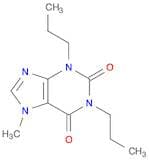
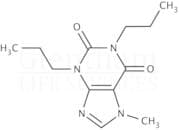
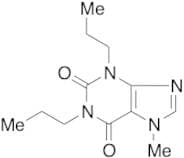
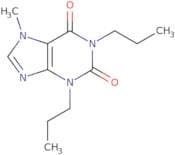
CAS 31542-63-9
:1,3-Dipropyl-7-méthylxanthine
- 1,3-Dipropylheteroxanthine
- 1H-Purine-2,6-dione, 3,7-dihydro-7-methyl-1,3-dipropyl-
- 3,7-Dihydro-7-methyl-1,3-dipropyl-1H-purine-2,6-dione
- 7-Methyl-1,3-dipropylxanthine
- 7-methyl-1,3-dipropyl-3,7-dihydro-1H-purine-2,6-dione
- Heteroxanthine, 1,3-dipropyl-
- Sc 5192
- (1,3)-Dipropyl-7-methylxanthine
7-Methyl-1,3-dipropyl-1H-purine-2,6(3H,7H)-dione
CAS :Formule :C12H18N4O2Couleur et forme :SolidMasse moléculaire :250.29691,3-Dipropyl-7-methylxanthine
CAS :Produit contrôléApplications A phosphodiesterase inhibitor and caffeine analog with some selectivity for A2 adenosine receptors. UV lmax = 273 nm, log e=3.98.
References Clark, K., et al.: J. Physiol., 481, 129 (1994), Liu, W., et al.: Pharmacol., 54, 135 (1997), Zarrindast, M., et al.: Eur. Neuropsychopharmacol., 13, 165 (2003), Malki, A., et al.: Exp. Oncol., 28, 16 (2006),Formule :C12H18N4O2Couleur et forme :NeatMasse moléculaire :250.301,3-Dipropyl-7-methylxanthine
CAS :Produit contrôlé1,3-Dipropyl-7-methylxanthine is a xanthine compound that is structurally related to caffeine. It has been shown to have an inhibitory effect on the production of reactive oxygen species and cytosolic calcium levels in primary cells, as well as a nonselective adenosine receptor antagonist activity. It has also been shown to antagonize the effects of adenosine receptors, p2 receptors, and p2y receptors. This drug is used for the treatment of basophilic leukemia.
Formule :C12H18N4O2Degré de pureté :Min. 95%Masse moléculaire :250.3 g/mol