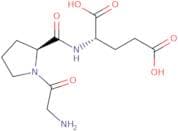
CAS 32302-76-4
:glycyl-L-prolyl-L-glutamique acide
Description :
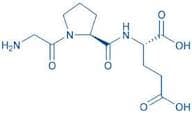
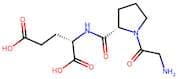
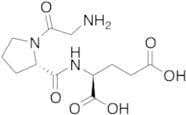
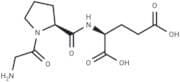
glycyl-L-prolyl-L-glutamique acide, également connu sous son numéro CAS 32302-76-4, est un tripeptide composé de trois acides aminés : glycine, proline et acide glutamique. Ce composé présente des caractéristiques typiques des peptides, y compris la capacité de former des liaisons hydrogène et d'adopter des conformations spécifiques en raison de sa séquence d'acides aminés. glycyl-L-prolyl-L-glutamique acide est connu pour ses activités biologiques potentielles, qui peuvent inclure des rôles dans la signalisation cellulaire et la modulation des processus physiologiques. La présence de proline dans sa structure peut conférer des propriétés conformationales uniques, influençant sa stabilité et son interaction avec d'autres biomolécules. De plus, le résidu d'acide glutamique contribue à la charge globale du peptide et à son hydrophilie, ce qui peut affecter sa solubilité dans des environnements aqueux. Ce tripeptide peut être d'un intérêt dans divers domaines, y compris la biochimie et la pharmacologie, pour ses applications potentielles dans le développement de médicaments et comme outil de recherche dans l'étude des interactions et des fonctions des peptides.
Formule :C12H19N3O6
InChI :InChI=1/C12H19N3O6/c13-6-9(16)15-5-1-2-8(15)11(19)14-7(12(20)21)3-4-10(17)18/h7-8H,1-6,13H2,(H,14,19)(H,17,18)(H,20,21)/t7-,8-/m0/s1
SMILES :C1C[C@@H](C(=N[C@@H](CCC(=O)O)C(=O)O)O)N(C1)C(=O)CN
Synonymes :- L-glutamic acid, glycyl-L-prolyl-
- Glycyl-Prolyl-Glutamic Acid
Trier par
Degré de pureté (%)
0
100
|
0
|
50
|
90
|
95
|
100
5 produits concernés.
IGF-I (1-3)
CAS :This N-terminal tripeptide of IGF-I facilitated the in vitro release of acetylcholine with a several hundredfold higher potency (10⁻¹⁰ – 10⁻⁶ M) than intact IGF-I (4 · 10⁻⁸ M), whereas truncated IGF-I lacking the tripeptide GPE, did not show any significant effect. This raises the possibility that GPE may be the active site of IGF-I. – Although the precise mode of action of GPE is still unknown, another study suggests that local administration of GPE is neuroprotective after brain HI injury via glial cells. In addition, systemic administration of GPE showed a more widespread neuroprotective effect. Therefore, GPE may represent a complementary pathway for central and systemic IGF-1’s antiapoptotic effects.Formule :C12H19N3O6Degré de pureté :99.7%Couleur et forme :White PowderMasse moléculaire :301.3Gly-Pro-Glu
CAS :Produit contrôléApplications GLY-PRO-GLU (cas# 32302-76-4) is a useful research chemical.
Formule :C12H19N3O6Couleur et forme :NeatMasse moléculaire :301.296Glypromate
CAS :Glypromate (Gly-Pro-Glu) is a neuroprotective agent, is a weak NMDA receptor agonistFormule :C12H19N3O6Degré de pureté :98%Couleur et forme :SolidMasse moléculaire :301.3IGF-I (1-3)
CAS :IGF-I (1-3) H-Gly-Pro-Glu-OH is a synthetic peptide that has been shown to be effective in treating neuronal death caused by glutamate. It binds to calcium ions and inhibits the activity of gamma-aminobutyric acid, which is an inhibitory neurotransmitter. IGF-I (1-3) H-Gly-Pro-Glu-OH also blocks fatty acid synthesis, leading to necrotic cell death. In vitro assays have shown that this drug can protect against blood group O erythrocytes from pyridoxal phosphate oxidation and protocatechuic acid binding. This drug has also been shown to increase locomotor activity in mice, as well as improve motor function in rats with experimental stroke. IGF-I (1-3) H-Gly-Pro-Glu-OH is synthesized using a polymerase chain reaction technique and consists of amino acids 1 through 3 ofFormule :C12H19N3O6Degré de pureté :Min. 95%Masse moléculaire :301.3 g/mol