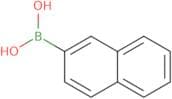
CAS 32316-92-0
:Acide 2-naphtylboronique
Description :
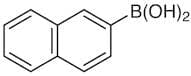
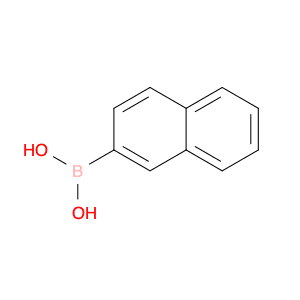
Acide 2-naphtylboronique est un composé organoboré caractérisé par la présence d'un groupe fonctionnel acide borique attaché à un anneau de naphtalène. Il apparaît généralement sous forme de solide blanc à blanc cassé et est soluble dans des solvants organiques polaires tels que l'éthanol et le méthanol, mais moins soluble dans des solvants non polaires. Le composé est connu pour sa capacité à former des liaisons covalentes réversibles avec des diols, ce qui le rend utile dans diverses applications, y compris la synthèse organique et comme réactif dans les réactions de couplage croisé de Suzuki-Miyaura. Sa fonctionnalité d'acide borique lui permet de participer à la formation d'esters boronés, qui sont des intermédiaires importants en chimie organique. De plus, Acide 2-naphtylboronique a été étudié pour ses applications potentielles en chimie médicinale, en particulier dans le développement de médicaments ciblant des voies biologiques spécifiques. Les considérations de sécurité incluent le maniement avec précaution, car les acides boriques peuvent être irritants. Dans l'ensemble, Acide 2-naphtylboronique est un composé polyvalent avec une utilité significative tant en chimie académique qu'industrielle.
Formule :C10H9BO2
InChI :InChI=1/C10H9BO2/c12-11(13)10-6-5-8-3-1-2-4-9(8)7-10/h1-7,12-13H
Code InChI :InChIKey=KPTRDYONBVUWPD-UHFFFAOYSA-N
SMILES :B(O)(O)C1=CC2=C(C=C1)C=CC=C2
Synonymes :- (2-Naphthalenyl)boronic acid
- (Naphthalene-2-yl)boronic acid
- 2-Naphthalene Boric Acid
- 2-Naphthaleneboronic acid
- 2-Naphthaleneylboronic acid
- 2-Naphthylbenzoic acid
- 2-Naphthylboric acid
- 2-Naphthylboronic acid
- 2-Naphthylboronic caid
- Akos Brn-0020
- Akos Brn-0041
- Alpha-Naphthylboric Acid
- B-2-Naphthalenylboronic acid
- Boronic acid, 2-naphthalenyl-
- Boronic acid, B-2-naphthalenyl-
- Naphthalen-2-Yl-2-Boronic Acid
- Naphthalen-2-Ylboronic Acid
- Naphthalenyl-2-Boronic Acid
- NAPHTHALENE-2-BORONIC ACID
- NAPHTHALEN-1-YLBORONIC ACID
- 1-NAPHTHALENEBORONIC ACID
- 1-NAPHTHYLBORONIC ACID
- RARECHEM AH PB 0126
- 1-NAPHTHYLENEBORONIC ACID
- NAPHTHALENE-1-BORONIC ACID
- 2-NAPHTHENEBORONIC ACID
- NAPHTHALENYL-1-BORONIC ACID
- Voir plus de synonymes
Trier par
Degré de pureté (%)
0
100
|
0
|
50
|
90
|
95
|
100
8 produits concernés.
2-Naphthaleneboronic Acid (contains varying amounts of Anhydride)
CAS :Formule :C10H9BO2Couleur et forme :White to Light yellow powder to crystalMasse moléculaire :171.992-Naphthaleneboronic acid, 97%
CAS :This Thermo Scientific Chemicals brand product was originally part of the Alfa Aesar product portfolio. Some documentation and label information may refer to the legacy brand. The original Alfa Aesar product / item code or SKU reference has not changed as a part of the brand transition to Thermo SciFormule :C10H9BO2Degré de pureté :97%Couleur et forme :White to cream to pale brown, Powder or crystalline powder and/or chunksMasse moléculaire :171.992-Naphthylboronic acid
CAS :Formule :C10H9BO2Degré de pureté :98%Couleur et forme :SolidMasse moléculaire :171.9883Ref: IN-DA0033EN
1kgÀ demander5kgÀ demander10kgÀ demander1g26,00€5g27,00€10g33,00€25g54,00€100g123,00€500g339,00€Naphthalene-2-boronic acid
CAS :Naphthalene-2-boronic acidFormule :C10H9BO2Degré de pureté :≥95%Couleur et forme : white crystalline powderMasse moléculaire :171.99g/mol2-Naphthaleneboronic acid
CAS :Formule :C10H9BO2Degré de pureté :97%Couleur et forme :Chunks,Crystalline PowderMasse moléculaire :171.992-Naphthaleneboronic acid
CAS :2-Naphthaleneboronic acid is an organic compound that has been used as a model system for studying the binding of organic molecules to metal ions. It has been shown to bind with high affinity and specificity to sodium, potassium, and lithium ions. 2-Naphthaleneboronic acid binds to the metal ion by forming a boronate ester linkage with one of its hydroxyl groups. The other two hydroxyl groups are involved in hydrogen bonding interactions with the metal ion. This process is reversible, which allows it to be used as a model system for studying the binding of organic molecules to metal ions. 2-Naphthaleneboronic acid is also used in the synthesis of various compounds, including diphenyl ethers and anhydrous sodium carbonate. It can be prepared by reacting naphthalene with anhydrous sodium carbonate in hydrochloric acid or sodium carbonate solution at temperatures ranging from 50 °C to 150 °CFormule :C10H9BO2Degré de pureté :Min. 95%Masse moléculaire :171.99 g/mol