CAS 3237-50-1
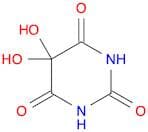
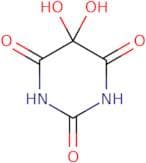
:5,5-Dihydroxy-2,4,6(1H,3H,5H)-pyrimidinetrione
Description :
5,5-Dihydroxy-2,4,6(1H,3H,5H)-pyrimidinetrione, également connu sous le nom d'uracile-5,5-diol, est un dérivé de la pyrimidine caractérisé par la présence de deux groupes hydroxyles en position 5 et une structure de trione. Ce composé présente un cycle aromatique à six membres contenant des atomes d'azote, ce qui contribue à sa stabilité et à sa réactivité. Il s'agit généralement d'un solide cristallin blanc à blanc cassé, soluble dans l'eau en raison de la présence de groupes hydroxyles pouvant former des liaisons hydrogène. Le composé présente des propriétés typiques des pyrimidines, y compris une activité biologique potentielle, car il peut interagir avec des acides nucléiques et des enzymes. Sa structure permet des formes tautomériques, qui peuvent influencer sa réactivité et ses interactions dans les voies biochimiques. 5,5-Dihydroxy-2,4,6(1H,3H,5H)-pyrimidinetrione suscite de l'intérêt dans divers domaines, y compris la chimie médicinale et la biochimie, en raison de ses applications potentielles dans le développement de médicaments et en tant que sonde biochimique.
Formule :C4H4N2O5
InChI :InChI=1S/C4H4N2O5/c7-1-4(10,11)2(8)6-3(9)5-1/h10-11H,(H2,5,6,7,8,9)
Code InChI :InChIKey=ZIIHZVKHFWOENY-UHFFFAOYSA-N
SMILES :OC1(O)C(=O)NC(=O)NC1=O
Synonymes :- 2,4,6(1H,3H,5H)-Pyrimidinetrione, 5,5-dihydroxy-
- 5-24-09-00382 (Beilstein Handbook Reference)
- 5,5-Dihydroxy-2,4,6(1H,3H,5H)-pyrimidinetrione
- 2,4,5,6(1H,3H)-Pyrimidinetetrone, monohydrate
- NSC 221304
- 2,4,5,6(1H,3H)-Pyrimidinetetrone hydrate
- Alloxan hydrate
- 5,5-Dihydroxybarbituric acid
- 2,4,6(1H,3H,5H)-Pyrimidinetrione, 5,5-dihydroxy-
- 5,5-dihydroxypyrimidine-2,4,6(1H,3H,5H)-trione
- BRN 0155548
- Alloxan monohydrate
- Alloxan hydrate
- 2,4,6(1H,3H,5H)-Pyrimidinetrione, 5,5-dihydroxy- (9CI)
- 5,5-Dihydroxyperhydropyrimidinetrione
- Alloxan monohydrate
- CCRIS 5957
- Barbituric acid, 5,5-dihydroxy-
- Voir plus de synonymes
Trier par
Degré de pureté (%)
0
100
|
0
|
50
|
90
|
95
|
100
4 produits concernés.
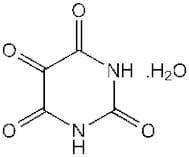
Alloxan monohydrate, 98%
CAS :Cytotoxic compound that causes oxidative base damage to nuclear DNAAlloxan monohydrate is used as a precursor to prepare purple dye murexide. It is also used in research models to induce diabetes and destroy beta cells. Further, it is a strong oxidizing agent and it forms a hemiacetal with its reduc
Formule :C4H2N2O4•H2ODegré de pureté :98%Couleur et forme :White to cream to yellow to brown to black, Crystals or powder or crystalline powderMasse moléculaire :160.09 (142.07anhy)5,5-Dihydroxypyrimidine-2,4,6(1H,3H,5H)-trione
CAS :Formule :C4H4N2O5Couleur et forme :SolidMasse moléculaire :160.0850Alloxan hydrate
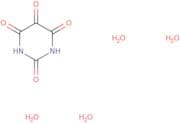
CAS :A pyrimidine derivative, widely used for the induction of diabetes in experimental animals. It preferentially accumulates in pancreatic β cells in Langerhans islets via glucose transporter GLUT2. In the presence of intracellular thiols such as glutathione, it gets involved in a cyclic redox reaction with its reduction product, dialuric acid. This triggers the production of toxic levels of reactive oxygen species (ROS) and directs the cells in necrosis. Alloxan also inhibits glucokinase, which regulates glucose-induced insulin secretion.Formule :C4H2N2O4•xH2ODegré de pureté :Min. 95%Masse moléculaire :142.07 g/mol5,5-Dihydroxypyrimidine-2,4,6(1H,3H,5H)-trione
CAS :Produit contrôlé5,5-Dihydroxypyrimidine-2,4,6(1H,3H,5H)-trione is a chemical compound that is found in animals. It is an intermediate in the biosynthesis of pyrimidines. This molecule has been shown to have hypoglycemic effects when administered orally to diabetic patients. 5,5-Dihydroxypyrimidine-2,4,6(1H,3H,5H)-trione can be metabolized by nitro and alkoxy radicals to form reactive oxygen species that are cytotoxic. This chemical also has insulin-like growth factor activity and can stimulate the production of density lipoprotein (LDL).Formule :C4H4N2O5Degré de pureté :Min. 95%Masse moléculaire :160.09 g/mol