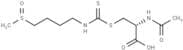
![N-Acetyl-S-[[[4-(methylsulfinyl)butyl]amino]thioxomethyl]-L-cysteine](/_next/image/?url=https%3A%2Fstatic.cymitquimica.com%2Fcas-image%2Fthumb-webp%2F317951-n-acetyl-s-4-methylsulfinyl-butyl-amino-thioxomethyl-l-cysteine.webp&w=3840&q=75)
CAS 334829-66-2
:N-Acétyl-S-[[[4-(méthylsulfinyl)butyl]amino]thioxométhyl]-L-cystéine
Description :
N-Acétyl-S-[[[4-(méthylsulfinyl)butyl]amino]thioxométhyl]-L-cystéine, identifié par son numéro CAS 334829-66-2, est un composé synthétique qui appartient à la classe des acides aminés et de leurs dérivés. Cette substance présente un groupe thioxométhyle, qui contribue à sa réactivité unique et à son activité biologique potentielle. La présence du groupe N-acétyle améliore sa solubilité et sa stabilité, le rendant adapté à diverses applications en biochimie et en pharmacologie. Le groupe méthylsulfinyle indique des propriétés antioxydantes potentielles, car les composés contenant du soufre présentent souvent de telles caractéristiques. De plus, la chaîne butyle peut influencer la lipophilie du composé, affectant son interaction avec les membranes biologiques. Dans l'ensemble, la structure de ce composé suggère qu'il pourrait avoir des applications en chimie médicinale, en particulier dans le développement de thérapies ciblant des voies biochimiques spécifiques. Cependant, des études détaillées sur sa pharmacodynamique, sa toxicité et son efficacité sont nécessaires pour comprendre pleinement ses utilisations potentielles et son profil de sécurité.
Formule :C11H20N2O4S3
InChI :InChI=1S/C11H20N2O4S3/c1-8(14)13-9(10(15)16)7-19-11(18)12-5-3-4-6-20(2)17/h9H,3-7H2,1-2H3,(H,12,18)(H,13,14)(H,15,16)/t9-,20?/m0/s1
Code InChI :InChIKey=IIHBKTCHILXGOT-KMYGYIBBSA-N
SMILES :[C@@H](CSC(NCCCCS(C)=O)=S)(NC(C)=O)C(O)=O
Synonymes :- L-Cysteine, N-acetyl-, [4-(methylsulfinyl)butyl]carbamodithioate (ester)
- N-Acetyl-S-[[[4-(methylsulfinyl)butyl]amino]thioxomethyl]-L-cysteine
- L-Cysteine, N-acetyl-S-[[[4-(methylsulfinyl)butyl]amino]thioxomethyl]-
- N-Acetyl-S-(((methylsulfinyl)butyl)carbamothioyl)-L-cysteine
Trier par
Degré de pureté (%)
0
100
|
0
|
50
|
90
|
95
|
100
5 produits concernés.
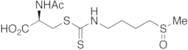
DL-Sulforaphane N-acetyl-L-cysteine
CAS :DL-Sulforaphane N-acetyl-L-cysteineDegré de pureté :≥95%Masse moléculaire :340.48g/molDL-Sulforaphane N-acetyl-L-cysteine
CAS :DL-Sulforaphane N-acetyl-L-cysteine (SFN-NAC), induces apoptosis through α-microtubulin and phosphorylation of ERK1/2-mediated Stathmin-1, and Hsp70 (NSCLC).Formule :C11H20N2O4S3Degré de pureté :99%Couleur et forme :SolidMasse moléculaire :340.48D,L-Sulforaphane N-Acetyl-L-cysteine
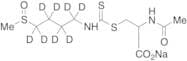
CAS :Produit contrôléFormule :C11H20N2O4S3Couleur et forme :NeatMasse moléculaire :340.48D,L-Sulforaphane-d8 N-Acetyl-L-cysteine Sodium Salt
CAS :Produit contrôléStability Hygroscopic
Applications The major labelled metabolite of Sulforaphane. Sulforaphane (SFN) is an isothiocyanate from broccoli that induces phase 2 detoxification enzymes. Antitumor agent.
References Singhal, D., et al.: J. Pharm. Sci., 87, 569 (1998), Cohen, J., et al.: J. Natl. Cancer. Inst., 92, 61 (2000), Johnson, B., et al.: J. Pharmacol. Exp. Ther., 305, 151 ( 2003), Petri, N., et al.: Drug Metabol. Dispos., 31, 805 (2003), Hu, R., et al.: J. Pharmacol. Exp. Ther., 310, 263 (2004),Formule :C11H11D8N2NaO4S3Couleur et forme :NeatMasse moléculaire :370.51D,L-Sulforaphane N-acetyl-L-cysteine
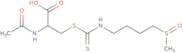
CAS :Sulforaphane is a natural compound found in broccoli and other cruciferous vegetables. It has been shown to have anti-cancer properties, including inhibition of skin cancer. Sulforaphane N-acetyl-L-cysteine (SFNAC) is an analogue of sulforaphane that can be used to inhibit the epidermal growth factor response element. SFNAC also has inhibitory properties against the apoptosis pathway and can induce cellular death by inhibiting mitochondrial membrane potential. The lc-ms/ms method was used to measure SFNAC levels in bovine fetal serum and it was found that this compound was present at low doses (1 mg/kg body weight).Formule :C11H20N2O4S3Degré de pureté :Min. 95%Couleur et forme :PowderMasse moléculaire :340.49 g/mol