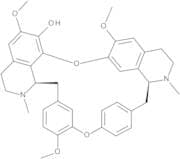
CAS 33889-68-8
:Fangchinoline
Description :
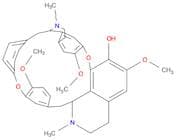
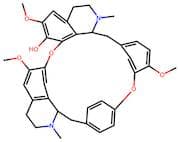
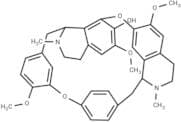
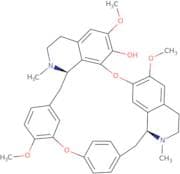
Fangchinoline est un composé alcaloïde dérivé principalement de l'espèce végétale *Stephania* et est connu pour ses diverses activités biologiques. Il se caractérise par sa structure tétracyclique complexe, qui contribue à ses propriétés pharmacologiques. Fangchinoline présente une gamme d'effets, y compris des activités anti-inflammatoires, analgésiques et des activités anticancéreuses potentielles, ce qui en fait un sujet d'intérêt en chimie médicinale. Le composé a été étudié pour sa capacité à moduler diverses voies biologiques, y compris celles impliquées dans la prolifération cellulaire et l'apoptose. De plus, Fangchinoline a montré des promesses dans la médecine traditionnelle, en particulier dans les pratiques herboristes asiatiques. Sa solubilité et sa stabilité peuvent varier en fonction du solvant et des conditions environnementales, qui sont des facteurs importants pour son application dans des contextes de recherche et thérapeutiques. Comme pour de nombreux produits naturels, d'autres études sont nécessaires pour élucider complètement ses mécanismes d'action et ses utilisations thérapeutiques potentielles. Les profils de sécurité et de toxicité sont également des domaines critiques de recherche pour garantir sa viabilité pour des applications cliniques.
Formule :C37H40N2O6
InChI :InChI=1/C37H40N2O6/c1-38-14-12-24-19-31(42-4)33-21-27(24)28(38)16-22-6-9-26(10-7-22)44-32-18-23(8-11-30(32)41-3)17-29-35-25(13-15-39(29)2)20-34(43-5)36(40)37(35)45-33/h6-11,18-21,28-29,40H,12-17H2,1-5H3
SMILES :CN1CCc2cc(c3cc2C1Cc1ccc(cc1)Oc1cc(ccc1OC)CC1c2c(CCN1C)cc(c(c2O3)O)OC)OC
Synonymes :- (+)-Hanfangichin B
- 6,6',12-Trimethoxy-2,2'-Dimethylberbaman-7-Ol
- (1beta)-6,6',12-Trimethoxy-2,2'-dimethylberbaman-7-ol
Trier par
Degré de pureté (%)
0
100
|
0
|
50
|
90
|
95
|
100
5 produits concernés.
(11S,31R)-16,36,54-Trimethoxy-12,32-dimethyl-11,12,13,14,31,32,33,34-octahydro-2,6-dioxa-1(7,1),3(8,1)-diisoquinolina-5(1,3),7(1,4)-dibenzenacyclooctaphan-37-ol
CAS :Formule :C37H40N2O6Degré de pureté :98%Couleur et forme :SolidMasse moléculaire :608.7233(R)-Fangchinoline
CAS :(R)-Fangchinoline ((+)-Thalrugosine) is extracted from Stephania tetrandra S. Moore.Formule :C37H40N2O6Degré de pureté :98% - 99.83%Couleur et forme :SolidMasse moléculaire :608.72Fangchinoline
CAS :Fangchinoline is a natural product that has been shown to have anticancer properties. It has been shown to inhibit the growth of human osteosarcoma cells in vitro and in vivo. Fangchinoline also induces autophagy, which is a process by which cells degrade damaged organelles and protein aggregates via lysosomes. Fangchinoline inhibits cancer cell growth by interfering with the G2-M phase transition, thereby preventing the production of cyclin D2 and inhibiting DNA synthesis by blocking polymerase chain reaction. Fangchinoline also blocks matrix metalloproteinases (MMPs) and increases the activity of tissue inhibitors of metalloproteinases (TIMPs), which are enzymes that regulate MMP activity. When fangchinoline binds to TIMP-1, it prevents its binding to MMP-9 and other pro-metalloproteinases, thereby reducing their activity. Fangchinoline can be synthesized from StephaniaFormule :C37H40N2O6Degré de pureté :Min. 95%Masse moléculaire :608.72 g/molFangchinoline
CAS :Produit contrôléApplications Fangchinoline is an isolate from Stephania Tetrandra that shows anti-cancer activity. It inhibits breast adenocarcinoma proliferation through apoptosis induction. In addition, it has been shown to inhibit HIV-Type 1 replication.
References Xing, Z. et al.: Chem. Pharm. Bull., 59, 1476 (2011); Wan, Z. et al.: PLoS One. 7, e39225 (2012);Formule :C37H40N2O6Couleur et forme :NeatMasse moléculaire :608.72