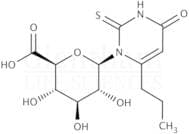
CAS 33987-24-5
:acide b-D-glucopyranuronique,1-désoxy-1-(3,4-dihydro-4-oxo-6-propyl-2-thioxo-1(2H)-pyrimidinyl)-
- Glucopyranuronicacid, 1-deoxy-1-(3,4-dihydro-4-oxo-6-propyl-2-thioxo-1(2H)-pyrimidinyl)-, b-D- (8CI)
- Propylthiouracilglucuronide
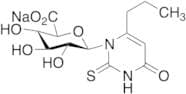
Propylthiouracil N-Beta-D-Glucuronide Sodium Salt
CAS :Produit contrôléApplications Salt of Propylthiouracil N-β-D-Glucuronide (P838315), also a metabolite of Propylthiouracil (P838310).
References Lindsay, R. H., et al.: J. Pharm. Sci., 63 1383 (1974)Taurog, A., et al.: Endocrinology, 122, 592 (1988),Formule :C13H17N2NaO7SCouleur et forme :NeatMasse moléculaire :368.34Propylthiouracil-d5 N-beta-D-Glucuronide Sodium Salt
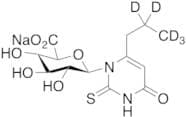
CAS :Produit contrôléApplications A labelled metabolite of Propylthiouracil.
References Lindsay, R. H., et al.: J. Pharm. Sci., 63 1383 (1974)Taurog, A., et al.: Endocrinology, 122, 592 (1988),Formule :C13D5H12N2NaO7SCouleur et forme :NeatMasse moléculaire :373.369Propylthiouracil N-b-D-glucuronide
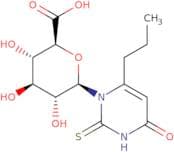
CAS :Propylthiouracil N-b-D-glucuronide is a glycosylation product of propylthiouracil, which is the active form of this drug. It has been shown to inhibit thyroid hormone synthesis by binding to the enzyme thyroid peroxidase. Propylthiouracil N-b-D-glucuronide is used in the treatment of thyrotoxicosis, and can also be used as an antithyroid agent for hyperthyroidism. It is chemically synthesized from propylthiouracil with a glycosyl group added at the C3 position on the thiourea ring by glycosyltransferases. This compound has also been fluorinated and polysaccharided, modified and saccharided, oligosaccharided or sugar, synthetic or monosaccharide, custom synthesis or high purity.
Formule :C13H18N2O7SDegré de pureté :Min. 95%Masse moléculaire :346.36 g/mol