CAS 339990-02-2
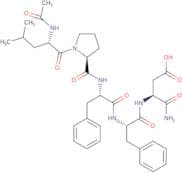
:L-a-Asparagine, N-acétyl-L-leucyl-L-prolyl-L-phénylalanil-L-phénylalanil-
Description :
La L-a-Asparagine, N-acétyl-L-leucyl-L-prolyl-L-phénylalanine-L-phénylalanine, identifiée par le numéro CAS 339990-02-2, est un peptide synthétique qui se compose d'une séquence d'acides aminés, y compris l'asparagine, la leucine, la proline et la phénylalanine. Ce composé est caractérisé par son agencement spécifique de ces acides aminés, ce qui contribue à ses propriétés uniques et à ses potentielles activités biologiques. Les peptides comme celui-ci présentent souvent diverses fonctions dans les systèmes biologiques, y compris des rôles dans la signalisation, l'activité enzymatique et le soutien structurel. La modification N-acétyl améliore généralement la stabilité et la solubilité du peptide, le rendant plus adapté à diverses applications en recherche et en pharmacie. De plus, la présence d'acides aminés aromatiques, tels que la phénylalanine, peut influencer les interactions du peptide avec d'autres biomolécules. Dans l'ensemble, ce composé représente une structure complexe qui peut être d'un intérêt dans les études liées à la biochimie, à la pharmacologie et à la synthèse de peptides.
Formule :C35H46N6O8
Synonymes :- 10:PN: WO03050139 SEQID: 15 claimed protein
- 3: PN: WO0134631 PAGE: 35 claimedprotein
- As 602704
- Ac-Leu-Pro-Phe-Phe-Asp-Nh2
Trier par
Degré de pureté (%)
0
100
|
0
|
50
|
90
|
95
|
100
3 produits concernés.
Acetyl-(Pro18,Asp21)-Amyloid b-Protein (17-21) amide
CAS :Acetyl-(Pro18,Asp21)-Amyloid b-Protein (17-21) amide is a peptide that was generated by incubating β-amyloid with the protease papain. This peptide has been shown to induce population and biochemical changes in cells, including focusing of β-amyloid aggregates. It also induces reactive oxygen species and promotes extracellular protofibril formation. Acetyl-(Pro18,Asp21)-Amyloid b-Protein (17-21) amide is a conjugate of acetylated lysine residues and amyloid β-protein that can be used as an anti-amyloid therapeutic. The peptide is characterized by dichroism spectroscopy, which has revealed its specific binding to the fibrils' surface.Formule :C35H46N6O8Degré de pureté :Min. 95%Masse moléculaire :678.78 g/molAcetyl-(Pro¹⁸,Asp²¹)-Amyloid β-Protein (17-21) amide
CAS :The pentapeptide Ac-LPFFD-NH₂ (iAβ5p) is an analog of product H-4876 with small chemical modifications which enhance its stability against proteolytic degradation. iAβ5p acts as a β-sheet breaker peptide and crosses the blood-brain barrier at a higher rate than most proteins and peptides known to be selectively taken up by the brain so that it is assumed that the peptide is being specifically transported to the brain. A significant increase in neuronal survival and decrease in brain inflammation associated with the reduction of amyloid plaques in two different transgenic Alzheimer`s disease (AD) models is additionally reported for iAβ5p.Formule :C35H46N6O8Degré de pureté :> 95%Couleur et forme :White PowderMasse moléculaire :678.79Ac-Leu-Pro-Phe-Phe-Asp-NH2
CAS :Ac-Leu-Pro-Phe-Phe-Asp-NH2 is a potential therapeutic for Alzheimer's disease. It has been shown to reduce the production of reactive oxygen species and inhibit the formation of amyloid beta oligomers. Ac-Leu-Pro-Phe-Phe-Asp-NH2 also reduces the frequency of protofibrils, which are aggregates that may play a role in Alzheimer's disease pathology. This peptide has been shown to have a protective effect on cell populations, which may lead to therapeutics that can delay or prevent Alzheimer's disease. Ac-Leu-Pro-Phe-Phe-Asp NH2 is an inhibitor of amyloid beta peptides and modulates their aggregation into protofibrils.
Formule :C35H46N6O8Degré de pureté :Min. 95%Masse moléculaire :678.89 g/mol