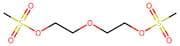
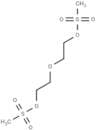
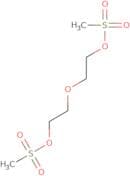
CAS 34604-52-9
:oxydiéthane-2,1-diyl diméthanesulfonate
Description :
oxydiéthane-2,1-diyl diméthanesulfonate, également connu sous son numéro CAS 34604-52-9, est un composé organique caractérisé par ses groupes fonctionnels d'ester sulfoné. Ce composé apparaît généralement sous forme de liquide incolore à jaune pâle et est soluble dans des solvants polaires tels que l'eau et les alcools, grâce à la présence des groupes sulfonés. Il est souvent utilisé dans la synthèse chimique et comme réactif dans diverses réactions organiques en raison de sa capacité à agir comme agent sulfonant. La présence du groupe oxydiéthane contribue à sa réactivité et à ses applications potentielles en chimie des polymères et comme agent de réticulation. Les données de sécurité indiquent que, comme de nombreux esters sulfonés, il doit être manipulé avec précaution, car il peut provoquer des irritations de la peau et des yeux. Des conditions de stockage appropriées sont essentielles pour maintenir sa stabilité et prévenir la dégradation. Dans l'ensemble, oxydiéthane-2,1-diyl diméthanesulfonate est un composé polyvalent avec des applications tant dans des environnements industriels que de laboratoire.
Formule :C6H14O7S2
InChI :InChI=1/C6H14O7S2/c1-14(7,8)12-5-3-11-4-6-13-15(2,9)10/h3-6H2,1-2H3
SMILES :CS(=O)(=O)OCCOCCOS(=O)(=O)C
Synonymes :- Ethanol, 2,2'-oxybis-, dimethanesulfonate
- Diethylene Glycol Dimethanesulfonate
- Ent 61168
- Diethylene Glycol Dimesylate
- Bis(2-Mesyloxyethyl) Ether
- 2,2'-Oxybis-ethanol DiMethanesulfonate
- 2,2'-Oxybis-ethanol 1,1'-Dimethanesulfonate
- Oxybis(ethane-2,1-diyl) dimethanesulfonate
- 2-(2-methylsulfonyloxyethoxy)ethyl methanesulfonate
- Ethanol, 2,2'-oxybis-, 1,1'-dimethanesulfonate
- SKL645
Trier par
Degré de pureté (%)
0
100
|
0
|
50
|
90
|
95
|
100
5 produits concernés.
Diethylene glycol dimethanesulfonate
CAS :Formule :C6H14O7S2Degré de pureté :97%Couleur et forme :SolidMasse moléculaire :262.3012Diethylene Glycol Dimethanesulfonate
CAS :Diethylene Glycol DimethanesulfonateDegré de pureté :99%Masse moléculaire :262.3g/molMs-PEG2-Ms
CAS :Ms-PEG2-Ms is a PEG-based linker for PROTACs which joins two essential ligands, crucial for forming PROTAC molecules.Formule :C6H14O7S2Degré de pureté :98%Couleur et forme :White SolidMasse moléculaire :262.3Diethylene Glycol Dimethanesulfonate
CAS :Produit contrôléApplications Intermediate in the production of alkylating agents
Not a dangerous good if item is equal to or less than 1g/ml and there is less than 100g/ml in the package
References Wong, I., et al.: J. Med. Chem., 52, 5311 (2009), Muehlebach, M., et al.: Bioorg. Med. Chem., 17, 4241 (2009),Formule :C6H14O7S2Couleur et forme :NeatMasse moléculaire :262.30Diethylene glycol dimethanesulfonate
CAS :Diethylene glycol dimethanesulfonate is a functional group that is used in the synthesis of organic compounds. It is a white crystalline solid with a melting point of about 130°C. Diethylene glycol dimethanesulfonate reacts slowly with water and hydrochloric acid to produce diethyl ether and hydrogen chloride gas. The reaction time for this process can be affected by the concentration of reactants, temperature, and pH. Diethylene glycol dimethanesulfonate undergoes acidic hydrolysis in the presence of hydrochloric acid or sodium hydroxide. This reaction produces sodium chloride and ethylene glycol. Busulfan, an anti-cancer drug, is produced by the dehydration of diethylene glycol dimethanesulfonate with copper chloride or chlorine gas. Intramolecular hydrogen bonds are formed during this process to give grandis as an intermediate product. Grandis can be converted into busulfan byFormule :C6H14O7S2Degré de pureté :Min. 95%Couleur et forme :PowderMasse moléculaire :262.3 g/mol