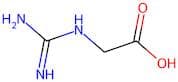
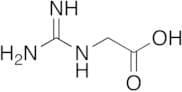
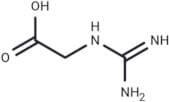
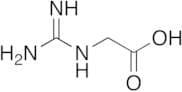
CAS 352-97-6
:Acide guanidinoacétique
Description :
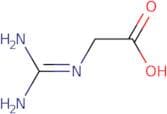
Acide guanidinoacétique, également connu sous le nom de glycocyamine, est un composé organique avec la formule chimique C3H7N5O2. Il se caractérise par la présence d'un groupe guanidine et d'un groupe acide acétique, ce qui en fait un dérivé des acides aminés et de la guanidine. Ce composé est un intermédiaire naturellement présent dans la biosynthèse de la créatine, qui est cruciale pour le métabolisme énergétique dans les tissus musculaires. Acide guanidinoacétique est typiquement un solide cristallin blanc soluble dans l'eau, reflétant sa nature polaire en raison de la présence de groupes fonctionnels aminés et acides carboxyliques. Il a été étudié pour ses avantages potentiels dans l'amélioration des performances sportives et de la fonction cognitive, car il sert de précurseur à la créatine. De plus, il peut avoir des implications dans diverses voies biochimiques et suscite un intérêt dans la recherche liée aux troubles métaboliques. Les données de sécurité indiquent qu'il doit être manipulé avec précaution, comme de nombreuses substances chimiques, pour éviter d'éventuels risques pour la santé.
Formule :C3H7N3O2
InChI :InChI=1S/C3H7N3O2/c4-3(5)6-1-2(7)8/h1H2,(H,7,8)(H4,4,5,6)
Code InChI :InChIKey=BPMFZUMJYQTVII-UHFFFAOYSA-N
SMILES :C(NC(=N)N)C(O)=O
Synonymes :- 2-(Diaminomethylideneazaniumyl)acetate
- 2-Carbamimidamidoacetic acid
- 2-Guanidinoacetic acid
- 2-[(Diaminomethylidene)amino]acetic acid
- 2-[[Amino(imino)methyl]amino]acetic acid
- Acetic acid, [(aminoiminomethyl)amino]-
- Betacyamine
- Betasyamine
- Glycine, N-(aminoiminomethyl)-
- Glycine, N-amidino-
- Glycocyamine
- Guanidine, (carboxymethyl)-
- Guanidinoacetic acid
- Guanidoacetic Acid
- Guanidylacetic acid
- Guanyl glycine
- N-(Aminoiminomethyl)glycine
- N-(diaminomethylidene)glycine
- N-Amidinoglycine
- NSC 1901
- NSC 227847
- NSC 26360
- α-Guanidinoacetic acid
- Voir plus de synonymes
Trier par
Degré de pureté (%)
0
100
|
0
|
50
|
90
|
95
|
100
12 produits concernés.
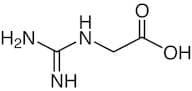
Glycocyamine
CAS :Formule :C3H7N3O2Degré de pureté :>97.0%(T)Couleur et forme :White to Almost white powder to crystalMasse moléculaire :117.112-Guanidinoacetic acid
CAS :Formule :C3H7N3O2Degré de pureté :95%Couleur et forme :SolidMasse moléculaire :117.10662-{[amino(imino)methyl]amino}acetic acid
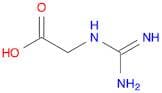
CAS :2-{[amino(imino)methyl]amino}acetic acidFormule :C3H7N3O2Degré de pureté :98%Couleur et forme : white solidMasse moléculaire :117.11g/molGuanidinoacetic acid
CAS :Produit contrôléFormule :C3H7N3O2Couleur et forme :NeatMasse moléculaire :117.11Glycocyamine
CAS :Glycocyamine, a creatine precursor and dietary arginine substitute, aids in bird energy balance and indicates renal health.Formule :C3H7N3O2Degré de pureté :99.42%Couleur et forme :SolidMasse moléculaire :117.11Guanidinoacetic Acid
CAS :Applications Guanidinoacetic Acid is an important marker for renal failure, in kidney transplantation, and for the renal metabolic activity.
References Zugno, A., et al.: Neurochem. Res., 33, 1804 (2008), Debray, F., et al.: Neurol., 71, 44 (2008), da Silva, R., et al.: Am. J. Physiol., 296, E256 (2009),Formule :C3H7N3O2Couleur et forme :WhiteMasse moléculaire :117.112-Guanidinoacetic acid
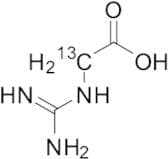
CAS :Formule :C3H7N3O2Degré de pureté :95%Couleur et forme :Solid, No data available.Masse moléculaire :117.108Guanidinoacetic-13C Acid
CAS :Produit contrôléFormule :CC2H7N3O2Couleur et forme :NeatMasse moléculaire :118.099Guanidinoacetic acid
CAS :Guanidinoacetic acid is a metabolite of creatine and is formed by reaction with the amino acid arginine. It is also synthesized from guanidinoacetate, which is derived from the oxidation of arginine. Guanidinoacetic acid can be found in human serum and eye disorders such as glaucoma. The analytical method for guanidinoacetic acid involves the conversion of guanidine to guanidinoacetic acid using nitrous acid, followed by gas chromatographic separation of the products. The concentration of guanidinoacetic acid in human serum has been shown to have an inverse relationship with body mass index (BMI). This means that people with a higher BMI have lower levels of guanidinoacetic acids in their blood than those who are thinner. Guanidinoacetate has also been shown to increase energy metabolism and inhibit glycolysis in humans.Formule :C3H7N3O2Degré de pureté :Min. 95%Masse moléculaire :117.11 g/mol


![2-{[amino(imino)methyl]amino}acetic acid](/_next/image/?url=https%3A%2Fstatic.cymitquimica.com%2Fproducts%2F54%2Fthumb%2FOR27969.jpg&w=3840&q=75)