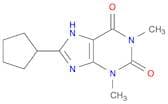
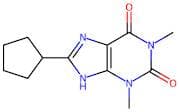
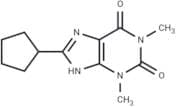
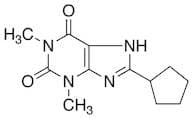
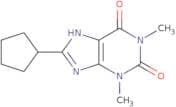
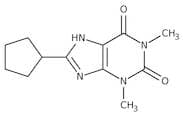
CAS 35873-49-5
:8-Cyclopentylthéophylline
- 1,3-Dimethyl-8-Cyclopentylxanthine
- 1H-purine-2,6-dione, 8-cyclopentyl-3,7-dihydro-1,3-dimethyl-
- 1H-purine-2,6-dione, 8-cyclopentyl-3,9-dihydro-1,3-dimethyl-
- 8-Cyclopentyl-1,3-dimethylxanthine
- 8-Cyclopentyl-3,9-dihydro-1,3-dimethyl-1H-purine-2,6-dione
- 8-Cyclopentyltheophylline
- 8-cyclopentyl-1,3-dimethyl-3,9-dihydro-1H-purine-2,6-dione
- NSC 101806
- Pd 116600
- 8-Cyclopentyl-1,3-dimethyl-3,7-dihydro-1H-purine-2,6-dione
8-Cyclopentyl-1,3-dimethylxanthine
CAS :Formule :C12H16N4O2Degré de pureté :98%Couleur et forme :SolidMasse moléculaire :248.28108-Cyclopentyl-1,3-dimethylxanthine
CAS :8-Cyclopentyl-1,3-dimethylxanthineDegré de pureté :≥95%Masse moléculaire :248.28g/mol8-Cyclopentyl-1,3-dimethylxanthine
CAS :8-Cyclopentyl-1,3-dimethylxanthine (CPT) is a potent antagonist of adenosine A1 receptor.Formule :C12H16N4O2Degré de pureté :98.58% - 99.9%Couleur et forme :SolidMasse moléculaire :248.288-Cyclopentyl-1,3-dimethylxanthine
CAS :Applications A selective A1 adenosine receptor antagonist. Binding activity in rat brain membranes: Ki = 10.9 nM (A1 receptor); Ki = 1440 nM (A2 receptor).
References Klaasse, E., et al.: Eur. J. Pharmacol., 499, 91 (2004), Romanelli, L., et al.: Neurotoxicol., 26, 829 (2005), Rezvani, M.E., et al.: Can. J. Physiol. Pharmacol., 85, 606 (2007),Formule :C12H16N4O2Couleur et forme :NeatMasse moléculaire :248.288-Cyclopentyl-1,3-dimethylxanthine
CAS :Produit contrôlé8-Cyclopentyl-1,3-dimethylxanthine (CPT) is a xanthine derivative that binds to the adenosine receptor and inhibits the phosphodiesterase enzyme. CPT is used in vivo as a model for measuring locomotor activity, dopamine receptors, adenosine receptors, and glutamate receptors. The binding of CPT to these receptors can lead to bronchoconstriction by stimulating the release of vasoactive substances from airway cells and increasing the sensitivity of airway cells to bronchoconstrictor stimuli. This drug also has been shown to inhibit calcium ion influx into cytosol and increase intracellular levels of cAMP.
Formule :C12H16N4O2Degré de pureté :Min. 95%Couleur et forme :PowderMasse moléculaire :248.28 g/mol8-Cyclopentyl-1,3-dimethylxanthine
CAS :A selective A1 adenosine receptor antagonist This Thermo Scientific Chemicals brand product was originally part of the Alfa Aesar product portfolio. Some documentation and label information may refer to the legacy brand. The original Alfa Aesar product / item code or SKU reference has not changed as a part of the brand transition to Thermo Scientific Chemicals.
Formule :C12H16N4O2Masse moléculaire :248.28