CAS 360-68-9
:Coprostanol
Description :
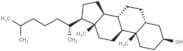
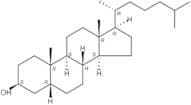
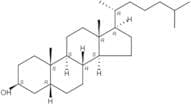
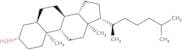
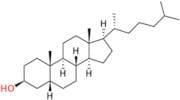
Coprostanol, avec le numéro CAS 360-68-9, est un stérol qui provient principalement de la réduction microbienne du cholestérol dans les intestins des mammifères. C'est un solide cristallin blanc à blanc cassé, insoluble dans l'eau mais soluble dans des solvants organiques tels que l'éthanol et le chloroforme. Coprostanol se caractérise par sa formule moléculaire, qui consiste en une structure stéroïdienne avec un groupe hydroxyle, contribuant à sa classification en tant que stérol. Ce composé est souvent utilisé comme biomarqueur dans les études environnementales, en particulier pour évaluer la contamination fécale dans les plans d'eau, car il est un composant significatif des déchets humains et animaux. De plus, Coprostanol a été étudié pour ses implications potentielles sur la santé humaine, en particulier en ce qui concerne le microbiote intestinal et le métabolisme du cholestérol. Sa présence dans divers échantillons biologiques et environnementaux en fait un composé important tant pour la recherche écologique que pour celle liée à la santé.
Formule :C27H48O
InChI :InChI=1/C27H48O/c1-18(2)7-6-8-19(3)23-11-12-24-22-10-9-20-17-21(28)13-15-26(20,4)25(22)14-16-27(23,24)5/h18-25,28H,6-17H2,1-5H3/t19-,20-,21-,22-,23-,24-,25-,26-,27+/m0/s1
Code InChI :InChIKey=QYIXCDOBOSTCEI-NWKZBHTNSA-N
SMILES :C[C@@]12[C@]([C@]3([C@@]([C@]4(C)[C@](CC3)(C[C@@H](O)CC4)[H])(CC1)[H])[H])(CC[C@@]2([C@@H](CCCC(C)C)C)[H])[H]
Synonymes :- (3Beta,5Beta)-Cholestan-3-Ol
- (3beta,5alpha,17alpha,20S)-cholestan-3-ol
- (3β,5β)-Cholestan-3-ol
- (5Beta)-Cholestan-3-One
- 3β-Hydroxy-5β-cholestanol
- 5-Beta-Cholestan-3-Beta-Ol
- 5-Β-Cholestan-3-Β-Ol
- 5-Β-Cholestane-3-Β-Ol
- 5-Β-Colestan-3-Β-Ol
- 5β-Cholestan-3β-ol
- 5β-Coprostanol
- Cholestan-3-Ol
- Cholestan-3-ol, (3β,5β)-
- Coprostan-3-ol
- Coprostan-3β-ol
- Coprosterol
- Koprosterin
- Koprosterol
- Nsc 18175
- Nsc 5060
- Stercorin
- Coprostanol
- 5BETA(H)-CHOLESTAN-3BETA-OL
- Zymostanol
- 5-beta-cholestan-3-beta-ol ??? 5beta 3beta???
- Coprostan-3-ol >=98%
- Cholestan-3-ol, (3beta,5beta)-
- 5beta-Coprostanol
- 3-beta-Hydroxycholestane
- 5-BETA-CHOLESTANE-3-BETA-OL
- Coprostanol analytical grade
- Coprostan-3-beta-ol
- 5-beta-Cholestan-3-Beta-Ol (Coprosterol)
- (3-beta,5-beta)-cholestan-3-o
- 3beta-Hydroxy-5beta-cholestanol
- 5beta-cholestanol
- Voir plus de synonymes
Trier par
Degré de pureté (%)
0
100
|
0
|
50
|
90
|
95
|
100
8 produits trouvés.
Coprosterol
CAS :Coprosterol is a stanol formed from the biohydrogenation of cholesterol as a biomarker for the presence of human faecal matter in the environment.Formule :C27H48OCouleur et forme :SolidMasse moléculaire :388.67Coprostanol
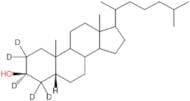
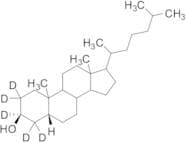
CAS :Formule :C27H48ODegré de pureté :>95%Couleur et forme :SolidMasse moléculaire :388.675β-Cholestan-3β-ol-2,2,3,4,4-d5
CAS :Degré de pureté :98 atom % DCouleur et forme :White To Off White SolidMasse moléculaire :393.715-β-Cholestan-3-β-Ol (Coprosterol)
CAS :Formule :C27H48ODegré de pureté :>95%Couleur et forme :SolidMasse moléculaire :388.67Coprostan-3-ol
CAS :Applications Coprostan-3-ol is a 27-carbon stanol resulted from biohydrogenation of cholesterol in the gut of most higher animals. It is a common biomarker for the presence of human faecal matter in the environment (1,2).This compound is a contaminant of emerging concern (CECs).
References (1) Bull, I. D., et al.: Environ Int. 27, 647 (2002) (2) Bethell, P. H., et al.: J. Archaeol. Sci 21, 619 (1994)Formule :C27H48OCouleur et forme :NeatMasse moléculaire :388.675b-Cholestan-3b-ol-2,2,3,4,4-d5
CAS :Produit contrôléFormule :C27D5H43OCouleur et forme :NeatMasse moléculaire :393.75-beta-Cholestan-3-Beta-Ol (Coprosterol)
CAS :Produit contrôléCoprosterol is a molecule that is an intermediate in the synthesis of cholesterol. It is found in human feces and can be isolated from soybean lipoxygenase. The hydroxy group on coprosterol has been shown to have an inhibitory effect on cancer cells, while its hydrophobic lipid tail allows it to cross the blood-brain barrier. Coprosterol has also been shown to be effective in treating cerebrotendinous xanthomatosis and familial hypercholesterolemia when given orally or intravenously. This molecule is used as a diagnostic tool for particle size analysis because it fluoresces under ultraviolet light when excited by a laser beam.Formule :C27H48ODegré de pureté :Min. 95%Couleur et forme :PowderMasse moléculaire :388.67 g/mol