CAS 363-11-1
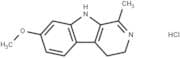
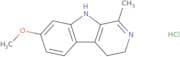
:Chlorhydrate d'harmaline
Description :
Chlorhydrate d'harmaline est un composé chimique dérivé de l'alcaloïde harmaline, que l'on trouve principalement dans les graines de la plante Peganum harmala, communément appelée rue syrienne. C'est une poudre cristalline blanche à blanc cassé qui est soluble dans l'eau et présente un goût amer. Le composé est connu pour ses propriétés psychoactives et est classé comme un inhibiteur réversible de la monoamine oxydase A (RIMA), qui peut influencer les niveaux de neurotransmetteurs dans le cerveau. Chlorhydrate d'harmaline a été étudié pour ses effets thérapeutiques potentiels, y compris son utilisation dans le traitement de certains troubles de l'humeur et son rôle dans les pratiques de médecine traditionnelle. De plus, il a suscité de l'intérêt dans le domaine des neurosciences pour ses effets sur la conscience et la perception. Cependant, il est important de noter que l'harmaline et ses dérivés peuvent également avoir des effets toxiques à des doses plus élevées, nécessitant une prudence dans leur utilisation. Comme pour de nombreuses substances psychoactives, des recherches supplémentaires sont nécessaires pour comprendre pleinement ses propriétés pharmacologiques et ses applications potentielles.
Formule :C13H14N2O·ClH
InChI :InChI=1S/C13H14N2O.ClH/c1-8-13-11(5-6-14-8)10-4-3-9(16-2)7-12(10)15-13;/h3-4,7,15H,5-6H2,1-2H3;1H
Code InChI :InChIKey=PULNGKOFHCQQQA-UHFFFAOYSA-N
SMILES :CC=1C2=C(C=3C(N2)=CC(OC)=CC3)CCN1.Cl
Synonymes :- 3H-Pyrido(3,4-b)indole, 4,9-dihydro-7-methoxy-1-methyl-, monohydrochloride
- 3H-Pyrido[3,4-b]indole, 4,9-dihydro-7-methoxy-1-methyl-, hydrochloride (1:1)
- 7-Methoxy-1-methyl-3H-pyrido(3,4-b)indole monohydrochloride
- 7-methoxy-1-methyl-3,4-dihydro-2H-beta-carboline hydrochloride
- 7-methoxy-1-methyl-4,9-dihydro-3H-beta-carbolin-9-ium chloride
- Harmaline hydrochloride (6CI)
- Harmidine HCl
- Harmidine hydrochloride
- Nsc 91546
- Harmaline hydrochloride
Trier par
Degré de pureté (%)
0
100
|
0
|
50
|
90
|
95
|
100
2 produits concernés.
Harmaline hydrochloride
CAS :Harmaline hydrochloride, a fluorescent indole from harmala alkaloids, causes tremors in rats by activating olivary neurons.Formule :C13H15ClN2ODegré de pureté :99.78%Couleur et forme :SolidMasse moléculaire :250.72Harmaline hydrochloride
CAS :Produit contrôléSanguinarine nitrate is a natural product that is extracted from plants of the genus Sanguinaria. It has been shown to have an inhibitory effect on prostate cancer cells, as well as to have a depressant effect on locomotor activity in rats. Harmaline hydrochloride, which belongs to the group of indole alkaloids, is used as a precursor for the synthesis of 5-hydroxytryptamine (5-HT). It also blocks dopamine receptors and damaged dopamine receptors in the brain. Harmaline HCl has been shown to inhibit cation channels, including voltage gated potassium channels and chloride channels. In addition, it has been reported to have beneficial effects on cardiac function and histological analysis in animals. The chemical structure of harmaline HCl is similar to that of chlorogenic acids found in plant material.Formule :C13H14N2O•HClDegré de pureté :Min. 95%Masse moléculaire :250.72 g/mol