CAS 3687-18-1
:Acide 3-aminopropanesulfonique
Description :
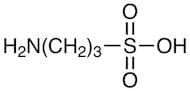
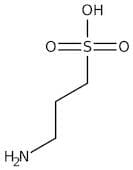
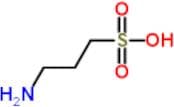
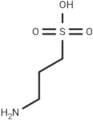
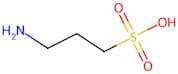
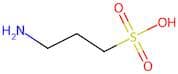
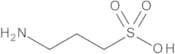
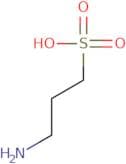
Acide 3-aminopropanesulfonique, communément connu sous le nom d'APSA, est un composé organique caractérisé par la présence d'un groupe amino et d'un groupe acide sulfonique. Sa structure moléculaire consiste en une chaîne de trois carbones avec un groupe amino (-NH2) attaché au premier carbone et un groupe acide sulfonique (-SO3H) attaché au troisième carbone. Ce composé est un solide cristallin incolore qui est hautement soluble dans l'eau, ce qui le rend utile dans diverses applications biochimiques. L'APSA est souvent utilisé comme agent tampon dans la recherche biologique et biochimique en raison de sa capacité à maintenir des niveaux de pH stables dans les solutions. Il est également reconnu pour son rôle dans la culture cellulaire et comme alternative potentielle à d'autres agents tampon comme le Tris. La présence des deux groupes fonctionnels, amino et acide sulfonique, contribue à ses propriétés uniques, y compris sa nature zwitterionique, qui peut influencer ses interactions dans les systèmes biologiques. Dans l'ensemble, Acide 3-aminopropanesulfonique est apprécié pour sa polyvalence et son efficacité dans les environnements de laboratoire.
Formule :C3H9NO3S
InChI :InChI=1S/C3H9NO3S/c4-2-1-3-8(5,6)7/h1-4H2,(H,5,6,7)
Code InChI :InChIKey=SNKZJIOFVMKAOJ-UHFFFAOYSA-N
SMILES :C(S(=O)(=O)O)CCN
Synonymes :- 1-Propanesulfonic acid, 3-amino-
- 3 Aps
- 3-Amino-1-propanesulfonate
- 3-Aminopropane-1-Sulphonic Acid
- 3-Aminopropanesulfonic acid
- 3-Aminopropiosulfonic acid
- 3-Azaniumylpropane-1-sulfonate
- 3-Sulfopropylamine
- Alzhemed
- Homotaurine
- NSC 77071
- Nc 758
- Tramiprosate
- γ-Aminopropylsulfonic acid
- Voir plus de synonymes
Trier par
Degré de pureté (%)
0
100
|
0
|
50
|
90
|
95
|
100
14 produits concernés.
3-Amino-1-propanesulfonic Acid
CAS :Formule :C3H9NO3SDegré de pureté :>98.0%(T)Couleur et forme :White to Almost white powder to crystalMasse moléculaire :139.173-Aminopropane-1-sulfonic acid, 97%
CAS :This Thermo Scientific Chemicals brand product was originally part of the Alfa Aesar product portfolio. Some documentation and label information may refer to the legacy brand. The original Alfa Aesar product / item code or SKU reference has not changed as a part of the brand transition to Thermo Sci
Formule :C3H9NO3SDegré de pureté :97%Masse moléculaire :139.17ACAMPROSATE IMPURITY A CRS
CAS :ACAMPROSATE IMPURITY A CRSFormule :C3H9NO3SCouleur et forme :Powder.Masse moléculaire :139.1735Acamprosate Related Compound A (3-aminopropane-1-sulfonic acid)
CAS :Acyclic monoamines and their derivatives, nesoiFormule :C3H9NO3SCouleur et forme :PowderMasse moléculaire :139.030313-Amino-1-propanesulfonic acid
CAS :Formule :C3H9NO3SDegré de pureté :95%Couleur et forme :SolidMasse moléculaire :139.1735Tramiprosate
CAS :Tramiprosate (Alzhemed) is an orally active, BBB-crossing, naturally occurring amino acid that binds soluble Aβ and maintains it in a non-protofibrillar form.Formule :C3H9NO3SDegré de pureté :99%Couleur et forme :White Crystals Or Crystalline PowerMasse moléculaire :139.173-Amino-1-Propanesulfonic Acid
CAS :3-Amino-1-Propanesulfonic AcidDegré de pureté :99%Masse moléculaire :139.17g/molAcamprosate EP Impurity A
CAS :Produit contrôléFormule :C3H9NO3SCouleur et forme :NeatMasse moléculaire :139.17Homotaurine (Tramiprosate, Acamprosate EP Impurity A)
CAS :Formule :C3H9NO3SMasse moléculaire :139.17Homotaurine
CAS :Applications Important gaba mimetic agent. It evokes neurological responses similar to those elicited by g-aminobutyric acid.
References Riv. Farmacol. Ter., 7, 155 (1976), Neuropharmacology, 17, 13 (1978), Br. J. Pharmacol., 59 373 (1977)Formule :C3H9NO3SCouleur et forme :NeatMasse moléculaire :139.173-aminopropane-1-sulfonic acid
CAS :Formule :C3H9NO3SDegré de pureté :95%Couleur et forme :SolidMasse moléculaire :139.17Homotaurine
CAS :Homotaurine is a secretase inhibitor that has been shown to have anti-Alzheimer's disease effects in vivo. It has been shown to increase serum prolactin levels and improve locomotor activity in mice. Homotaurine also has the ability to inhibit the production of glutamate, an excitatory neurotransmitter, through its inhibition of N-acetyl-L-aspartate (NAA) synthesis. This drug is also an oral prodrug, which can be activated by hydrolysis in the gastrointestinal tract to release homotaurine. The reaction mechanism for this compound is not yet clear but it may involve natural compounds such as choline or acetylcholine.Formule :C3H9NO3SDegré de pureté :(Titration) Min 96%Couleur et forme :White PowderMasse moléculaire :139.17 g/mol