

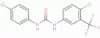
CAS 369-77-7
:halocarbure
Description :
La substance chimique connue sous le nom de halocarbure, avec le numéro CAS 369-77-7, est un type de composé organohalogéné. Elle contient généralement des atomes de carbone liés à des atomes d'halogène, tels que le chlore, le brome ou le fluor. Les halocarbures se caractérisent par leurs diverses propriétés chimiques, qui peuvent varier considérablement en fonction de l'halogène spécifique et de la structure carbonée présente. Ils sont souvent utilisés dans diverses applications industrielles, notamment comme solvants, réfrigérants et dans la production de produits pharmaceutiques. Les halocarbures peuvent présenter différents degrés de stabilité, de volatilité et de réactivité, en fonction de leur structure moléculaire. Certains halocarbures sont connus pour leur impact environnemental, en particulier ceux qui contribuent à la dégradation de la couche d'ozone ou ont un fort potentiel de réchauffement climatique. Les considérations de sécurité sont cruciales lors de la manipulation des halocarbures, car ils peuvent être toxiques ou nuisibles pour la santé humaine et l'environnement. Des méthodes de stockage et d'élimination appropriées sont essentielles pour atténuer les risques associés à ces composés.
Formule :C14H9Cl2F3N2O
InChI :InChI=1/C14H9Cl2F3N2O/c15-8-1-3-9(4-2-8)20-13(22)21-10-5-6-12(16)11(7-10)14(17,18)19/h1-7H,(H2,20,21,22)
Code InChI :InChIKey=ZFSXZJXLKAJIGS-UHFFFAOYSA-N
SMILES :N(C(NC1=CC=C(Cl)C=C1)=O)C2=CC(C(F)(F)F)=C(Cl)C=C2
Synonymes :- 1-(4-Chlorophenyl)-3-[4-Chloro-3-(Trifluoromethyl)Phenyl]Urea
- 3-(Trifluoromethyl)-4,4′-dichlorocarbanilide
- 3-Trifluoromethyl-4,4′-dichloro-N,N′-diphenylurea
- 4,4'-Dichlro-3-(trifluoromethyl)carbanilide
- 4,4′-Dichloro-3-(trifluoromethyl)carbanilide
- 44Dichloro3Trifluoromethylcarbanilide
- Carbanilide, 4,4′-dichloro-3-(trifluoromethyl)-
- Cloflucarban
- Clofucarban
- Irgasan CF<sub>3</sub>
- Irgosan CF3
- N-(4-Chlorophenyl)-N'-[4-Chloro-3-(Trifluoromethyl)Phenyl]-Ure
- N-(4-Chlorophenyl)-N-[4-chloro-3-(triflu-romethyl)phenyl]-ures
- N-(4-Chlorophenyl)-N′-[4-chloro-3-(trifluoromethyl)phenyl]urea
- NSC 114133
- Tfc-
- Trifluoromethyl44Dichlorocarbanilide
- Trifluoromethyldichlorocarbanilide
- Urea, N-(4-chlorophenyl)-N′-[4-chloro-3-(trifluoromethyl)phenyl]-
- Halocarban
- Halocarbon
- N-(3-Trifluoromethyl-4-chlorophenyl)-N'-(4-chlorophenyl)urea
- Voir plus de synonymes
Trier par
Degré de pureté (%)
0
100
|
0
|
50
|
90
|
95
|
100
5 produits concernés.
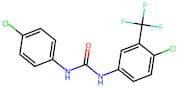
1-(4-Chlorophenyl)-3-[4-chloro-3-(trifluoromethyl)phenyl]urea, 97%
CAS :This Thermo Scientific Chemicals brand product was originally part of the Alfa Aesar product portfolio. Some documentation and label information may refer to the legacy brand. The original Alfa Aesar product / item code or SKU reference has not changed as a part of the brand transition to Thermo SciFormule :C14H9Cl2F3N2ODegré de pureté :97%Masse moléculaire :349.13Halocarban
CAS :Cloflucarban can be used as a disinfectant agent.Formule :C14H9Cl2F3N2OCouleur et forme :SolidMasse moléculaire :349.143-[4-Chloro-3-(trifluoromethyl)phenyl]-1-(4-chlorophenyl)urea
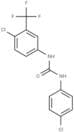
CAS :3-[4-Chloro-3-(trifluoromethyl)phenyl]-1-(4-chlorophenyl)urea is a compound that has been shown to be an antimicrobial agent. It is used in wastewater treatment, where it has been shown to be effective against enterocolitica. 3-[4-Chloro-3-(trifluoromethyl)phenyl]-1-(4-chlorophenyl)urea is also active against other Gram positive and Gram negative bacteria, including methicillin resistant Staphylococcus aureus (MRSA). The mechanism of action is not well understood, but it may work by inhibiting the production of enzymes or by interfering with protein synthesis. This compound can kill bacteria without harming human cells and is biocompatible with living tissue.Formule :C14H9Cl2F3N2ODegré de pureté :Min. 95%Masse moléculaire :349.1 g/mol
![1-(4-Chlorophenyl)-3-[4-chloro-3-(trifluoromethyl)phenyl]urea, 97%](/_next/image/?url=https%3A%2Fstatic.cymitquimica.com%2Fproducts%2F02%2Fthumb%2FH65397.jpg&w=3840&q=75)




![3-[4-Chloro-3-(trifluoromethyl)phenyl]-1-(4-chlorophenyl)urea](/_next/image/?url=https%3A%2Fstatic.cymitquimica.com%2Fproducts%2F3D%2Fthumb%2FAAA36977.jpg&w=3840&q=75)
