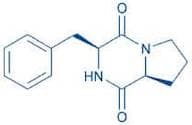
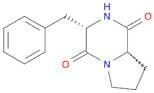
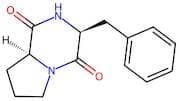
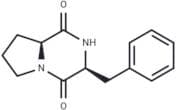
CAS 3705-26-8
:Cyclo(L-Phénylalanine-L-Proline)
Description :
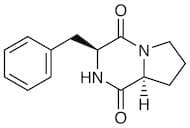
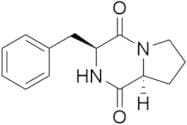
Cyclo(L-Phénylalanine-L-Proline), également connu sous le nom de cyclo(L-phénylalanine-L-proline), est un dipeptide cyclique composé des acides aminés phénylalanine et proline. Ce composé présente une structure cyclique qui améliore sa stabilité par rapport aux peptides linéaires. La présence du résidu de phénylalanine contribue à ses caractéristiques hydrophobes, tandis que le résidu de proline introduit une rigidité unique en raison de sa structure cyclique, ce qui peut influencer la conformation du peptide. Cyclo(L-Phénylalanine-L-Proline) est connu pour ses activités biologiques potentielles, y compris des propriétés antimicrobiennes et antioxydantes, ce qui le rend intéressant dans la recherche pharmaceutique et biochimique. Sa nature cyclique peut également affecter son interaction avec des récepteurs biologiques et des enzymes, pouvant conduire à des effets pharmacologiques uniques. De plus, la solubilité et la stabilité du composé peuvent varier en fonction du pH et des conditions du solvant, ce qui est crucial pour ses applications dans la formulation et les systèmes de délivrance de médicaments. Dans l'ensemble, Cyclo(L-Phénylalanine-L-Proline) représente un domaine fascinant d'étude en chimie des peptides et dans ses applications en chimie médicinale.
Formule :C14H16N2O2
InChI :InChI=1S/C14H16N2O2/c17-13-12-7-4-8-16(12)14(18)11(15-13)9-10-5-2-1-3-6-10/h1-3,5-6,11-12H,4,7-9H2,(H,15,17)/t11-,12-/m0/s1
Code InChI :InChIKey=QZBUWPVZSXDWSB-RYUDHWBXSA-N
SMILES :O=C1N2[C@](C(=O)N[C@H]1CC3=CC=CC=C3)(CCC2)[H]
Synonymes :- (3S,8aS)-3-benzylhexahydropyrrolo[1,2-a]pyrazine-1,4-dione
- (3S,8aS)-Hexahydro-3-(phenylmethyl)pyrrolo[1,2-a]pyrazine-1,4-dione
- 3-Benzylhexahydropyrrolo[1,2-A]Pyrazine-1,4-Dione
- <span class="text-smallcaps">L</smallcap>-Phenylalanyl-<smallcap>L</span>-proline lactam
- <span class="text-smallcaps">L</smallcap>-Prolyl-<smallcap>L</span>-phenylalanine diketopiperazine
- Cyclo(-Phe-Pro)
- Cyclo(<span class="text-smallcaps">L</smallcap>-Phe-<smallcap>L</span>-Pro)
- Cyclo(<span class="text-smallcaps">L</smallcap>-Pro-<smallcap>L</span>-Phe)
- Cyclo(<span class="text-smallcaps">L</smallcap>-phenylalanyl-<smallcap>L</span>-prolyl-)
- Cyclo(<span class="text-smallcaps">L</smallcap>-prolyl-<smallcap>L</span>-phenylalanyl)
- Maculosin 2
- Maculosine 2
- Pyrrolo[1,2-a]pyrazine-1,4-dione, 3-benzylhexahydro-, (3S,8aS)-
- Pyrrolo[1,2-a]pyrazine-1,4-dione, hexahydro-3-(phenylmethyl)-, (3S,8aS)-
- Pyrrolo[1,2-a]pyrazine-1,4-dione, hexahydro-3-(phenylmethyl)-, (3S-trans)-
- Smfei 02
- (3S-trans)-3-Benzylhexahydropyrrolo(1,2-a)pyrazine-1,4-dione
- Voir plus de synonymes
Trier par
Degré de pureté (%)
0
100
|
0
|
50
|
90
|
95
|
100
10 produits concernés.
Cyclo(-Phe-Pro)
CAS :Cain et al. obtained an array of small molecule peptide mimetics targeting the melanocortin receptors from this diketopiperazine. Brauns et al. demonstrated that cyclo(Phe-Pro) inhibits the growth of HT-29, MCF-7 and HeLa cells and induces apoptosis in HT-29 colon cancer cells.Formule :C14H16N2O2Degré de pureté :99.9%Couleur et forme :White PowderMasse moléculaire :244.29Cyclo(-Phe-Pro)
CAS :Formule :C14H16N2O2Degré de pureté :%Couleur et forme :SolidMasse moléculaire :244.2890Cyclo(L-Phe-L-Pro)
CAS :Cyclo(L-Phe-L-Pro) shows broad-spectrum antibacterial and antifungal activities.Formule :C14H16N2O2Degré de pureté :97.08%Couleur et forme :SolidMasse moléculaire :244.29Cyclo(-Phe-Pro)
CAS :Formule :C14H16N2O2Degré de pureté :>95.0%(HPLC)Couleur et forme :White to Light yellow powder to crystalMasse moléculaire :244.29Cyclo(L-prolyl-L-phenylalanyl)
CAS :Applications Cyclo(L-prolyl-L-phenylalanyl) is a diketopiperazine derivative isolated from Bacillus thuringiensis and Bacillus endophyticus.
References Sansinenea, E., et al.: Tetrahedron Lett., 57, 2604 (2016)Formule :C14H16N2O2Couleur et forme :NeatMasse moléculaire :244.29Cyclo(-Phe-Pro)
CAS :Cyclo-Phe-Pro is an intermolecular hydrogen bond that has been shown to inhibit the growth of viruses. Cyclo-Phe-Pro binds to the hydrophobic region on viral capsid proteins and inhibits their uptake into cells, which may be due to its ability to form hydrogen bonds with the amino acid serine in these proteins. It also has antimicrobial activity against a number of bacterial species and can be used as a pre-preparation for high performance liquid chromatography (HPLC).
Formule :C14H16N2O2Degré de pureté :Min. 95%Couleur et forme :PowderMasse moléculaire :244.29 g/mol