CAS 37074-90-1
:b-D-Glucopyranose,6-O-(triphenylméthyl)-, 1,2,3,4-tétracétate
Description :
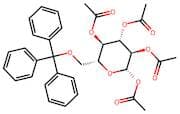
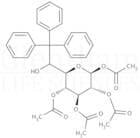
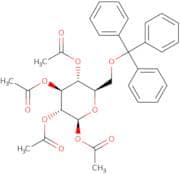
β-D-Glucopyranose, 6-O-(triphénylméthyle)-, 1,2,3,4-tetraacétate est un dérivé du glucose, spécifiquement modifié en position 6 avec un groupe triphénylméthyle (trityl) et acétylé aux groupes hydroxyles des positions 1, 2, 3 et 4. Ce composé se caractérise par sa structure complexe, qui améliore sa stabilité et sa solubilité dans les solvants organiques. La présence du groupe trityl fournit une protection stérique, ce qui le rend utile en synthèse organique et en chimie des glucides. La forme tétraacétate indique que les quatre groupes hydroxyles de la molécule de glucose sont acétylés, ce qui peut influencer la réactivité du composé et ses interactions avec d'autres molécules. Cette modification entraîne généralement une lipophilie accrue et une activité biologique altérée par rapport au sucre parent. Le composé est souvent utilisé dans des voies synthétiques pour la préparation de glucides plus complexes ou comme groupe protecteur dans les réactions de glycosylation. Son numéro CAS, 37074-90-1, permet une identification et une référence faciles dans les bases de données chimiques.
Formule :C33H34O10
Synonymes :- b-D-Glucopyranose,6-O-(triphenylmethyl)-, tetraacetate (9CI)
- 1,2,3,4-Tetra-O-acetyl-6-O-triphenylmethyl-b-D-glucopyranose
- Nsc 404268
Trier par
Degré de pureté (%)
0
100
|
0
|
50
|
90
|
95
|
100
3 produits concernés.
1,2,3,4-Tetra-O-acetyl-6-O-trityl-β-D-glucopyranose
CAS :1,2,3,4-Tetra-O-acetyl-6-O-trityl-β-D-glucopyranoseDegré de pureté :>98%Masse moléculaire :590.62g/mol1,2,3,4-Tetra-O-acetyl-6-O-triphenylmethyl-b-D-glucopyranose
CAS :1,2,3,4-Tetra-O-acetyl-6-O-triphenylmethyl-b-D-glucopyranose (TATPG) is a carbohydrate that belongs to the family of saccharides. It is a synthetic sugar with a modified glycosidic linkage between the hexoses 1 and 2. The preparation of TATPG is through the modification of sugar with fluorination and glycosylation. TATPG has been used in Click chemistry to attach polymers and proteins to oligosaccharides or monosaccharides. This modification can be achieved through methylation or substitution reactions with other chemical groups such as acetate, phosphates, and thiols. This molecule has also been used in the synthesis of complex carbohydrates by modifying the glucose unit with glucose oxidase, which leads to the formation of D-arabinitol 1,5-.Formule :C33H34O10Degré de pureté :Min. 95%Couleur et forme :PowderMasse moléculaire :590.62 g/mol