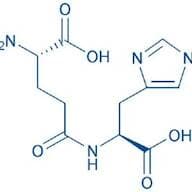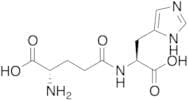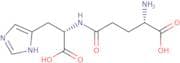
CAS 37460-15-4
:γ-Glutamylhistidine
- <span class="text-smallcaps">L</smallcap>-Histidine, <smallcap>L</span>-γ-glutamyl-
- <span class="text-smallcaps">L</smallcap>-Histidine, N-<smallcap>L</span>-γ-glutamyl-
- <span class="text-smallcaps">L</smallcap>-γ-Glutamyl-<smallcap>L</span>-histidine
- H-.gamma.-Glu-His-OH
- γ-Glu-His
- γ-Glutamyl-<span class="text-smallcaps">L</span>-histidine
- γ-Glutamylhistidine
- γ-Glutamyl-L-histidine
- L-γ-Glutamyl-L-histidine
- L-Histidine, N-L-γ-glutamyl-
- L-Histidine, L-γ-glutamyl-
H-Glu(His-OH)-OH
CAS :Bachem ID: 4014368.
Formule :C11H16N4O5Couleur et forme :White PowderMasse moléculaire :284.27H-γ-Glu-His-Oh
CAS :Produit contrôléFormule :C11H16N4O5Couleur et forme :NeatMasse moléculaire :284.269H-Glu(His-OH)-OH
CAS :H-Glu(His-OH)-OH is a protein, which can be found in the plasma samples of patients with fatty acid metabolism disorders. It is one of the most selective markers for identifying these disorders and has been extensively used for profiling and genomic analyses. H-Glu(His-OH)-OH is also present in rat cerebral cortex and it has been shown to be statistically significantly elevated in cerebral cortex samples from patients with Alzheimer's disease. This protein has been observed to have an acidic property and can be used as a biomimetic marker. Regression analysis has shown that H-Glu(His-OH)-OH levels are correlated with the severity of neuronal damage. This protein may serve as a biomarker for different diseases, including Parkinson's disease, Huntington's disease, or amyotrophic lateral sclerosis (ALS).
Formule :C11H16N4O5Degré de pureté :Min. 95%Masse moléculaire :284.27 g/mol