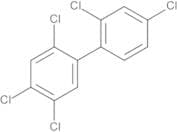
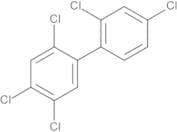
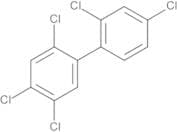
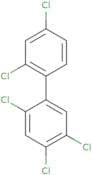
CAS 38380-01-7
:PCB 99
Description :
PCB 99, ou biphényle polychloré 99, est un membre de la famille des biphényles polychlorés (PCB), qui se compose de produits chimiques organiques synthétiques connus pour leur persistance dans l'environnement et leur toxicité potentielle. Caractérisé par une structure de biphényle avec plusieurs atomes de chlore, PCB 99 contient généralement un agencement spécifique de substitutions de chlore qui influencent ses propriétés chimiques et son comportement dans l'environnement. C'est un solide incolore à jaune clair à température ambiante et est insoluble dans l'eau mais soluble dans des solvants organiques. PCB 99 est connu pour sa stabilité, ce qui le rend résistant à la dégradation, contribuant ainsi à sa bioaccumulation dans la chaîne alimentaire. En raison de ses risques potentiels pour la santé, y compris la perturbation endocrinienne et les effets cancérigènes, PCB 99 est soumis à des réglementations strictes et à un suivi. Son utilisation a été largement éliminée dans de nombreux pays, mais reste une préoccupation dans les sites contaminés et nécessite une gestion prudente pour atténuer les impacts environnementaux et sur la santé.
Formule :C12H5Cl5
InChI :InChI=1S/C12H5Cl5/c13-6-1-2-7(9(14)3-6)8-4-11(16)12(17)5-10(8)15/h1-5H
Code InChI :InChIKey=LMQJBFRGXHMNOX-UHFFFAOYSA-N
SMILES :ClC1=C(C=C(Cl)C(Cl)=C1)C2=C(Cl)C=C(Cl)C=C2
Synonymes :- 1,1'-Biphenyl, 2,2',4,4',5-Pentachloro-
- 1,1′-Biphenyl, 2,2′,4,4′,5-pentachloro-
- 2,2',4,4',5-Pcb
- 2,2',4,4',5-Pentachloro-1,1'-biphenyl
- 2,2′,4,4′,5-Pentachloro-1,1′-biphenyl
- 2,2′,4,4′,5-Pentachlorobiphenyl
- 2,4,2',4',5'-Pentachlorobiphenyl
- 2,4,2′,4′,5′-Pentachlorobiphenyl
- 2,4,5,2',4'-Pentachlorobiphenyl
- 2,4,5,2′,4′-Pentachlorobiphenyl
- 38380-01-7
- Cb 99
- Pcb 99
- Voir plus de synonymes
Trier par
Degré de pureté (%)
0
100
|
0
|
50
|
90
|
95
|
100
8 produits concernés.
PCB Congener Mixture 465 100 µg/mL in Isooctane
CAS :Produit contrôlé- 31508-00-6
- 32598-14-4
- 32690-93-0
- 35065-27-1
- 35065-28-2
- 35065-29-3
- 35065-30-6
- 35693-99-3
- 37680-65-2
- 37680-73-2
- 38379-99-6
- 38380-01-7
- 38380-03-9
- 38380-04-0
- 38380-08-4
- 52663-68-0
- 7012-37-5
Formule :C12H4Cl6Couleur et forme :MixtureMasse moléculaire :360.88PCB-Mix 37 10 µg/mL in Isooctane
CAS :Produit contrôlé- 31508-00-6
- 32598-14-4
- 35065-27-1
- 35065-28-2
- 35065-29-3
- 35065-30-6
- 35693-99-3
- 37680-73-2
- 38379-99-6
- 38380-01-7
- 38380-03-9
- 38380-04-0
- 51908-16-8
- 52663-63-5
- 52663-68-0
- 52663-69-1
- 52663-70-4
- 7012-37-5
Formule :C12H4Cl6Couleur et forme :MixtureMasse moléculaire :360.88PCB Mixture for Food & Human Tissue Analysis 297 10 µg/mL in Isooctane
CAS :Produit contrôlé- 15862-07-4
- 31508-00-6
- 32598-10-0
- 32598-11-1
- 32598-13-3
- 32598-14-4
- 32690-93-0
- 32774-16-6
- 33025-41-1
- 34883-43-7
- 35065-27-1
- 35065-28-2
- 35065-29-3
- 35065-30-6
- 35693-99-3
- 37680-73-2
- 38379-99-6
- 38380-01-7
- 38380-02-8
- 38380-03-9
- 38380-04-0
- 38380-07-3
- 38380-08-4
- 38444-90-5
- 39635-31-9
- 41411-63-6
- 41464-39-5
- 41464-40-8
- 51908-16-8
- 52663-62-4
- 52663-63-5
- 52663-64-6
- 52663-68-0
- 52663-69-1
- 52663-70-4
- 57465-28-8
- 7012-37-5
- 70362-50-4
- 74472-37-0
- 74472-42-7
Couleur et forme :MixtureWHO/Europe ISS PCB Mixture 319 10 µg/mL in Isooctane
CAS :Produit contrôlé- 16606-02-3
- 31508-00-6
- 32598-13-3
- 32598-14-4
- 32774-16-6
- 35065-27-1
- 35065-28-2
- 35065-29-3
- 35065-30-6
- 35693-99-3
- 37680-65-2
- 37680-73-2
- 38379-99-6
- 38380-01-7
- 38380-03-9
- 38380-04-0
- 38380-07-3
- 38380-08-4
- 39635-31-9
- 41464-39-5
- 51908-16-8
- 52663-63-5
- 52663-68-0
- 52663-69-1
- 52663-70-4
- 52663-72-6
- 57465-28-8
- 65510-44-3
- 69782-90-7
- 7012-37-5
- 70362-50-4
- 74472-37-0
Couleur et forme :MixturePCB No. 99 10 µg/mL in Isooctane
CAS :Produit contrôléFormule :C12H5Cl5Couleur et forme :Single SolutionMasse moléculaire :326.432,2',4,4',5-Pentachlorobiphenyl
CAS :Produit contrôléFormule :C12H5Cl5Couleur et forme :NeatMasse moléculaire :326.432,2',4,4',5-Pentachlorobiphenyl
CAS :Produit contrôlé2,2',4,4',5-Pentachlorobiphenyl is a lipophilic compound that is classified as a polychlorinated biphenyl. 2,2',4,4',5-Pentachlorobiphenyl is metabolized by cytochrome P450 enzymes and can inhibit mitochondrial ATP synthesis. In rats exposed to the compound, this inhibition was shown to lead to increased levels of reactive oxygen species and lipid peroxidation. This exposure also resulted in increased expression of the constitutive androstane receptor and decreased expression of cytochrome P450 1A1 (CYP1A1). These effects were observed in both male and female rats. The effects of 2,2',4,4',5-pentachlorobiphenyl on health are not fully known at this time.
Formule :C12H5Cl5Degré de pureté :Min. 95%Masse moléculaire :326.43 g/mol