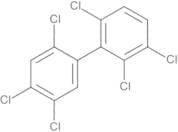
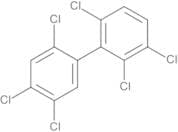
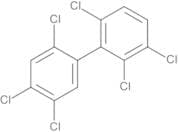
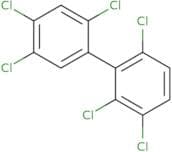
CAS 38380-04-0
:PCB 149
Description :
PCB 149, ou biphényle polychloré 149, est un membre de la famille des biphényles polychlorés (PCB), qui se compose de produits chimiques organiques synthétiques connus pour leur persistance dans l'environnement et leur toxicité potentielle. PCB 149 se caractérise par sa structure de biphényle chloré, contenant plusieurs atomes de chlore attachés à des cycles de biphényle, ce qui influence ses propriétés physiques et chimiques. Il s'agit généralement d'un liquide ou d'un solide visqueux et huileux, selon la température, et il est insoluble dans l'eau mais soluble dans des solvants organiques. Les PCB, y compris PCB 149, sont connus pour leur stabilité, leur résistance à la dégradation et leur capacité à bioaccumuler dans l'environnement et les organismes vivants. En raison de leurs risques potentiels pour la santé, y compris des effets cancérigènes et une perturbation endocrinienne, les PCB ont été interdits ou fortement réglementés dans de nombreux pays. PCB 149 a été spécifiquement étudié pour son impact environnemental et sa toxicité, contribuant à la recherche en cours sur la réhabilitation des sites contaminés et les effets des PCB sur la santé humaine et les écosystèmes.
Formule :C12H4Cl6
InChI :InChI=1S/C12H4Cl6/c13-6-1-2-7(14)12(18)11(6)5-3-9(16)10(17)4-8(5)15/h1-4H
Code InChI :InChIKey=LKHLFUVHHXCNJH-UHFFFAOYSA-N
SMILES :ClC1=C(C=C(Cl)C(Cl)=C1)C2=C(Cl)C(Cl)=CC=C2Cl
Synonymes :- (.+-.)-Pcb 149
- 1,1'-Biphenyl, 2,2',3,4',5',6-Hexachloro-
- 1,1′-Biphenyl, 2,2′,3,4′,5′,6-hexachloro-
- 2,2',3',4,5,6'-Hexachlorobiphenyl
- 2,2',3,4',5',6-Pcb
- 2,2',4',5,5',6-Hexachlorobiphenyl
- 2,2′,3,4′,5′,6-Hexachloro-1,1′-biphenyl
- 2,2′,3,4′,5′,6-Hexachlorobiphenyl
- 2,2′,4′,5,5′,6-Hexachlorobiphenyl
- 2,3,6,2',4',5'-Hexachlorobiphenyl
- 2,3,6,2′,4′,5′-Hexachlorobiphenyl
- 2,4,5,2',3',6'-Hexachlorobiphenyl
- 2,4,5,2′,3′,6′-Hexachlorobiphenyl
- 38380-04-0
- Cb 149
- Voir plus de synonymes
Trier par
Degré de pureté (%)
0
100
|
0
|
50
|
90
|
95
|
100
12 produits concernés.
PCB No. 149 10 µg/mL in Isooctane
CAS :Produit contrôléFormule :C12H4Cl6Couleur et forme :Single SolutionMasse moléculaire :360.88PCB-Mix 37 10 µg/mL in Isooctane
CAS :Produit contrôlé- 31508-00-6
- 32598-14-4
- 35065-27-1
- 35065-28-2
- 35065-29-3
- 35065-30-6
- 35693-99-3
- 37680-73-2
- 38379-99-6
- 38380-01-7
- 38380-03-9
- 38380-04-0
- 51908-16-8
- 52663-63-5
- 52663-68-0
- 52663-69-1
- 52663-70-4
- 7012-37-5
Formule :C12H4Cl6Couleur et forme :MixtureMasse moléculaire :360.88PCB Congener Mixture 465 100 µg/mL in Isooctane
CAS :Produit contrôlé- 31508-00-6
- 32598-14-4
- 32690-93-0
- 35065-27-1
- 35065-28-2
- 35065-29-3
- 35065-30-6
- 35693-99-3
- 37680-65-2
- 37680-73-2
- 38379-99-6
- 38380-01-7
- 38380-03-9
- 38380-04-0
- 38380-08-4
- 52663-68-0
- 7012-37-5
Formule :C12H4Cl6Couleur et forme :MixtureMasse moléculaire :360.88PCB-Mix 19 10 µg/mL in Isooctane
CAS :Produit contrôlé- 16606-02-3
- 2051-24-3
- 31508-00-6
- 35065-27-1
- 35065-28-2
- 35065-29-3
- 35065-30-6
- 35693-99-3
- 35694-08-7
- 37680-65-2
- 37680-73-2
- 38380-04-0
- 41464-39-5
- 7012-37-5
Formule :C12H4Cl6Couleur et forme :MixtureMasse moléculaire :360.88PCB-Mix 19 10 µg/mL in Isooctane
CAS :Produit contrôlé- 16606-02-3
- 2051-24-3
- 31508-00-6
- 35065-27-1
- 35065-28-2
- 35065-29-3
- 35065-30-6
- 35693-99-3
- 35694-08-7
- 37680-65-2
- 37680-73-2
- 38380-04-0
- 41464-39-5
- 7012-37-5
Formule :C12H4Cl6Couleur et forme :MixtureMasse moléculaire :360.88PCB Mixture for Food & Human Tissue Analysis 297 10 µg/mL in Isooctane
CAS :Produit contrôlé- 15862-07-4
- 31508-00-6
- 32598-10-0
- 32598-11-1
- 32598-13-3
- 32598-14-4
- 32690-93-0
- 32774-16-6
- 33025-41-1
- 34883-43-7
- 35065-27-1
- 35065-28-2
- 35065-29-3
- 35065-30-6
- 35693-99-3
- 37680-73-2
- 38379-99-6
- 38380-01-7
- 38380-02-8
- 38380-03-9
- 38380-04-0
- 38380-07-3
- 38380-08-4
- 38444-90-5
- 39635-31-9
- 41411-63-6
- 41464-39-5
- 41464-40-8
- 51908-16-8
- 52663-62-4
- 52663-63-5
- 52663-64-6
- 52663-68-0
- 52663-69-1
- 52663-70-4
- 57465-28-8
- 7012-37-5
- 70362-50-4
- 74472-37-0
- 74472-42-7
Couleur et forme :MixtureWHO/Europe ISS PCB Mixture 319 10 µg/mL in Isooctane
CAS :Produit contrôlé- 16606-02-3
- 31508-00-6
- 32598-13-3
- 32598-14-4
- 32774-16-6
- 35065-27-1
- 35065-28-2
- 35065-29-3
- 35065-30-6
- 35693-99-3
- 37680-65-2
- 37680-73-2
- 38379-99-6
- 38380-01-7
- 38380-03-9
- 38380-04-0
- 38380-07-3
- 38380-08-4
- 39635-31-9
- 41464-39-5
- 51908-16-8
- 52663-63-5
- 52663-68-0
- 52663-69-1
- 52663-70-4
- 52663-72-6
- 57465-28-8
- 65510-44-3
- 69782-90-7
- 7012-37-5
- 70362-50-4
- 74472-37-0
Couleur et forme :MixtureEN 12766/CEN EN 61619 PCB Calibration Mixture 10 µg/mL in Isooctane
CAS :Produit contrôlé- 16606-02-3
- 2051-24-3
- 31508-00-6
- 35065-27-1
- 35065-28-2
- 35065-29-3
- 35065-30-6
- 35693-99-3
- 35694-08-7
- 37680-65-2
- 37680-73-2
- 38380-04-0
- 41464-39-5
- 7012-37-5
Formule :C12H4Cl6Couleur et forme :MixtureMasse moléculaire :360.88EPA Method 525.3 PCB Mixture 500 µg/mL in Acetone
CAS :Produit contrôlé- 2051-60-7
- 2051-62-9
- 31508-00-6
- 32598-11-1
- 34883-43-7
- 35065-27-1
- 35065-28-2
- 35065-29-3
- 35693-99-3
- 37680-65-2
- 38380-03-9
- 38380-04-0
- 41464-39-5
- 7012-37-5
Formule :C12H4Cl6Couleur et forme :MixtureMasse moléculaire :360.882,4,5,2',3',6'-Hexachlorobiphenyl
CAS :Produit contrôléApplications 2,4,5,2',3',6'-Hexachlorobiphenyl is a toxic and persistent organic pollutant.
References Shoeib, M., Harner, T.: Environ. Sci. Technol., 36, 4142 (2002); Harner, T., et al.: Environ. Sci. Technol., 38, 4474 (2004);Formule :C12H4Cl6Couleur et forme :NeatMasse moléculaire :360.88PCB No 149
CAS :Produit contrôléPCB No 149 is a polychlorinated biphenyl (PCB) which has been shown to cause toxicity in humans. PCBs are lipophilic and accumulate in adipose tissue, where they can affect enzyme activities. PCBs also interfere with the synthesis of cholesterol, which is important for normal development and function of the adrenocortical cells. PCB No 149 has been shown to cause an increase in the incidence of adrenocortical carcinoma in rats. It also inhibits bacterial growth, as well as polymerase chain reaction-based assays when tested on model organisms such as Escherichia coli and Saccharomyces cerevisiae. PCB No 149 contains a number of congeners that have different effects on cellular activity. The α subunit is responsible for the inhibition of bacterial growth and protein synthesis by binding to ribosomes at the peptidyl transferase center, blocking peptide bond formation during translation.Formule :C12H4Cl6Degré de pureté :Min. 95%Masse moléculaire :360.88 g/mol