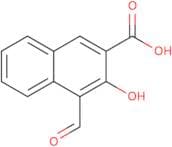
CAS 38399-46-1
:Acide 4-formyl-3-hydroxy-2-naphtoïque
Description :
Acide 4-formyl-3-hydroxy-2-naphtoïque, avec le numéro CAS 38399-46-1, est un composé organique caractérisé par sa structure de naphtalène, qui présente un groupe hydroxyle et un groupe fonctionnel aldéhyde. Ce composé apparaît généralement sous forme solide et est connu pour ses applications potentielles dans la synthèse organique et comme intermédiaire dans la production de colorants et de produits pharmaceutiques. La présence du groupe hydroxyle contribue à sa solubilité dans les solvants polaires, tandis que le système d'anneau de naphtalène fournit stabilité et caractéristiques hydrophobes. La réactivité du composé est influencée par le groupe aldéhyde, ce qui le rend susceptible à l'attaque nucléophile et facilite diverses transformations chimiques. De plus, Acide 4-formyl-3-hydroxy-2-naphtoïque peut présenter une activité biologique, ce qui pourrait intéresser la chimie médicinale. Ses caractéristiques structurelles permettent des interactions potentielles avec des cibles biologiques, en faisant un sujet de recherche dans le développement de nouveaux agents thérapeutiques. Dans l'ensemble, ce composé illustre l'intersection de la chimie organique et des applications pratiques potentielles dans divers domaines.
Formule :C12H8O4
InChI :InChI=1/C12H8O4/c13-6-10-8-4-2-1-3-7(8)5-9(11(10)14)12(15)16/h1-6,14H,(H,15,16)
Code InChI :InChIKey=LPRBZICETYEWOZ-UHFFFAOYSA-N
SMILES :C(=O)C=1C2=C(C=C(C(O)=O)C1O)C=CC=C2
Synonymes :- 2-Hydroxy-1-naphthaldehyde-3-carboxylic acid
- 2-Hydroxy-3-carboxy-1-naphthaldehyde
- 2-Naphthalenecarboxylic Acid, 4-Formyl-3-Hydroxy-
- 2-Naphthoic acid, 4-formyl-3-hydroxy-
- 3-Carboxy-2-hydroxy-1-naphthaldehyde
- 4-Formyl-3-hydroxy-2-naphthalenecarboxylic acid
- 4-Formyl-3-hydroxy-2-naphthoic acid
- 2-Hydroxy-3-carboxy-1-naphthaldehyd
Trier par
Degré de pureté (%)
0
100
|
0
|
50
|
90
|
95
|
100
1 produits concernés.
4-Formyl-3-hydroxynaphthalene-2-carboxylic acid
CAS :4-Formyl-3-hydroxynaphthalene-2-carboxylic acid (4FHN) is an antibacterial agent. It is bacteriostatic and has been shown to be effective against gram-negative bacteria such as Escherichia coli and Pseudomonas aeruginosa, but not against gram-positive bacteria such as Staphylococcus aureus. 4FHN was found to inhibit the growth of both gram-positive and gram-negative bacteria by binding to the ribosomal RNA in the bacterial cell wall, thereby inhibiting protein synthesis and cell division. 4FHN also shows antimicrobial activity due to its ability to form stable hydrazones with nucleophilic centers in the bacterial cell wall. These compounds react with cellular macromolecules, leading to cell death.Formule :C12H8O4Degré de pureté :Min. 95%Masse moléculaire :216.19 g/mol