CAS 38854-46-5
:N-Acétylchitohexaose
Description :
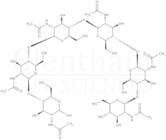
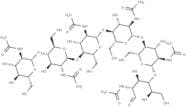
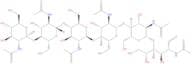
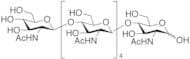
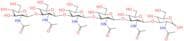
N-Acétylchitohexaose est un hexasaccharide composé d'unités répétitives de N-acétylglucosamine et de glucosamine, qui sont des dérivés de la chitine. Ce composé se caractérise par sa structure, qui comprend six unités de sucre liées par des liaisons glycosidiques β(1→4), avec des groupes N-acétyle présents sur les sucres aminés. Il est typiquement soluble dans l'eau et présente des propriétés associées aux polysaccharides, telles que la viscosité et la formation de gels. N-Acétylchitohexaose suscite de l'intérêt dans divers domaines, y compris la biochimie et la science des matériaux, en raison de ses applications potentielles dans la délivrance de médicaments, la cicatrisation des plaies et en tant que matériau biocompatible. De plus, il peut présenter des activités biologiques, telles que des effets immunomodulateurs, ce qui en fait un sujet de recherche dans le contexte de la santé et de la maladie. Son numéro CAS, 38854-46-5, permet une identification et une référence faciles dans la littérature scientifique et les bases de données. Dans l'ensemble, N-Acétylchitohexaose représente un composé significatif dans l'étude des glycosaminoglycanes et de leurs dérivés.
Formule :C48H80N6O31
InChI :InChI=1S/C48H80N6O31/c1-14(62)49-20(7-55)32(69)39(21(68)8-56)81-45-28(51-16(3)64)35(72)41(23(10-58)77-45)83-47-30(53-18(5)66)37(74)43(25(12-60)79-47)85-48-31(54-19(6)67)38(75)42(26(13-61)80-48)84-46-29(52-17(4)65)36(73)40(24(11-59)78-46)82-44-27(50-15(2)63)34(71)33(70)22(9-57)76-44/h7,20-48,56-61,68-75H,8-13H2,1-6H3,(H,49,62)(H,50,63)(H,51,64)(H,52,65)(H,53,66)(H,54,67)/t20-,21+,22+,23+,24+,25+,26+,27+,28+,29+,30+,31+,32+,33+,34+,35+,36+,37+,38+,39+,40+,41+,42+,43+,44-,45-,46-,47-,48-/m0/s1
Code InChI :InChIKey=FUHDMRPNDKDRFE-LPUYKFNUSA-N
SMILES :O([C@H]1[C@H](NC(C)=O)[C@@H](O)[C@H](O[C@H]2[C@H](NC(C)=O)[C@@H](O)[C@H](O[C@H]3[C@H](NC(C)=O)[C@@H](O)[C@H](O)[C@@H](CO)O3)[C@@H](CO)O2)[C@@H](CO)O1)[C@@H]4[C@@H](CO)O[C@@H](O[C@@H]5[C@@H](CO)O[C@@H](O[C@@H]([C@@H]([C@@H](NC(C)=O)C=O)O)[C@@H](CO)O)[C@H](NC(C)=O)[C@H]5O)[C@H](NC(C)=O)[C@H]4O
Synonymes :- 2-(acetylamino)-2-deoxy-beta-D-glucopyranosyl-(1->4)-2-(acetylamino)-2-deoxy-beta-D-glucopyranosyl-(1->4)-2-(acetylamino)-2-deoxy-beta-D-glucopyranosyl-(1->4)-2-(acetylamino)-2-deoxy-beta-D-glucopyranosyl-(1->4)-2-(acetylamino)-2-deoxy-beta-D-glucopyranosyl-(1->4)-2-(acetylamino)-2-deoxy-D-glucose
- <span class="text-smallcaps">D</smallcap>-Glucose, O-2-(acetylamino)-2-deoxy-β-<smallcap>D</smallcap>-glucopyranosyl-(1→4)-O-2-(acetylamino)-2-deoxy-β-<smallcap>D</smallcap>-glucopyranosyl-(1→4)-O-2-(acetylamino)-2-deoxy-β-<smallcap>D</smallcap>-glucopyranosyl-(1→4)-O-2-(acetylamino)-2-deoxy-β-<smallcap>D</smallcap>-glucopyranosyl-(1→4)-O-2-(acetylamino)-2-deoxy-β-<smallcap>D</span>-glucopyranosyl-(1→4)-2-(acetylamino)-2-deoxy-
- Brn 0001006
- Chitohexaose, hexa-N-acetyl (6CI)
- Chitohexaose, hexa-N-acetyl-
- D-Glucose, O-2-(acetylamino)-2-deoxy-beta-D-glucopyranosyl-(1-4)-O-2-(acetylamino)-2-deoxy-beta-D-glucopyranosyl-(1-4)-O-2-(acetylamino)-2-deoxy-beta-D-glucopyranosyl-(1-4)-O-2-(acetylamino)-2-deoxy-beta-D-glucopyranosyl-(1-4)-O-2-(acetylamino)-2-deoxy-beta-D-glucopyranosyl-(1-4)-2-(acetylamino)-2-deoxy-
- Hexa-N-acetylchitohexaose
- N-Acetylchitohexaose
- N-Acetylglucosamine hexamer
- N-Acetylglucosamine hexasaccharide
- Nacos-6
- O-2-(Acetylamino)-2-deoxy-β-<span class="text-smallcaps">D</smallcap>-glucopyranosyl-(1→4)-O-2-(acetylamino)-2-deoxy-β-<smallcap>D</smallcap>-glucopyranosyl-(1→4)-O-2-(acetylamino)-2-deoxy-β-<smallcap>D</smallcap>-glucopyranosyl-(1→4)-O-2-(acetylamino)-2-deoxy-β-<smallcap>D</smallcap>-glucopyranosyl-(1→4)-O-2-(acetylamino)-2-deoxy-β-<smallcap>D</smallcap>-glucopyranosyl-(1→4)-2-(acetylamino)-2-deoxy-<smallcap>D</span>-glucose
- O-2-(Acetylamino)-2-deoxy-β-D-glucopyranosyl-(1→4)-O-2-(acetylamino)-2-deoxy-β-D-glucopyranosyl-(1→4)-O-2-(acetylamino)-2-deoxy-β-D-glucopyranosyl-(1→4)-O-2-(acetylamino)-2-deoxy-β-D-glucopyranosyl-(1→4)-O-2-(acetylamino)-2-deoxy-β-D-glucopyranosyl-(1→4)-2-(acetylamino)-2-deoxy-D-glucose
- Voir plus de synonymes
Trier par
Degré de pureté (%)
0
100
|
0
|
50
|
90
|
95
|
100
8 produits concernés.
N,N'',N'''',N'''''',N'''''''',N''''''''''-Hexaacetylchitohexaose
CAS :Formule :C48H80N6O31Degré de pureté :≥ 90.0%Couleur et forme :White to off-white powderMasse moléculaire :1237.18Hexa-N-acetylchitohexaose
CAS :Hexa-N-acetylchitohexaose boosts crop immunity, soybean health, and has antitumor effects.Formule :C48H80N6O31Degré de pureté :98%Couleur et forme :SolidMasse moléculaire :1237.17N,N',N'',N''',N'''',N'''''-Hexaacetyl chitohexaose
CAS :Formule :C48H80N6O31Degré de pureté :95%~99%Masse moléculaire :1237.18N,N’,N’’,N’’’,N’’’’,N’’’’’-Hexaacetyl Chitohexaose
CAS :Formule :C48H80N6O31Masse moléculaire :1237.18N,N’,N’’,N’’’,N’’’’,N’’’’’-Hexaacetylchitohexaose
CAS :Produit contrôléStability Hygroscopic
Applications Studied for anti-tumor effects.
References Suzuki, K., et al.: Carbohydrate Research, 151, 403 (1986)Formule :C48H80N6O31Couleur et forme :NeatMasse moléculaire :1237.2N,N',N'',N''',N'''',N'''''-Hexaacetylchitohexaose
CAS :Hexaacetylchitohexaose is a hexamer of N-acetylgucosamine subunits which are linked by β-(1,4)-glucosidic bonds. N-acetylgucosamine is the monomeric unit of the natural polymer chitin which is degraded by chitinases, in mammals, to form smaller fragments that can induce an immune response. Like chitin and some of its derivatives, hexaacetylchitohexaose is a substrate of lysozymes. Hexaacetylchitohexaose has been shown to significantly inhibit tumour growth in mice by the activation of innate and adaptive immune cells.Formule :C48H80N6O31Degré de pureté :Min. 90 Area-%Couleur et forme :White PowderMasse moléculaire :1,237.2 g/molN,N’,N’’,N’’’,N’’’’,N’’’’’-Hexaacetyl Chitohexaose
CAS :Formule :C48H80N6O31Masse moléculaire :1237.18