


CAS 38964-22-6
:2,8-Dichlorodibenzo-p-dioxine
Description :
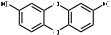
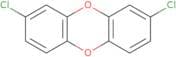
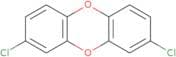
2,8-Dichlorodibenzo-p-dioxine (CAS 38964-22-6) est un composé organique chloré appartenant à la classe des dioxines, connues pour leur persistance environnementale et leur toxicité potentielle. Ce composé présente une structure de dioxine caractérisée par deux cycles benzéniques reliés par deux atomes d'oxygène, avec des substituants de chlore aux positions 2 et 8. C'est un solide incolore à jaune pâle qui est insoluble dans l'eau mais soluble dans des solvants organiques. 2,8-Dichlorodibenzo-p-dioxine est d'un intérêt particulier en raison de son potentiel en tant que contaminant dans divers processus industriels et de son association avec des effets néfastes sur la santé, y compris la cancérogénicité et la perturbation endocrinienne. Le composé se forme généralement comme un sous-produit lors de la combustion de matériaux organiques chlorés et lors de la production de certains herbicides et pesticides. En raison de sa stabilité et de son potentiel de bioaccumulation, il pose des risques environnementaux et sanitaires significatifs, entraînant des réglementations strictes concernant son émission et sa gestion.
Formule :C12H6Cl2O2
InChI :InChI=1S/C12H6Cl2O2/c13-7-1-3-9-11(5-7)16-12-6-8(14)2-4-10(12)15-9/h1-6H
Code InChI :InChIKey=WMWJCKBJUQDYLM-UHFFFAOYSA-N
SMILES :ClC=1C=C2C(OC=3C(O2)=CC(Cl)=CC3)=CC1
Synonymes :- 2,8-Dichlordibenzo-p-dioxin
- 2,8-Dichloro-dibenzo[1,4]dioxin
- 2,8-Dichlorodibenzo-p-dioxin
- 2,8-Dichlorodibenzo[b,e][1,4]dioxin
- 2,8-Dichlorodibenzodioxin
- 3,6-Dichloro-9,10-dioxaanthracene
- Dibenzo[B,E][1,4]Dioxin, 2,8-Dichloro-
- Pcdd 12
- 2,8-Dichlorooxanthrene
Trier par
Degré de pureté (%)
0
100
|
0
|
50
|
90
|
95
|
100
5 produits concernés.
2,8-Dichlorodibenzo-p-dioxin
CAS :2,8-Dichlorodibenzo-p-dioxin (2,8-DCDD) is a chlorinated dioxin. It is used as an analytical reagent in wastewater treatment methods. 2,8-DCDD can be prepared by the reaction of chlorine atoms with a sample that contains dioxins. The preparation of 2,8-DCDD involves the use of solvents such as dichloromethane or toluene and has been shown to require activation energies between 10 and 40 kcal/mol. 2,8-DCDD is a postulated carcinogen because it binds to receptor sites on cells and promotes tumor formation in animal models. The rate of formation of 2,8-DCDD has been shown to increase when triclosan is present in the environment at concentrations greater than 0.1 ppm. Triclosan can also promote the formation of 2,6-dichlorophenolFormule :C12H6Cl2O2Degré de pureté :Min. 95%Masse moléculaire :253.08 g/mol2,8-Dichlorodibenzo-p-dioxin
CAS :2,8-Dichlorodibenzo-p-dioxin is a high quality chemical that is used as a building block in the synthesis of more complex compounds. It can be used as a reagent and speciality chemical, as well as being a versatile intermediate in organic synthesis. The CAS number for 2,8-Dichlorodibenzo-p-dioxin is 38964-22-6.Formule :C12H6Cl2O2Degré de pureté :Min. 95.0 Area-%Masse moléculaire :253.08 g/molRef: 3D-J-200144
10mgÀ demander25mgÀ demander50mgÀ demander100mgÀ demander250mgÀ demander-Unit-ggÀ demander2,8-Dichlorodibenzo[b,e][1,4]dioxin
CAS :Produit contrôlé<p>Applications 2,8-Dichlorodibenzo[b,e][1,4]dioxin is a standard used for environmental testing and research such as the study of hydrophobic organic contaminants in river water.<br>References Khairy, M. et al.: Env. Sci. Tech., 48, 2533 (2014);<br></p>Formule :C12H6Cl2O2Couleur et forme :NeatMasse moléculaire :253.08


![2,8-Dichlorodibenzo[b,e][1,4]dioxin](/_next/image/?url=https%3A%2Fstatic.cymitquimica.com%2Fproducts%2FTR%2Fthumb%2FD436513.jpg&w=3840&q=75)


