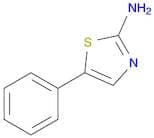
CAS 39136-63-5
:5-Phényl-2-thiazolamine
- 2-Amino-5-phenyl-1,3-thiazole
- 2-Amino-5-phenylthiazol
- 2-Amino-5-phenylthiazole
- 2-Thiazolamine, 5-phenyl-
- 5-Phenyl-1,3-Thiazol-2-Amine
- 5-Phenyl-2-aminothiazole
- 5-Phenyl-2-thiazolamine
- 5-Phenyl-Thiazol-2-Ylamine
- Thiazole, 2-amino-5-phenyl-
2-Amino-5-phenylthiazole
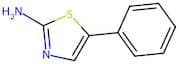
CAS :Formule :C9H8N2SDegré de pureté :95%Couleur et forme :SolidMasse moléculaire :176.23825-Phenyl-1,3-thiazol-2-amine
CAS :5-Phenyl-1,3-thiazol-2-amineDegré de pureté :97%Couleur et forme :SolidMasse moléculaire :176.23822g/mol5-Phenylthiazol-2-amine
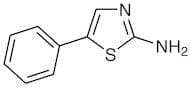
CAS :Formule :C9H8N2SDegré de pureté :>98.0%(T)(HPLC)Couleur et forme :White to Light yellow powder to crystalMasse moléculaire :176.245-Phenylthiazol-2-amine
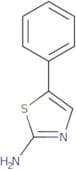
CAS :Formule :C9H8N2SDegré de pureté :95%Couleur et forme :SolidMasse moléculaire :176.245-Phenylthiazol-2-amine
CAS :5-Phenylthiazol-2-amine is a chemical compound with clinical use in the synthesis of dyestuffs and as an intermediate for pharmaceuticals. It is also used for the treatment of cancer, although its clinical efficacy has not been proven. The cellular process that 5-phenylthiazol-2-amine inhibits is the shikimate pathway, which is involved in bacterial metabolism. This compound also inhibits kinases and may be used to treat cancer. 5-Phenylthiazol-2-amine can be synthesized from 2-(4'-nitrophenoxy)benzaldehyde or 2-(4'-nitrophenoxy)benzaldehyde chloride. This chemical reacts with ammonia or ammonium chloride to produce 5-(phenylamino)-1,3,4-thiadiazole (5PT). The reaction mechanism involves nucleophilic substitution at the nitro group followed by hydrolysis of the nitro group to form a
Formule :C9H8N2SDegré de pureté :Min. 95%Masse moléculaire :176.24 g/mol