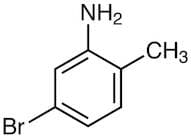
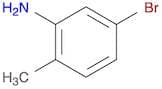
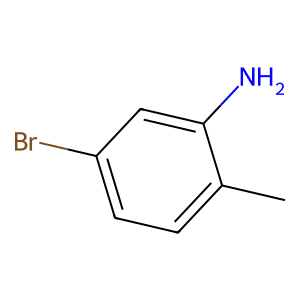
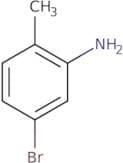
CAS 39478-78-9
:5-Bromo-2-méthylbenzenamine
- 2-Amino-4-Bromotoluene
- 2-Methyl-5-bromoaniline
- 3-Bromo-6-methylaniline
- 5-Bromo-2-methylaniline
- 5-Bromo-2-methylbenzenamine
- 5-Bromo-2-methylphenylamine
- Benzenamine, 5-bromo-2-methyl-
5-Bromo-2-methylaniline
CAS :Formule :C7H8BrNDegré de pureté :>97.0%(GC)(T)Couleur et forme :White or Colorless to Yellow to Green powder to lump to clear liquidMasse moléculaire :186.055-Bromo-2-methylaniline
CAS :Formule :C7H8BrNDegré de pureté :97%Couleur et forme :SolidMasse moléculaire :186.04915-Bromo-2-methylaniline
CAS :5-Bromo-2-methylanilineFormule :C7H8BrNDegré de pureté :≥95%Couleur et forme : dark reddish brown fused solidMasse moléculaire :186.04912g/mol5-Bromo-2-methylaniline
CAS :Formule :C7H8BrNDegré de pureté :97%Couleur et forme :ClearMasse moléculaire :186.0525-Bromo-2-methylaniline
CAS :5-Bromo-2-methylaniline (5BMA) is a nonsteroidal, insecticidal compound. It is an alkylating agent that reacts with nucleophilic sites such as DNA and proteins to form covalent bonds. 5BMA has been shown to act as a surfactant in the synthesis of carbinols. It can also be used as an additive or a coupling reagent for the synthesis of other compounds. The bromine atom in 5BMA is electron-rich and has high affinity for electrophiles, which makes it useful for reactions involving nucleophiles such as DNA, proteins, or phosphines. The functional groups on 5BMA are fluorine and two methoxy groups. It can bind to DNA by forming hydrogen bonds with the phosphate backbone. Hybridization occurs when 5BMA binds to its complementary strand of DNA; this process prevents transcription and replication of genetic material.
Formule :C7H8BrNDegré de pureté :Min. 95%Masse moléculaire :186.05 g/mol