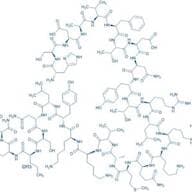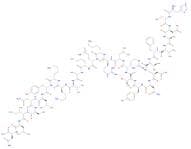
CAS 40077-57-4
:Aviptadil
Description :
Aviptadil, avec le numéro CAS 40077-57-4, est un peptide synthétique principalement connu pour son rôle d'analogue du peptide intestinal vasoactif (VIP). Il présente une gamme d'activités biologiques, y compris la vasodilatation, la modulation des réponses immunitaires et la neuroprotection. Aviptadil est composé de 28 acides aminés et se caractérise par sa capacité à se lier aux récepteurs VIP, qui sont impliqués dans divers processus physiologiques, y compris la relaxation des muscles lisses et l'inhibition des réponses inflammatoires. Ce peptide a suscité de l'intérêt pour ses applications thérapeutiques potentielles, en particulier dans les conditions respiratoires, car il pourrait aider à réduire l'inflammation et à améliorer la fonction pulmonaire. De plus, Aviptadil a été étudié pour son utilisation potentielle dans le traitement de conditions telles que la dysfonction érectile et les maladies pulmonaires. Sa stabilité et sa bioactivité en font un sujet d'intérêt dans la recherche pharmacologique, bien que d'autres études soient nécessaires pour élucider pleinement ses mécanismes d'action et son efficacité thérapeutique.
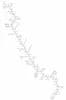
Formule :C147H237N43O43S
InChI :InChI=1/C147H237N43O43S/c1-18-75(12)115(142(229)180-96(56-72(6)7)131(218)183-104(145(232)233)63-110(155)200)188-139(226)106(68-192)185-134(221)101(62-109(154)199)177-130(217)95(55-71(4)5)174-132(219)97(58-81-37-41-84(195)42-38-81)175-125(212)88(33-23-26-49-149)167-123(210)89(34-24-27-50-150)171-140(227)113(73(8)9)186-118(205)76(13)164-121(208)93(47-53-234-17)170-127(214)92(45-46-107(152)197)169-122(209)87(32-22-25-48-148)166-124(211)90(35-28-51-161-146(156)157)168-129(216)94(54-70(2)3)173-126(213)91(36-29-52-162-147(158)159)172-143(230)116(78(15)193)189-136(223)98(59-82-39-43-85(196)44-40-82)176-133(220)100(61-108(153)198)178-135(222)103(65-112(203)204)182-144(231)117(79(16)194)190-137(224)99(57-80-30-20-19-21-31-80)181-141(228)114(74(10)11)187-119(206)77(14)165-128(215)102(64-111(201)202)179-138(225)105(67-191)184-120(207)86(151)60-83-66-160-69-163-83/h19-21,30-31,37-44,66,69-79,86-106,113-117,191-196H,18,22-29,32-36,45-65,67-68,148-151H2,1-17H3,(H2,152,197)(H2,153,198)(H2,154,199)(H2,155,200)(H,160,163)(H,164,208)(H,165,215)(H,166,211)(H,167,210)(H,168,216)(H,169,209)(H,170,214)(H,171,227)(H,172,230)(H,173,213)(H,174,219)(H,175,212)(H,176,220)(H,177,217)(H,178,222)(H,179,225)(H,180,229)(H,181,228)(H,182,231)(H,183,218)(H,184,207)(H,185,221)(H,186,205)(H,187,206)(H,188,226)(H,189,223)(H,190,224)(H,201,202)(H,203,204)(H,232,233)(H4,156,157,161)(H4,158,159,162)/t75-,76-,77-,78+,79+,86-,87-,88-,89-,90-,91-,92-,93-,94-,95-,96-,97-,98-,99-,100-,101-,102-,103-,104-,105-,106-,113-,114-,115-,116-,117-/m0/s1
Synonymes :- Aviptadil Acetate
- VIP (human, mouse, rat) acetate salt
Trier par
Degré de pureté (%)
0
100
|
0
|
50
|
90
|
95
|
100
9 produits concernés.
VIP (human, mouse, rat)
CAS :VIP, a 28-amino acid peptide belonging to the secretin-glucagon-CRF family, is widely distributed in the central and peripheral nervous systems. Acting both as a neurotransmitter and as a hormone, VIP is involved in a wide variety of biological activities, including vaso- and bronchodilation, smooth muscle relaxation, and stimulation of secretion. An injectable formulation of this peptide in combination with the adrenergic drug phentolamine is expected to provide a new and effective alternative for erectile dysfunction patients.Formule :C147H238N44O42SDegré de pureté :≥ 99%Couleur et forme :White PowderMasse moléculaire :3325.84VIP (human, mouse, rat) acetate salt H-His-Ser-Asp-Ala-Val-Phe-Thr-Asp-Asn-Tyr-Thr-Arg-Leu-Arg-Lys-Gln-Met-Ala-Val-Lys-Lys-Tyr-Leu-Asn-Ser-Ile-Leu-Asn-NH2 acetate salt
CAS :Formule :C147H238N44O42SDegré de pureté :95%Couleur et forme :SolidMasse moléculaire :3325.7972Aviptadil
CAS :Aviptadil (INN) is an analog of vasoactive intestinal polypeptide (VIP) for the treatment of erectile dysfunction.Formule :C147H238N44O42SCouleur et forme :SolidMasse moléculaire :3325.8Aviptadil Acetate
CAS :Formule :C147H238N44O42S1Degré de pureté :95%~99%Couleur et forme :White to Off-white PowderMasse moléculaire :3325.8Vasoactive Intestinal peptide
CAS :Peptide Vasoactive Intestinal peptide is a Research Peptide with significant interest within the field academic and medical research. This peptide is available for purchase at Cymit Quimica in multiple sizes and with a specification of your choice.Formule :C147H238N44O42SMasse moléculaire :3,325.7 g/molVIP (Human, Porcine)
CAS :VIP is a peptide that is an activator of cAMP-dependent protein kinase (PKA) and phospholipase C. It also inhibits the release of histamine from mast cells, stimulates gastric acid secretion, and causes vasodilation. VIP has been shown to interact with a number of proteins including ion channels and receptors. The peptide is a ligand for the neuropeptide Y receptor (NPY-R) and is involved in the regulation of appetite, immune responses, and blood pressure. VIP can be used as a research tool for studying protein interactions or as an inhibitor in pharmacological studies.Formule :C147H238N44O42SDegré de pureté :Min. 95%Masse moléculaire :3,325.8 g/molVasoactive Intestinal peptide
CAS :Custom research peptide; min purity 95%.Formule :C147H238N44O42SDegré de pureté :Min. 95%Masse moléculaire :3,325.7 g/molVIP (Human, Porcine)
CAS :VIP is a polypeptide that belongs to the vasoactive intestinal peptide family. VIP is a potent stimulator of adenylate cyclase, which increases intracellular cAMP levels and activates protein kinase A. VIP has been shown to interact with ion channel receptors, such as the nicotinic acetylcholine receptor, and regulate membrane potentials in neuronal cells. It also functions as a ligand for G protein-coupled receptors and can be used as an immunogen or antibody against VIP. VIP has been shown to have a variety of pharmacological effects including the ability to stimulate cell proliferation and inhibit apoptosis. VIP has also been shown to function as an activator of latent TGF-β1, which may play a role in tumor suppression.
Formule :C147H238N44O42SDegré de pureté :Min. 95%Masse moléculaire :3,325.8 g/mol