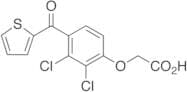
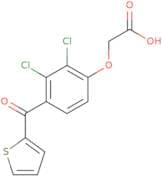
CAS 40180-04-9
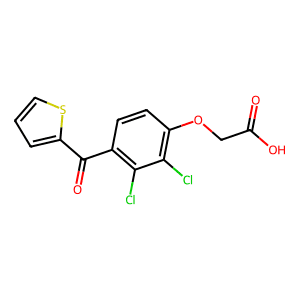
:Acide tienilique
- 2,3-Dichloro-4-(2-thenoyl)phenoxyacetic acid
- 2-[2,3-Dichloro-4-(2-thienylcarbonyl)phenoxy]acetic acid
- 2-[2,3-Dichloro-4-(thiophene-2-carbonyl)phenoxy]acetic acid
- 4-(2-Thenoyl)-2,3-dichlorophenoxyacetic acid
- 4-(2-Thienylcarbonyl)-2,3-dichlorophenoxyacetic acid
- Acetic Acid, 2-[2,3-Dichloro-4-(2-Thienylcarbonyl)Phenoxy]-
- Acetic Acid, [2,3-Dichloro-4-(2-Thienylcarbonyl)Phenoxy]-
- Anp 3624
- Ce 3624
- Difluorex
- Fr 3068
- Selacryn
- Skf 62698
- Thienylic acid
- Ticrynafen
- Tienylic acid
- [2,3-Dichloro-4-(2-thienylcarbonyl)phenoxy]acetic acid
- [2,3-Dichloro-4-(Thiophen-2-Ylcarbonyl)Phenoxy]Acetic Acid
- {[2,3-Dichloro-4-(2-Thienylcarbonyl)Phenyl]Oxy}Acetic Acid
- Voir plus de synonymes
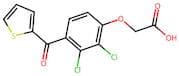
2-{2,3-dichloro-4-[(thiophen-2-yl)carbonyl]phenoxy}acetic acid
CAS :Formule :C13H8Cl2O4SDegré de pureté :97%Couleur et forme :SolidMasse moléculaire :331.1712Tienilic Acid
CAS :Tienilic Acid is a uricosuric diuretic with certain hepatotoxicity
Formule :C13H8Cl2O4SDegré de pureté :99.55%Couleur et forme :SolidMasse moléculaire :331.17Tienilic Acid
CAS :Applications Tienilic Acid is a heterocyclic derivative of phenoxyacetic acid. Tienilic acid is used as diuretic, uricosuric, antihypertensive.
References Kerremans, A.L., et al.: Eur. J. Clin. Pharmacol., 22, 515 (1982), Manier, J.W., et al.: Am. J. Gastroenterol., 77, 401 (1982)Formule :C13H8Cl2O4SCouleur et forme :White To Light BrownMasse moléculaire :331.172-(2,3-DICHLORO-4-(THIOPHENE-2-CARBONYL)PHENOXY)ACETIC ACID
CAS :Formule :C13H8Cl2O4SDegré de pureté :97%Masse moléculaire :331.16Tienilic acid
CAS :Tienilic acid is a drug that belongs to the group of diastolic pressure-lowering drugs. It lowers blood pressure by inhibiting the renin-angiotensin system, which is a hormone system that regulates blood pressure. Tienilic acid inhibits the activity of renin and angiotensin converting enzyme (ACE), which are enzymes involved in the production of angiotensin II, a peptide that causes vasoconstriction and stimulates the release of aldosterone from the adrenal gland. Tienilic acid has been shown to be safe for use in humans and animals at doses up to 300 mg/kg/day, although it can cause adverse effects such as drug reactions or drug metabolites. Tienilic acid has also been shown to inhibit protease activity in human liver cells, suggesting that it may have an inhibitory effect on other proteases as well.
Formule :C13H8Cl2O4SDegré de pureté :Min. 95%Couleur et forme :PowderMasse moléculaire :331.17 g/mol
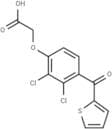
![2-{2,3-dichloro-4-[(thiophen-2-yl)carbonyl]phenoxy}acetic acid](/_next/image/?url=https%3A%2Fstatic.cymitquimica.com%2Fproducts%2FIN%2Fthumb%2FDA00C0X1.jpg&w=3840&q=75)