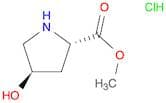
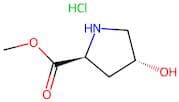
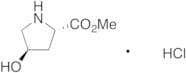
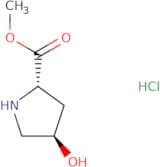
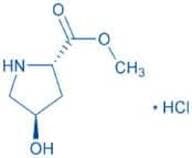
CAS 40216-83-9
:Chlorhydrate de 4-hydroxy-L-proline ester méthylique
Description :
Chlorhydrate de 4-hydroxy-L-proline ester méthylique est un dérivé de la proline, un acide aminé qui joue un rôle crucial dans la synthèse des protéines et la formation de collagène. Ce composé présente un groupe hydroxyle au quatrième carbone de l'anneau de proline, ce qui contribue à ses propriétés uniques. En tant qu'ester méthylique, il possède un groupe méthoxy attaché à l'acide carboxylique, améliorant sa solubilité dans les solvants organiques. La forme chlorhydrate indique qu'il s'agit d'un sel, ce qui améliore généralement la stabilité et la solubilité dans les solutions aqueuses. Ce composé est souvent utilisé dans la recherche biochimique et les applications pharmaceutiques, en particulier dans les études liées à la synthèse du collagène et comme un potentiel bloc de construction dans la synthèse des peptides. Sa structure moléculaire permet diverses interactions, ce qui en fait un composé précieux en chimie médicinale. De plus, il peut présenter des activités biologiques, bien que les effets spécifiques dépendent du contexte de son utilisation et des systèmes biologiques impliqués. Dans l'ensemble, Chlorhydrate de 4-hydroxy-L-proline ester méthylique est un composé significatif tant en chimie synthétique qu'en chimie biologique.
Formule :C6H11NO3·ClH
InChI :InChI=1S/C6H11NO3.ClH/c1-10-6(9)5-2-4(8)3-7-5;/h4-5,7-8H,2-3H2,1H3;1H/t4-,5+;/m1./s1
Code InChI :InChIKey=KLGSHNXEUZOKHH-JBUOLDKXSA-N
SMILES :C(OC)(=O)[C@@H]1C[C@@H](O)CN1.Cl
Synonymes :- (2S,4R)-4-Hydroxypyrrolidine-2-carboxylic acid methyl ester hydrochloride
- (2S,4R)-Methyl 4-Hydroxypyrrolidine-2-Carboxylate Hydrochloride
- (4R)-4-Hydroxy-<span class="text-smallcaps">L</span>-proline methyl ester hydrochloride
- 4-Hydroxy-<span class="text-smallcaps">L</span>-proline methyl ester hydrochloride
- 4-Hydroxy-L-Proline Methyl Ester Hcl
- 4-Hydroxyproline ester hydrochloride
- 4-Hydroxyproline methyl ester hydrochloride
- 4-trans-Hydroxy-<span class="text-smallcaps">L</span>-proline methyl ester hydrochloride
- <span class="text-smallcaps">L</span>-Hydroxyproline methyl ester hydrochloride
- <span class="text-smallcaps">L</span>-Proline, 4-hydroxy-, methyl ester, hydrochloride (1:1), (4R)-
- <span class="text-smallcaps">L</span>-Proline, 4-hydroxy-, methyl ester, hydrochloride, (4R)-
- <span class="text-smallcaps">L</span>-Proline, 4-hydroxy-, methyl ester, hydrochloride, trans-
- H-D-trans-Hyp-OMe.HCl
- H-Hyp-Ome・Hcl
- H-L-Hyp-Ome Hcl
- Hcl.Trans-D-Hyp-Ome
- Hydroxyproline methyl ester hydrochloride
- Hydroxyproline-Ome Hcl
- L-4-Hydroxyproline Methyl Ester Hydrochloride
- L-4-Hydroxyproline Methyl Ester Hydrochloride Salt
- L-4-Trans-Hydroxyproline Methyl Ester Hydrochloride
- L-4-Trans-Hydroxyproline Methyl Ester Hydrochloride Salt
- L-Trans-4-Hydroxyproline Methyl Ester Hydrochloride Salt
- Methyl (2S,4R)-4-Hydroxypyrrolidine-2-Carboxylate Hydrochloride
- Methyl (2S,4R)-4-hydroxy-2-pyrrolidinecarboxylate hydrochloride
- Methyl <span class="text-smallcaps">L</span>-hydroxyprolinate hydrochloride
- Methyl trans-4-hydroxy-<span class="text-smallcaps">L</span>-prolinate hydrochloride
- Proline, 4-hydroxy-, methyl ester, hydrochloride
- Trans-4-Hydroxy-L-Proline Methyl Ester Hydrochloride
- trans-4-Hydroxy-<span class="text-smallcaps">L</span>-proline methyl ester hydrochloride
- trans-4-Hydroxyproline methyl ester hydrochloride
- L-Proline, 4-hydroxy-, methyl ester, hydrochloride, trans-
- L-Proline, 4-hydroxy-, methyl ester, hydrochloride, (4R)-
- L-Proline, 4-hydroxy-, methyl ester, hydrochloride (1:1), (4R)-
- Voir plus de synonymes
Trier par
Degré de pureté (%)
0
100
|
0
|
50
|
90
|
95
|
100
10 produits concernés.
trans-4-Hydroxy-L-proline Methyl Ester Hydrochloride
CAS :Formule :C6H11NO3·HClDegré de pureté :>98.0%(T)Couleur et forme :White to Almost white powder to crystalMasse moléculaire :181.62trans-4-Hydroxy-L-proline methyl ester hydrochloride, 98%
CAS :This Thermo Scientific Chemicals brand product was originally part of the Alfa Aesar product portfolio. Some documentation and label information may refer to the legacy brand. The original Alfa Aesar product / item code or SKU reference has not changed as a part of the brand transition to Thermo SciFormule :C6H12ClNO3Degré de pureté :98%Couleur et forme :White, CrystalsMasse moléculaire :181.62H-Hyp-OMe.HCl
CAS :Formule :C6H12ClNO3Degré de pureté :97%Couleur et forme :SolidMasse moléculaire :181.6174Methyl (2S,4R)-4-hydroxypyrrolidine-2-carboxylate hydrochloride
CAS :Methyl (2S,4R)-4-hydroxypyrrolidine-2-carboxylate hydrochlorideFormule :C6H11NO3·ClHDegré de pureté :≥95%Couleur et forme : white to off-white solidMasse moléculaire :181.62g/moltrans-4-Hydroxy-L-proline Methyl Ester Hydrochloride
CAS :Applications trans-4-Hydroxy-L-proline (H952376) derivative. A natural constituent of animal structural proteins such as collagen and elastin.
References Langmaier, F. et al.: Int. J. Cosm. Sci., 24, 273 (2002); Lawrence, C., et al.: Biochem. J., 313, 185 (1996); Mori, H., et al.: J. Bacteriol.; 179, 5677 (1997); Clifton, I., et al.: Eur. J. Biochem., 268, 6625 (2001)Formule :C6H12ClNO3Couleur et forme :NeatMasse moléculaire :181.62Methyl (2S,4R)-4-hydroxypyrrolidine-2-carboxylate hydrochloride
CAS :Formule :C6H12ClNO3Degré de pureté :97%Couleur et forme :Solid, Crystalline Powder or SolidMasse moléculaire :181.62trans-4-Hydroxy-L-proline methyl ester hydrochloride
CAS :Trans-4-hydroxy-L-proline methyl ester hydrochloride is a matrix metalloproteinase inhibitor. It inhibits the activity of matrix metalloproteinases, which are enzymes that break down collagen and other proteins in the extracellular matrix. The inhibition of these enzymes leads to a decrease in restenosis, which is the recurrence of artery narrowing after angioplasty or stent placement. Trans-4-hydroxy-L-proline methyl ester hydrochloride has been shown to be effective against chemokine receptors, including CCR5 receptor and chemokines such as TNFα. It also inhibits cytokine production by inhibiting signaling pathways that lead to inflammation and cell proliferation.Formule :C6H11NO3·HClCouleur et forme :White/Off-White SolidMasse moléculaire :181.62 g/molH-Hyp-OMe · HCl
CAS :Bachem ID: 4002341.
Formule :C6H11NO3·HClDegré de pureté :> 99%Couleur et forme :WhiteMasse moléculaire :181.62