CAS 4084-27-9
:3-Désoxyglucosone
Description :
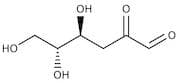
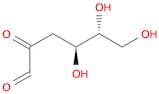
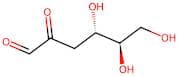
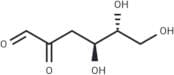
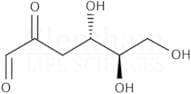
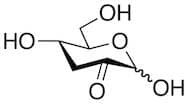
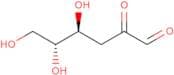
3-Désoxyglucosone (3-DG) est un composé dicarbonyle réactif dérivé du métabolisme du glucose. Il se caractérise par sa structure, qui présente un groupe fonctionnel cétone et un groupe fonctionnel aldéhyde, ce qui en fait un puissant précurseur dans la formation de produits de glycation avancée (AGEs). Ces AGEs sont impliqués dans diverses conditions pathologiques, y compris le diabète et les maladies cardiovasculaires. On sait que le 3-DG a la capacité de réagir avec des acides aminés, des protéines et des acides nucléiques, entraînant des modifications qui peuvent affecter la fonction cellulaire et contribuer au stress oxydatif. Le composé est généralement présent en quantités traces dans les systèmes biologiques et peut se former par des processus de glycation non enzymatique. Sa réactivité et ses effets biologiques potentiels en font un sujet d'intérêt dans la recherche liée aux troubles métaboliques et au vieillissement. De plus, 3-Désoxyglucosone peut être analysé à l'aide de diverses techniques, y compris la chromatographie et la spectrométrie de masse, pour étudier son rôle dans la santé et la maladie.
Formule :C6H10O5
InChI :InChI=1S/C6H10O5/c7-2-4(9)1-5(10)6(11)3-8/h2,5-6,8,10-11H,1,3H2/t5-,6+/m0/s1
Code InChI :InChIKey=ZGCHLOWZNKRZSN-NTSWFWBYSA-N
SMILES :[C@H](CC(C=O)=O)([C@@H](CO)O)O
Synonymes :- 2-keto-3-Deoxyglucose
- 3-Deoxy-<span class="text-smallcaps">D</span>-erythro-hexos-2-ulose
- 3-Deoxy-<span class="text-smallcaps">D</span>-erythro-hexosulose
- 3-Deoxy-<span class="text-smallcaps">D</span>-glucosone
- 3-Deoxyglucosone
- <span class="text-smallcaps">D</span>-erythro-Hexos-2-ulose, 3-deoxy-
- <span class="text-smallcaps">D</span>-erythro-Hexosulose, 3-deoxy-
- D-erythro-hexos-2-ulose, 3-deoxy-
- 3-Deoxy-D-erythro-hexosulose
- D-erythro-Hexosulose, 3-deoxy-
- 3-Deoxy-D-erythro-hexos-2-ulose
Trier par
Degré de pureté (%)
0
100
|
0
|
50
|
90
|
95
|
100
10 produits concernés.
3-Deoxy-D-glucosone, 95%
CAS :Frequently used as a reference for the analysis and detection of glucose degradation products and glycating agents. Also used for cross-linking studies as it readily reacts with protein amino groups. This Thermo Scientific Chemicals brand product was originally part of the Alfa Aesar product portfolFormule :C6H10O5Degré de pureté :95%Couleur et forme :Yellow, Powder or crystals or crystalline powderMasse moléculaire :162.143-deoxy Glucosone
CAS :Formule :C6H12O5Degré de pureté :75%Couleur et forme :SolidMasse moléculaire :164.15653-Deoxy-D-glucosone
CAS :3-Deoxy-D-glucosoneFormule :C6H10O5Degré de pureté :>95%Couleur et forme : yellow amorphous solidMasse moléculaire :162.14g/mol3-Deoxy-D-erythro-hexos-2-ulose
CAS :3-Deoxy-D-erythro-hexos-2-uloseDegré de pureté :≥95%Couleur et forme :Pale Yellow SolidMasse moléculaire :162.14g/mol3-Deoxyglucosone
CAS :3-Deoxyglucosone(3-Deoxy-D-glucosone) is synthesized by the intermediate pathway of the melad and polyol reactions.3-Deoxyglucosone reacts rapidly with proteinFormule :C6H10O5Degré de pureté :95%Couleur et forme :SolidMasse moléculaire :162.143-Deoxyglucosone
CAS :Formule :C6H10O5Degré de pureté :One spotCouleur et forme :Pale yellow to yellow powder or solidMasse moléculaire :162.143-Deoxyglucosone
CAS :Stability Hygroscopic, Light Sensitive, Temperature Sensitive
Applications An intermediate in the Maillard reaction of proteins with glucose, which is metabolised to 3-Deoxyfructose. An intermediate in the formation of pyrraline, which might contribute to a pathological effect, such as carcinogenesis.
References Kato, H. et al.: Agric. Biol. Chem., 51, 683 (1987), Hayase, F. et al.: J. Biol. Chem., 264, 3758 (1989), Kato, H. et al.: Biochimica et Biophysica Acta, 1035, 71 (1990)Formule :C6H10O5Couleur et forme :White To YellowMasse moléculaire :162.143-Deoxy-D-glucosone
CAS :3-Deoxy-D-glucosone is a compound that belongs to the group of monosaccharides and has a basic structure. It can be found in many types of biological samples, including blood. The x-ray diffraction data for 3-deoxy-D-glucosone shows an asymmetric unit of two molecules with a coordination geometry of 2.3. This compound is known to have high protein oxidation rates, which are caused by dna binding activity. 3-Deoxyglucosone has been shown to be involved in the pathogenic mechanism of many types of cancers.Formule :C6H10O5Degré de pureté :Min. 95%Couleur et forme :PowderMasse moléculaire :162.14 g/mol