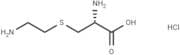
CAS 4099-35-8
:S-(2-Aminoéthyl)-L-cystéine chlorhydrate
Description :
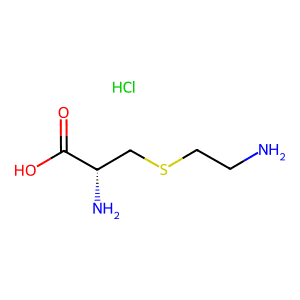
S-(2-Aminoéthyl)-L-cystéine chlorhydrate, avec le numéro CAS 4099-35-8, est un dérivé de l'acide aminé cystéine, caractérisé par la présence d'une chaîne latérale aminoéthyle. Ce composé se présente généralement sous forme de poudre cristalline blanche à blanc cassé, soluble dans l'eau en raison de la présence de la forme de sel hydrochlorique. Il présente des propriétés typiques des acides aminés, y compris la capacité de participer à des réactions redox grâce au groupe thiol (-SH), ce qui en fait un potentiel antioxydant. Le groupe aminoéthyle augmente sa réactivité et son activité biologique potentielle, qui peut inclure des rôles dans la signalisation cellulaire et le métabolisme. En tant que sel hydrochlorique, il est stable dans des conditions standard, mais doit être conservé dans un endroit frais et sec pour maintenir son intégrité. Ce composé est souvent utilisé dans la recherche biochimique et peut avoir des applications en pharmacie, en particulier dans des études liées à la synthèse des protéines et à la fonction cellulaire. Des précautions de sécurité doivent être observées lors de la manipulation de cette substance, comme pour tous les produits chimiques, afin d'éviter d'éventuels risques pour la santé.
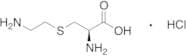
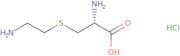
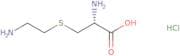
Formule :C5H12N2O2S·ClH
InChI :InChI=1S/C5H12N2O2S.ClH/c6-1-2-10-3-4(7)5(8)9;/h4H,1-3,6-7H2,(H,8,9);1H/t4-;/m0./s1
Code InChI :InChIKey=CVHKULVNPGAEQM-WCCKRBBISA-N
SMILES :[C@H](CSCCN)(C(O)=O)N.Cl
Synonymes :- 2-(Aminoethyl)cysteine monohydrochloride
- 2-Amino-ethyl-cystein monohydrochloride
- 2-{[(2R)-2-amino-2-carboxyethyl]sulfanyl}ethanaminium chloride
- <span class="text-smallcaps">L</span>-4-Thialysine hydrochloride
- <span class="text-smallcaps">L</span>-Cysteine, S-(2-aminoethyl)-, hydrochloride (1:1)
- <span class="text-smallcaps">L</span>-Cysteine, S-(2-aminoethyl)-, monohydrochloride
- Alanine, 3-((2-aminoethyl)thio)-, monohydrochloride, L-
- Alanine, 3-[(2-aminoethyl)thio]-, monohydrochloride, <span class="text-smallcaps">L</span>-
- Cysteine, S-(2-aminoethyl)-, monohydrochloride, L-
- L-Cysteine, S-(2-aminoethyl)-, monohydrochloride
- Lj 226
- N-(2-aminoethyl)-L-cysteine hydrochloride
- Nsc 186915
- S-(2-Aminoethyl)-<span class="text-smallcaps">L</span>-cysteine hydrochloride
- S-(2-Aminoethyl)-<span class="text-smallcaps">L</span>-cysteine monohydrochloride
- S-(2-Aminoethyl)-L-cysteine HCl
- S-(2-aminoethyl)-L-cysteine
- S-(2-aminoethyl)-L-cysteine monohydrochloride
- S-(2-aminoethyl)cysteine
- S-(beta-Amino ethyl) cysteine monochlorhydrate
- S-(beta-Amino ethyl) cysteine monochlorhydrate [French]
- S-(beta-Aminoethyl)-L-cysteine hydrochloride
- S-(β-Aminoethyl)-<span class="text-smallcaps">L</span>-cysteine hydrochloride
- Thialysine HCl
- Thialysine hydrochloride
- Usaf Xr-43
- S-(β-Aminoethyl)-L-cysteine hydrochloride
- Voir plus de synonymes
Trier par
Degré de pureté (%)
0
100
|
0
|
50
|
90
|
95
|
100
8 produits concernés.
S-(2-Aminoethyl)-L-cysteine hydrochloride
CAS :Formule :C5H13ClN2O2SDegré de pureté :98%Couleur et forme :SolidMasse moléculaire :200.6869S-(2-Aminoethyl)-L-cysteine hydrochloride
CAS :S-(2-Aminoethyl)-L-cysteine hydrochlorideDegré de pureté :98%Masse moléculaire :200.69g/molS-(2-Aminoethyl)-l-cysteine, hydrochloride
CAS :Applications S-(2-Aminoethyl)-l-cysteine, HCl
Formule :C5H13ClN2O2SCouleur et forme :NeatMasse moléculaire :200.69S-Aminoethyl-L-cysteine hydrochloride
CAS :S-Aminoethyl-L-cysteine hydrochloride is an amino acid that is used in the diagnosis of metabolic disorders. It has been found to have a high concentration in plasma and can be used to measure the activity of bowel disease. S-Aminoethyl-L-cysteine hydrochloride is also used as a diagnostic marker for inflammatory diseases. It is extensively metabolized by acidic hydrolysis, which results in the release of chloride ions and amines.
Formule :C5H12N2O2S·HClDegré de pureté :Min. 95%Couleur et forme :White PowderMasse moléculaire :200.69 g/molS-2-Aminoethyl-L-cysteine hydrochloride
CAS :Please enquire for more information about S-2-Aminoethyl-L-cysteine hydrochloride including the price, delivery time and more detailed product information at the technical inquiry form on this pageFormule :C5H13ClN2O2SMasse moléculaire :200.69 g/molThialysine HCl
CAS :Thialysine HCl is a cytotoxic cysteine derivative that inhibits Escherichia coli, acting as a protein synthesis inhibitor and metabolite.Formule :C5H13ClN2O2SCouleur et forme :SolidMasse moléculaire :200.69H-Cys(aminoethyl)-OH · HCl
CAS :A naturally occuring cytotoxic lysine analog. Substrate of bacterial lysine-2-monooxygenase. L-Thialysine inhibits homocitrate synthase, E. coli aspartate kinase III, and the lysine aminomutases lysine-2,3-aminomutase and lysine-5,6-aminomutase.Formule :C5H12N2O2S·HClDegré de pureté :> 99%Couleur et forme :Whitish PowderMasse moléculaire :200.69