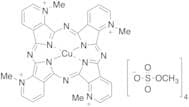
![Copper(4+), [1,8,15,22-tetramethyl-29H,31H-tetrapyrido[2,3-b:2′,3′-g:2′′,3′′-l:2′′′,3′′′-q]porphyr…](/_next/image/?url=https%3A%2Fstatic.cymitquimica.com%2Fcas-image%2Fthumb-webp%2F316460-copper-4-181522-tetramethyl-29h-31h-tetrapyrido-23-b-23-g-23-l-23-q-porphyraziniumato-2-kn29-kn30-kn31-kn32-sp-4-1-methyl-sulfate-1-4.webp&w=3840&q=75)
CAS 41276-95-3
:Cuivre(4+), [1,8,15,22-tétraméthyl-29H,31H-tétrapyrido[2,3-b:2′,3′-g:2′′,3′′-l:2′′′,3′′′-q]porphyraziniumato(2-)-κN29,κN30,κN31,κN32]-, (SP-4-1)-, sulfate de méthyle (1:4)
Description :
Le cuivre(4+), spécifiquement dans le contexte du composé que vous avez mentionné, est un complexe de coordination présentant du cuivre dans un état d'oxydation +4, qui est relativement rare par rapport à ses états d'oxydation plus courants +1 et +2. Ce composé se caractérise par sa structure complexe, qui comprend un cadre de porphyrazine, un type de ligand macrociclique connu pour sa capacité à se coordonner avec des ions métalliques. La présence de plusieurs groupes méthyle dans le ligand améliore sa solubilité et sa stabilité. Le composant sulfate de méthyle indique que le composé est probablement un sel, ce qui peut influencer sa solubilité et sa réactivité dans divers solvants. La coordination de l'ion cuivre avec des atomes d'azote de la structure de porphyrazine suggère des applications potentielles en catalyse ou comme colorant, compte tenu des propriétés électroniques imparties par les interactions métal-ligand. Dans l'ensemble, ce composé illustre la complexité et la polyvalence des structures organométalliques en chimie de coordination.
Formule :C32H24CuN12·4CH3O4S
InChI :InChI=1S/C32H24N12.CH4O4S.Cu/c1-41-13-5-9-17-21(41)29-33-25(17)38-30-23-19(11-7-15-43(23)3)27(35-30)40-32-24-20(12-8-16-44(24)4)28(36-32)39-31-22-18(26(34-31)37-29)10-6-14-42(22)2;1-5-6(2,3)4;/h5-16H,1-4H3;1H3,(H,2,3,4);/q+2;;+2/p-1
Code InChI :InChIKey=OHJXJJRFAPKPSP-UHFFFAOYSA-M
SMILES :C[N+]1=C2C=3[N-]4[Cu+2]56[N-]7C(=C8C(=C7N=C9[N]5=C(N3)C=%10C9=[N+](C)C=CC%10)C=CC=[N+]8C)N=C%11[N]6=C(N=C4C2=CC=C1)C=%12C%11=CC=C[N+]%12C.S(OC)(=O)(=O)[O-]
Synonymes :- Copper(4+), [1,8,15,22-tetramethyl-29H,31H-tetrapyrido[2,3-b:2′,3′-g:2′′,3′′-l:2′′′,3′′′-q]porphyraziniumato(2-)-κN29,κN30,κN31,κN32]-, (SP-4-1)-, tetrakis(methyl sulfate)
- Copper(4+), [1,8,15,22-tetramethyl-29H,31H-tetrapyrido[2,3-b:2′,3′-g:2′′,3′′-l:2′′′,3′′′-q]porphyraziniumato(2-)-N29,N30,N31,N32]-, (SP-4-1)-, tetrakis(methyl sulfate)
- 29H,31H-Tetrapyrido[2,3-b:2′,3′-g:2′′,3′′-l:2′′′,3′′′-q]porphyrazinium, 1,8,15,22-tetramethyl-, copper complex
- 29H,31H-Tetrapyrido[2,3-b:2′,3′-g:2′′,3′′-l:2′′′,3′′′-q]porphyrazine, copper(4+) deriv.
- (1,8,15,22-Tetramethyl-29H,31H-tetrapyrido(2,3-b:2',3'-g:2'',3''-l:2''',3'''-q)porphyraziniumato(2-)-N29,N30,N31,N32)copper(4+) tetramethyl tetrakis(sulphate)
- Copper(4+), [1,8,15,22-tetramethyl-29H,31H-tetrapyrido[2,3-b:2′,3′-g:2′′,3′′-l:2′′′,3′′′-q]porphyraziniumato(2-)-κN29,κN30,κN31,κN32]-, (SP-4-1)-, methyl sulfate (1:4)
Trier par
Degré de pureté (%)
0
100
|
0
|
50
|
90
|
95
|
100
3 produits concernés.
Cuprolinic Blue (>90%)
CAS :Produit contrôléApplications Cuprolinic Blue, has been shown to be able to form a particularly stable blue chromophore with single-stranded RNA in neuronal Nissl substance and nucleoli, and thus can be used for counterstaining of enteric neurons for peroxidase immunocytochemistry
References Holst, M., et al.: J. Neurosci., Meth., 62, 121 (1995);Formule :C32H26N12·4CH3O4S·CuDegré de pureté :>90%Couleur et forme :NeatMasse moléculaire :1086.56Cuprolinic Blue-d12
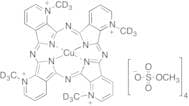
CAS :Produit contrôléApplications Cuprolinic Blue-d12 is the labeled analogue of Cuprolinic Blue (C834800), which has been shown to be able to form a particularly stable blue chromophore with single-stranded RNA in neuronal Nissl substance and nucleoli, and thus can be used for counterstaining of enteric neurons for peroxidase immunocytochemistry.
References Holst, M., et al.: J. Neurosci., Meth., 62, 121 (1995)Formule :C35H12D12CuN12•4(CD3O4S)Couleur et forme :Dark BlueMasse moléculaire :1108.69Cuprolinic blue
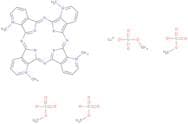
CAS :Cuprolinic blue is a fluorescent dye that is used for collagen gel localization and histochemical staining. It binds to the amide groups of proteins, such as collagen, and stains them blue. Cuprolinic blue has been used to show the ultrastructural localisation of collagen in blood capillaries in vivo. Cuprolinic blue also binds to nuclear DNA and can be used as a marker for the localization of nuclei in cells. This dye can also be used as an indicator for cervical cancer and proteoglycans in proteoglycan-enriched tissues.Formule :C36H36CuN12O16S4Degré de pureté :90%MinCouleur et forme :PowderMasse moléculaire :1,084.6 g/mol