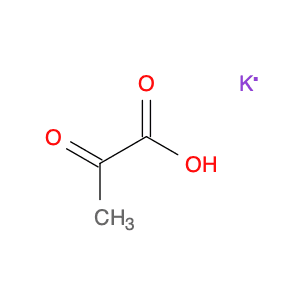
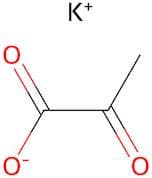
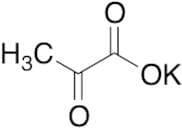
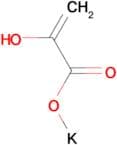
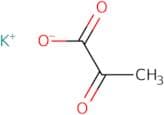
CAS 4151-33-1
:Pyruvate de potassium
- Potassium 2-Oxopropanoate
- Potassium pyruvate
- Propanoic acid, 2-oxo-, potassium salt
- Propanoic acid, 2-oxo-, potassium salt (1:1)
- Pyruvic acid Potassium salt
- Pyruvic acid, potassium salt
- 2-Oxopropionic acid potassium salt
- 2-oxo-propanoicacipotassiumsalt
- POTASSIUMPYRUVATE(PYRUVICACIDPOTASSIUM)
potassium 2-oxopropanoate
CAS :Formule :C3H4KO3Degré de pureté :98%Couleur et forme :SolidMasse moléculaire :127.1604Pyruvic Acid Potassium Salt
CAS :Produit contrôléStability Hygroscopic
Applications Potassium pyruvate (cas# 4151-33-1) is a useful research chemical.Formule :C3H3KO3Couleur et forme :NeatMasse moléculaire :126.15POTASSIUM PYRUVATE
CAS :Formule :C3H3KO3Degré de pureté :98.0%Couleur et forme :SolidMasse moléculaire :126.152Potassium pyruvate
CAS :Potassium pyruvate is a chemical compound that is formed by the oxidation of pyruvic acid. It can be used in analytical methods to measure the concentration of caproic acid, a group P2 molecule, in a sample. Potassium pyruvate has been shown to have antioxidant properties and reduce oxidative stress in human macrophages. Potassium pyruvate has also been shown to stimulate ribitol dehydrogenase, an enzyme that can convert ribitol into ribose-5-phosphate, which is important for DNA synthesis. The detection sensitivity of potassium pyruvate is much higher than that of other analytical methods and it can be used as an indicator for measuring the concentration of many organic compounds. Potassium pyruvate may have physiological effects on cells because it has been shown to promote pluripotent cells in plants as well as play a role in ischemic brain damage and basic fibroblast growth.
Formule :C3H3KO3Degré de pureté :Min. 95%Couleur et forme :White Off-White PowderMasse moléculaire :126.15 g/mol