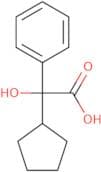
CAS 427-49-6
:Acide α-cyclopentylmandélique
Description :
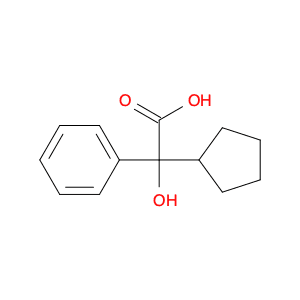
Acide α-cyclopentylmandélique, avec le numéro CAS 427-49-6, est un composé organique caractérisé par son groupe cyclopentyle unique attaché à la structure de l'acide mandélique. Ce composé présente un centre chiral, ce qui contribue à son activité optique potentielle. Il apparaît généralement sous forme de solide cristallin blanc à blanc cassé et est soluble dans des solvants polaires, tels que l'eau et les alcools, en raison de la présence du groupe fonctionnel acide carboxylique. Le groupe cyclopentyle peut influencer l'hydrophobicité et l'activité biologique du composé, ce qui le rend intéressant en chimie médicinale et en conception de médicaments. Acide α-cyclopentylmandélique peut présenter diverses propriétés biologiques, y compris des effets antimicrobiens ou anti-inflammatoires, bien que les activités spécifiques puissent varier en fonction des modifications structurelles et de la présence de substituants. Sa synthèse implique souvent la réaction de dérivés cyclopentyles avec de l'acide mandélique ou ses précurseurs. Comme de nombreux acides organiques, il peut participer à des réactions acido-basiques et former des sels avec des bases, ce qui peut être pertinent pour ses applications en pharmacie et en synthèse organique.
Formule :C13H16O3
InChI :InChI=1S/C13H16O3/c14-12(15)13(16,11-8-4-5-9-11)10-6-2-1-3-7-10/h1-3,6-7,11,16H,4-5,8-9H2,(H,14,15)
Code InChI :InChIKey=WFLUEQCOAQCQLP-UHFFFAOYSA-N
SMILES :C(C(O)=O)(O)(C1=CC=CC=C1)C2CCCC2
Synonymes :- (2R)-cyclopentyl(hydroxy)phenylethanoate
- (2S)-cyclopentyl(hydroxy)phenylethanoate
- (±)-Cyclopentylmandelic acid
- 2-Cyclopentyl-2-hydroxy-2-(phenyl)acetic acid
- 2-Cyclopentyl-2-hydroxy-2-phenylacetic acid
- 2-Cyclopentylmandelic acid
- Benzeneacetic acid, α-cyclopentyl-α-hydroxy-
- Cyclopentyl(Hydroxy)Phenylacetic Acid
- Cyclopentylhydroxyphenylacetic acid
- Mandelic acid, α-cyclopentyl-
- NSC 96637
- alpha-Cyclopentylmandelic acid
- α-Cyclopentyl-α-hydroxybenzeneacetic acid
- α-Cyclopentylmandelic acid
- ALFA-CYCLOPENTYLMANDELIC ACID
- Voir plus de synonymes
Trier par
Degré de pureté (%)
0
100
|
0
|
50
|
90
|
95
|
100
11 produits concernés.
α-Cyclopentyl-DL-mandelic Acid
CAS :Formule :C13H16O3Degré de pureté :>98.0%(T)(HPLC)Couleur et forme :White to Light yellow powder to crystalMasse moléculaire :220.27Glycopyrrolate Related Compound C (2-Cyclopentyl-2-hydroxy-2-phenylacetic acid)
CAS :Carboxylic acids w/ alcohol function but w/o other oxygen function and their derivatives, nesoiFormule :C13H16O3Couleur et forme :White Off-White PowderMasse moléculaire :220.109942-Cyclopentyl-2-hydroxy-2-phenylacetic acid
CAS :Formule :C13H16O3Degré de pureté :96%Couleur et forme :SolidMasse moléculaire :220.2643Glycopyrronium Bromide EP Impurity J (Glycopyrrolate USP Related Compound C)
CAS :Formule :C13H16O3Couleur et forme :Off-White SolidMasse moléculaire :220.272-Cyclopentyl-2-hydroxy-2-phenylacetic acid
CAS :2-Cyclopentyl-2-hydroxy-2-phenylacetic acidDegré de pureté :98%Masse moléculaire :220.27g/mol2-(RS)-Cyclopentyl-2-hydroxy-2-phenylacetic Acid (α-Cyclopentylmandelic Acid)
CAS :Couleur et forme :Neat2-Cyclopentyl-2-hydroxy-2-phenylacetic Acid
CAS :Applications 2-Cyclopentyl-2-hydroxy-2-phenylacetic Acid is an impurity of Glycopyrrolate (G657000), a novel pharmaceutical compound based on PDE IV inhibitors; used in the treatment of respiratory complaints. It is used in the synthesis of muscarinic M3 receptor antagonists.
References Gomez, et al.: Br. J. Anaesth., 74, 549 (1995); Kumar, N. et al.: Bioorg. Med. Chem. Lett., 17, 5256 (2007);Formule :C13H16O3Couleur et forme :Off White To Light BrownMasse moléculaire :220.26Cyclopentylmandelic acid
CAS :Cyclopentylmandelic acid (CPM) is a bifunctional drug that binds to the receptors of the adrenergic system and acts as an agonist. It has been shown to have a matrix effect, which stabilizes and minimizes the effects of other drugs. CPM can also reduce carbonyl groups in the body, which are linked to stress and aging. CPM is a synthetic drug that was first isolated by chromatography. The structural formula for this drug is similar to that of cyclopentanol, with the exception of one methyl group on its side chain. CPM has been shown to have anticholinergic properties, meaning it blocks acetylcholine receptors in nerve cells and leads to dry mouth, blurred vision, constipation, and urinary retention.Formule :C13H16O3Couleur et forme :White PowderMasse moléculaire :220.27 g/mol2-Cyclopentyl-2-hydroxy-2-phenylacetic acid
CAS :Formule :C13H16O3Degré de pureté :96%Masse moléculaire :220.268