CAS 4309-82-4
:N-Formylméthionine
Description :
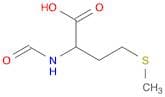
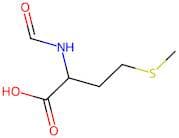
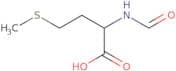
N-Formylméthionine, avec le numéro CAS 4309-82-4, est un dérivé de l'acide aminé méthionine, caractérisé par la présence d'un groupe formyle (-CHO) attaché à l'atome d'azote du groupe amino. Ce composé est remarquable pour son rôle dans les systèmes biologiques, en particulier en tant que précurseur dans la synthèse des protéines chez certains organismes. Il est souvent impliqué dans l'initiation de la synthèse des protéines chez les procaryotes, où il sert de premier acide aminé incorporé dans les chaînes polypeptidiques naissantes. N-Formylméthionine est typiquement un solide blanc à blanc cassé et est soluble dans des solvants polaires. Sa structure moléculaire comprend un atome de soufre, qui est caractéristique de la méthionine, contribuant à ses propriétés uniques. Le composé est également d'un intérêt dans la recherche liée à la synthèse des peptides et à l'étude des mécanismes de traduction. En raison de son importance biologique, N-Formylméthionine est souvent utilisé dans des études biochimiques et des applications impliquant l'ingénierie et la synthèse des protéines.
Formule :C6H11NO3S
InChI :InChI=1S/C6H11NO3S/c1-11-3-2-5(6(9)10)7-4-8/h4-5H,2-3H2,1H3,(H,7,8)(H,9,10)
Code InChI :InChIKey=PYUSHNKNPOHWEZ-UHFFFAOYSA-N
SMILES :C(CCSC)(NC=O)C(O)=O
Synonymes :- 2-Formamido-4-(methylsulfanyl)butanoic acid
- 2-Formamido-4-methylsulfanylbutanoic acid
- For-DL-Met-OH
- Methionine, N-formyl-
- Methionine, N-formyl-, <span class="text-smallcaps">DL</span>-
- N-Formyl-<span class="text-smallcaps">DL</span>-methionine
- N-Formylmethionine
- NSC 206506
- Methionine, N-formyl-, DL-
- N-Formyl-DL-methionine
Trier par
Degré de pureté (%)
0
100
|
0
|
50
|
90
|
95
|
100
4 produits concernés.
For-DL-Met-OH
CAS :Formule :C6H11NO3SDegré de pureté :98%Couleur et forme :SolidMasse moléculaire :177.2214For-DL-Met-OH
CAS :For-DL-Met-OH is a colony-stimulating factor that belongs to the group of pharmacokinetic properties. It has been shown to have an effect on white blood cell production in patients with radiation therapy, and is also effective against Pseudomonas aeruginosa, which is an important pathogen in chronic lung disease. For-DL-Met-OH has been found to be effective when administered intravenously and orally in this indication. The compound acts by binding to the target tissue cyclic peptide receptor and acylation reaction with the antibiotic. It has been found that For-DL-Met-OH can be synthesized using a neutral pH process and polypeptide synthesis.Formule :C6H11NO3SDegré de pureté :Min. 95%Masse moléculaire :177.22 g/mol