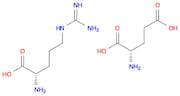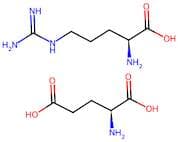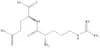
CAS 4320-30-3
:Glutamate d'arginine
Description :
Glutamate d'arginine, avec le numéro CAS 4320-30-3, est un dipeptide composé des acides aminés arginine et acide glutamique. Il se caractérise par son rôle de neurotransmetteur et son implication dans divers processus métaboliques. Ce composé est connu pour ses avantages potentiels dans l'amélioration des performances sportives, la promotion de la récupération musculaire et le soutien de la fonction immunitaire. Glutamate d'arginine présente une solubilité dans l'eau, ce qui le rend adapté à diverses applications en biochimie et en nutrition. Sa structure comprend un groupe guanidinium chargé positivement provenant de l'arginine, qui contribue à son activité physiologique, et le groupe carboxylate provenant du glutamate, qui peut participer à diverses réactions biochimiques. De plus, Glutamate d'arginine peut jouer un rôle dans la synthèse de l'oxyde nitrique, une molécule de signalisation critique dans le système cardiovasculaire. Dans l'ensemble, ce composé suscite de l'intérêt tant dans la recherche que dans les applications pratiques, en particulier dans les domaines de la nutrition sportive et des suppléments de santé.
Formule :C6H14N4O2·C5H9NO4
InChI :InChI=1S/C6H14N4O2.C5H9NO4/c7-4(5(11)12)2-1-3-10-6(8)9;6-3(5(9)10)1-2-4(7)8/h4H,1-3,7H2,(H,11,12)(H4,8,9,10);3H,1-2,6H2,(H,7,8)(H,9,10)/t4-;3-/m00/s1
Code InChI :InChIKey=RVEWUBJVAHOGKA-WOYAITHZSA-N
SMILES :C(CCNC(=N)N)[C@@H](C(O)=O)N.[C@H](CCC(O)=O)(C(O)=O)N
Synonymes :- <span class="text-smallcaps">L</smallcap>-Arginine, <smallcap>L</span>-glutamate (1:1)
- <span class="text-smallcaps">L</smallcap>-Glutamic acid, compd. with <smallcap>L</span>-arginine (1:1)
- Argimate
- Arginine Glutamate
- Arginine l-glutamate
- Arginine, <span class="text-smallcaps">L</smallcap>-, <smallcap>L</span>-glutamate (1:1)
- Arginine, <span class="text-smallcaps">L</smallcap>-, salt with <smallcap>L</span>-glutamic acid (1:1)
- Ginamate
- Glutamic acid compd. with arginine
- Glutamic acid, <span class="text-smallcaps">L</smallcap>-, compd. with <smallcap>L</span>-arginine (1:1)
- Glutargin
- Glutepar
- L-Arg L-Glu
- L-Arginine L-glutamate (1:1)
- L-arginyl-L-glutamate
- L-glutamic acid, compd. with L-arginine
- Modumate
- NSC 122009
- NSC 164937
- N~5~-(diaminomethylidene)-L-ornithine-L-glutamic acid (1:1)
- N~5~-(diaminomethylidene)ornithine-glutamic acid (1:1)
- arginine, glutamate, L-
- glutamic acid compd with L-arginine
- Arginine, L-, salt with L-glutamic acid (1:1)
- Glutamic acid, L-, compd. with L-arginine (1:1)
- L-Glutamic acid, compd. with L-arginine (1:1)
- Voir plus de synonymes
Trier par
Degré de pureté (%)
0
100
|
0
|
50
|
90
|
95
|
100
5 produits concernés.
L-Glutamic acid, compd. with L-arginine (1:1)OTHER CA INDEX NAMES:L-Arginine, L-glutamate (1:1)
CAS :Formule :C11H23N5O6Degré de pureté :98%Couleur et forme :SolidMasse moléculaire :321.3302L-Arginine L-glutamate
CAS :L-Arginine L-glutamateFormule :C11H23N5O6Degré de pureté :98%Couleur et forme : white solidMasse moléculaire :321.33g/molL-Arginine-L-glutamate
CAS :L-Arginine-L-glutamate is a compound that belongs to the group of amino acids. It is an important intermediate in metabolism and a precursor for other compounds, such as creatine, nitric oxide and polyamines. L-Arginine-L-glutamate has been shown to have pharmacokinetic properties that are similar to those of glucose. L-Arginine-L-glutamate can be used for the treatment of diabetes mellitus type 2. This amino acid also has structural analysis properties, which may be due to its chemical structure containing a hydroxyl group and fatty acid chain.Formule :C6H14N4O2•C5H9NO4Degré de pureté :Min. 95%Couleur et forme :White PowderMasse moléculaire :321.33 g/molL-Arginine L-glutamate
CAS :Formule :C11H23N5O6Degré de pureté :95%Couleur et forme :Solid, No data available.Masse moléculaire :321.334L-Arginine L-Glutamate
CAS :Produit contrôléApplications L-Arginine L-Glutamate is used in the making of solution of arginine glutamate for the healing of radiation-induced skin ulcers in guinea pigs
References Khalin I., et al.: Int. J. Radiat. Biol., 89, 1108 (2013)Formule :C6H14N4O2·C5H9NO4Couleur et forme :NeatMasse moléculaire :321.33