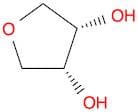
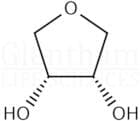
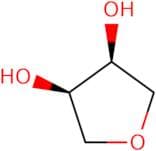
CAS 4358-64-9
:Érythritan
- (3R,4S)-Tetrahydro-3,4-furandiol
- (3R,4S)-tetrahydrofuran-3,4-diol
- (3S,4R)-Tetrahydrofuran-3,4-diol
- 3,4-Furandiol, tetrahydro-, (3R,4S)-rel-
- 3,4-Furandiol, tetrahydro-, cis-
- Erythritan
- Erythritol, 1,4-anhydro-
- Erythritol-1,4-anhydride
- cis-3,4-Dihydroxyoxolane
- cis-3,4-Dihydroxytetrahydrofuran
- cis-Oxolane-3,4-diol
- cis-Tetrahydrofuran-3,4-diol
- meso-3,4-Dihydroxytetrahydrofuran
- rel-(3R,4S)-Tetrahydro-3,4-furandiol
- 1,4-Anhydroerythritol 95%
- (3S,4S)-TETRAHYDRO-FURAN-3,4-DIOL
- Meso-3,4-Dihydr
- 1,4-ANHYDROERYTHRITOL 98.0+%(GC)
- 1,4-Anhydroerythrotole
- oxolane-3,4-diol
- (3S)-Tetrahydrofuran-3α,4β-diol
- 1,4-anhydride - erythritol
- L-THREITAN
- (-)-1,4-ANHYDRO-L-THREITOL
- 1,4-Anhydroerythritol min. 98%
- Voir plus de synonymes
1,4-Anhydroerythritol
CAS :Formule :C4H8O3Degré de pureté :>98.0%(GC)Couleur et forme :White or Colorless to Almost white or Almost colorless powder to lump to clear liquidMasse moléculaire :104.111,4-Anhydroerythritol
CAS :1,4-AnhydroerythritolFormule :C4H8O3Degré de pureté :>98%Couleur et forme :Pale yellow Solid-Low MeltMasse moléculaire :104.10451(3R,4S)-Tetrahydrofuran-3,4-diol
CAS :Formule :C4H8O3Degré de pureté :98%Couleur et forme :LiquidMasse moléculaire :104.10451,4-Anhydro-D-erythritol
CAS :1,4-Anhydro-D-erythritol is a sugar alcohol that can be found in various plants and fruits. It is a reaction product of D-erythrose and glycerol, with an average formation rate of 10%. The hydroxyl group on the 1,4-anhydro-D-erythritol molecule reacts with methyl glycosides to produce an ester. Trifluoromethanesulfonic acid is used as a catalyst in this process, which activates the hydroxyl group on the molecule. The reaction mechanism for this process involves three steps: elimination of water, dehydration of the hydroxyl group, and addition of methyl glycoside. This process results in a new molecule called 1,4-anhydro-D-erythritol methyl ester (AEME). AEME has been shown to have conformational properties that are different from those of its parent compound. The conformational
Formule :C4H8O3Degré de pureté :Min. 95%Couleur et forme :Clear LiquidMasse moléculaire :104.1 g/mol(3R,4S)-Tetrahydrofuran-3,4-diol
CAS :Formule :C4H8O3Degré de pureté :97%Couleur et forme :Liquid, ClearMasse moléculaire :104.105