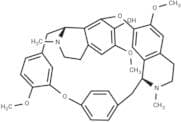
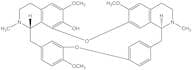
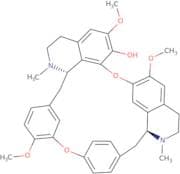
CAS 436-77-1
:Fangchinoline
Description :
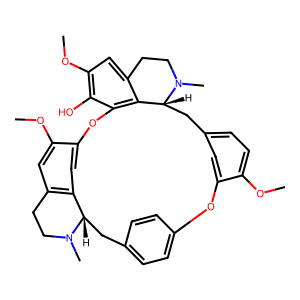
Fangchinoline est un composé alcaloïde principalement dérivé de l'espèce végétale *Stephania* et est connu pour ses diverses activités biologiques. Il se caractérise par sa structure tétracyclique complexe, qui contribue à ses propriétés pharmacologiques. Fangchinoline présente une gamme d'effets, y compris des activités anti-inflammatoires, analgésiques et des activités anticancéreuses potentielles, ce qui le rend intéressant en chimie médicinale et en pharmacologie. Le composé a été étudié pour sa capacité à moduler diverses voies biologiques, y compris celles impliquées dans la prolifération cellulaire et l'apoptose. De plus, Fangchinoline a montré des promesses dans la médecine traditionnelle, en particulier dans les pratiques herboristes asiatiques. Sa solubilité et sa stabilité peuvent varier en fonction du solvant et des conditions environnementales, ce qui est important pour son application dans la recherche et les utilisations thérapeutiques potentielles. Comme pour de nombreux produits naturels, des études supplémentaires sont nécessaires pour élucider complètement ses mécanismes d'action et son potentiel thérapeutique. Les profils de sécurité et de toxicité sont également des considérations critiques pour toute application future dans des contextes cliniques.
Formule :C37H40N2O6
InChI :InChI=1S/C37H40N2O6/c1-38-14-12-24-19-31(42-4)33-21-27(24)28(38)16-22-6-9-26(10-7-22)44-32-18-23(8-11-30(32)41-3)17-29-35-25(13-15-39(29)2)20-34(43-5)36(40)37(35)45-33/h6-11,18-21,28-29,40H,12-17H2,1-5H3/t28-,29-/m0/s1
Code InChI :InChIKey=IIQSJHUEZBTSAT-VMPREFPWSA-N
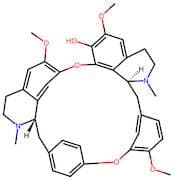
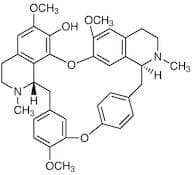
SMILES :OC1=C2C=3[C@](CC=4C=C(C(OC)=CC4)OC=5C=CC(C[C@]6(C7=CC(O2)=C(OC)C=C7CCN6C)[H])=CC5)(N(C)CCC3C=C1OC)[H]
Synonymes :- (+)-Hanfangichin B
- (+)-Limacine
- (1beta)-6,6',12-Trimethoxy-2,2'-dimethylberbaman-7-ol
- (4aS,16aS)-3,4,4a,5,16a,17,18,19-Octahydro-12,21,26-trimethoxy-4,17-dimethyl-16H-1,24:6,9-dietheno-11,15-metheno-2H-pyrido[2′,3′:17,18][1,11]dioxacycloeicosino[2,3,4-ij]isoquinolin-22-ol
- 16H-1,24:6,9-Dietheno-11,15-metheno-2H-pyrido[2′,3′:17,18][1,11]dioxacycloeicosino[2,3,4-ij]isoquinolin-22-ol, 3,4,4a,5,16a,17,18,19-octahydro-12,21,26-trimethoxy-4,17-dimethyl-, (4aS,16aS)-
- 16H-1,24:6,9-Dietheno-11,15-metheno-2H-pyrido[2′,3′:17,18][1,11]dioxacycloeicosino[2,3,4-ij]isoquinolin-22-ol, 3,4,4a,5,16a,17,18,19-octahydro-12,21,26-trimethoxy-4,17-dimethyl-, [4aS-(4aR*,16aR*)]-
- 6,6',12-Trimethoxy-2,2'-Dimethylberbaman-7-Ol
- 7-O-Demethyltetrandrine
- Berbaman-7-ol, 6,6′,12-trimethoxy-2,2′-dimethyl-, (1β)-
- Hanfangchin B
- NSC 77036
- (+)-Fangchinoline
- Voir plus de synonymes
Trier par
Degré de pureté (%)
0
100
|
0
|
50
|
90
|
95
|
100
9 produits concernés.
16H-1,24:6,9-Dietheno-11,15-metheno-2H-pyrido[2',3':17,18][1,11]dioxacycloeicosino[2,3,4-ij]isoquinolin-22-ol,3,4,4a,5,16a,17,18,19-octahydro-12,21,26-trimethoxy-4,17-dimethyl-,(4aS,16aS)-
CAS :Formule :C37H40N2O6Degré de pureté :98%Couleur et forme :SolidMasse moléculaire :608.7233Fangchinoline
CAS :Formule :C37H40N2O6Degré de pureté :>97.0%(HPLC)Couleur et forme :White to Orange to Green powder to crystalMasse moléculaire :608.74Hanfangchin B
CAS :Fangchinoline and tetrandrine are the major alkaloids from Stephania tetrandrae S. they shows anti-inflammatory effects on mouse ear edema induced by croton oil, the biochemical mechanisms of fangchinoline and tetrandrine on anti-inflammation are significantly different even though they are similar in chemical structure.Formule :C37H40N2O6Degré de pureté :95%~99%Couleur et forme :PowderMasse moléculaire :608.735Fangchinoline
CAS :Fangchinoline (Tetrandrine B) is extracted from Stephania tetrandra S. Moore.Formule :C37H40N2O6Degré de pureté :99.86% - >99.99%Couleur et forme :SolidMasse moléculaire :608.72Fangchinoline
CAS :Natural alkaloidFormule :C37H40N2O6Degré de pureté :≥ 95.0 % (HPLC)Couleur et forme :PowderMasse moléculaire :608.72(+)-Fangchinoline
CAS :(+)-Fangchinoline is a bisbenzylisoquinoline alkaloid, which is derived from the roots of Stephania plants, particularly Stephania tetrandra. These plants are known for their diverse array of alkaloids, which have been studied for their pharmacological properties. The mode of action of (+)-Fangchinoline is multifaceted, involving interactions with various cellular pathways, including modulation of calcium channels and inhibition of acetylcholinesterase. It also exhibits antioxidant, anti-inflammatory, and potential anticancer activities, demonstrating its ability to interfere with key molecular and cellular processes.Formule :C37H40N2O6Degré de pureté :Min. 95%Masse moléculaire :608.72 g/mol
![16H-1,24:6,9-Dietheno-11,15-metheno-2H-pyrido[2',3':17,18][1,11]dioxacycloeicosino[2,3,4-ij]isoqui…](/_next/image/?url=https%3A%2Fstatic.cymitquimica.com%2Fproducts%2FIN%2Fthumb%2FDA00I8BX.jpg&w=3840&q=75)