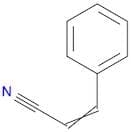
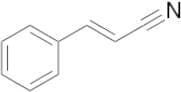
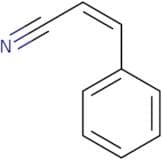
CAS 4360-47-8
:Cinammonitrile
- (2E)-3-phenylprop-2-enenitrile
- (2Z)-3-phenylprop-2-enenitrile
- 1-Cyano-2-phenylethene
- 1-Cyano-2-phenylethylene
- 2-Propenenitrile, 3-phenyl-
- 3-Phenyl-2-propenenitrile
- 3-Phenylacrylonitrile
- 3-Phenylpropenenitrile
- Cinnamonitrilecistrans
- Cinnamyl nitrile
- NSC 42118
- NSC 49137
- Styryl cyanide
- β-Cyanostyrene
- β-Phenylacrylonitrile
- Voir plus de synonymes
Cinnamonitrile
CAS :Formule :C9H7NDegré de pureté :97%Couleur et forme :LiquidMasse moléculaire :129.15863-Phenylacrylonitrile
CAS :Applications 3-Phenylacrylonitrile can be used to study signalling pathway. It can also inhibit EGF receptor kinase activity.
References Talalay, P., et al.: Proc. Natl. Acad. Sci. USA 85, 8261 (1988); Yasih, P., et al.: Science 242, 933 (1988)Formule :C9H7NCouleur et forme :NeatMasse moléculaire :129.1583-Phenylacrylonitrile
CAS :3-Phenylacrylonitrile is an enzyme inhibitor that binds to the active site of the diphenolase enzyme, thereby inhibiting its function. The nitrile group in 3-phenylacrylonitrile is responsible for binding to the enzyme and forming a hydrogen bond with a zirconium oxide group. Hydroxyl groups on the phenyl ring also contribute to this reaction by making polar bonds with water molecules. This reaction is reversible and can be reversed by adding hydrochloric acid or by heating it at high temperatures. This reversibility provides a way to determine when 3-phenylacrylonitrile has bound to the active site of diphenolase by measuring the amount of heat released during the reaction.
Formule :C9H7NDegré de pureté :Min. 95%Masse moléculaire :129.16 g/mol